
- today

Peptide quality is commonly associated with analytical parameters such as purity, molecular identity and peptide content.
These measurements provide important information about the chemical characteristics of a peptide. However, they do not evaluate whether viable microorganisms are present in the tested material.
For this reason, microbial contamination testing represents a separate part of comprehensive peptide quality assessment.
Microbiological testing helps evaluate whether microorganisms may have been introduced during manufacturing, handling, filling, storage or packaging.
A peptide may demonstrate excellent chromatographic purity and correct molecular identity while microbial contamination remains undetected if dedicated microbiological testing has not been performed.
Understanding microbiological quality therefore helps researchers interpret laboratory documentation more accurately and understand why peptide quality cannot be assessed using a single analytical parameter.
For a broader explanation of the different laboratory parameters used to evaluate peptide quality, read our article: Peptide Quality: A Comprehensive Guide to Laboratory Quality Assessment.
What Is Microbial Contamination?
Microbial contamination refers to the presence of viable microorganisms in a material.
These microorganisms may include:
-
bacteria,
-
yeasts,
-
molds and other fungi.
Microbial contamination is different from chemical impurities.
It does not describe changes in the molecular structure of the peptide itself. Instead, it provides information about the microbiological condition of the material and the controls used throughout the manufacturing process.
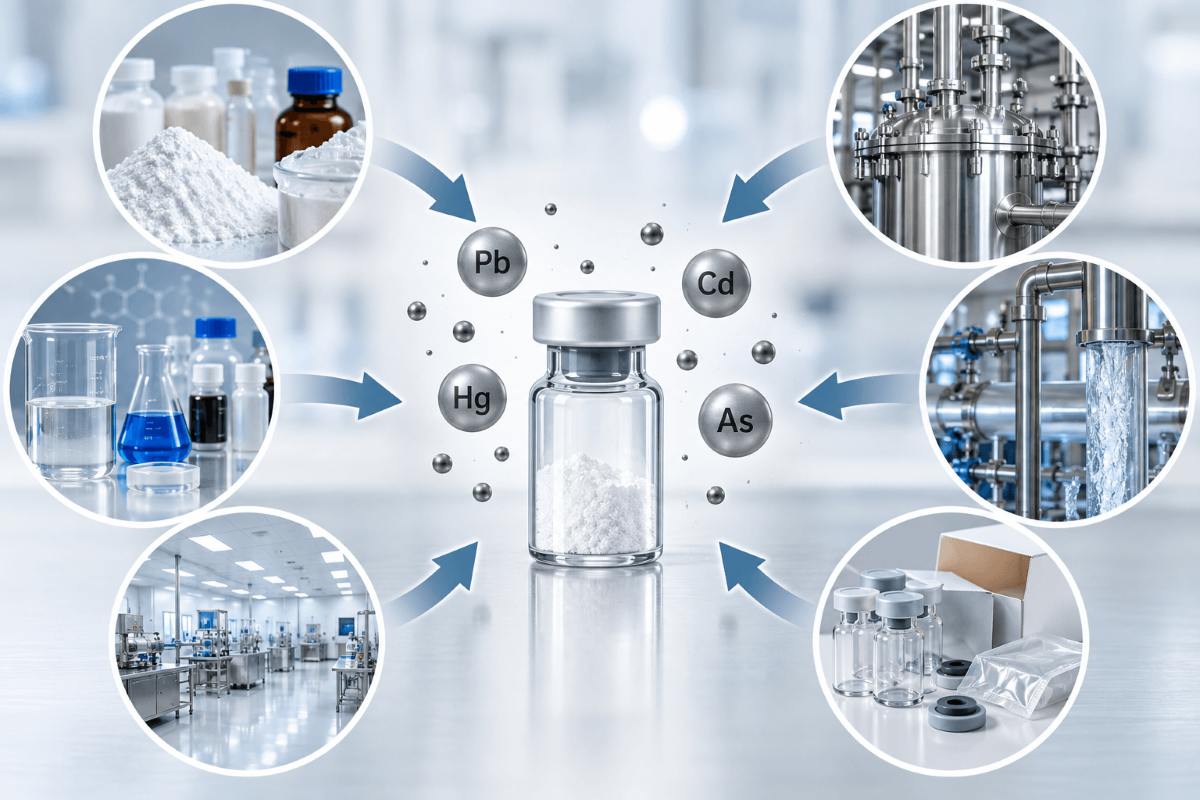
For example, microbial contamination may be influenced by:
-
manufacturing environment,
-
water quality,
-
equipment cleanliness,
-
personnel handling,
-
filling operations,
-
packaging conditions.
Even a peptide with high chemical purity can potentially contain microorganisms if appropriate manufacturing and environmental controls are not maintained.

How Can Microbial Contamination Occur?
Microorganisms are naturally present in the environment.
Without appropriate manufacturing controls, they may potentially enter a production process at different stages.
Manufacturing Environment
Air, surfaces and production areas can contain microorganisms.
Controlled manufacturing environments are therefore used to reduce unnecessary exposure to environmental contamination during production.
Environmental monitoring can also help evaluate whether appropriate microbiological conditions are being maintained.
Water Systems
Water is widely used in pharmaceutical, chemical and laboratory manufacturing.
If water systems are not appropriately maintained and monitored, they can potentially become a source of microbial contamination.
For this reason, water quality represents an important component of manufacturing process control.
Manufacturing Equipment
Equipment that comes into contact with materials during production must be appropriately cleaned and maintained.
Insufficient cleaning or inadequate process controls may increase the risk of microbial contamination between manufacturing steps or production runs.
Personnel
People naturally carry microorganisms on their skin, hair and clothing.
Controlled manufacturing environments therefore use defined hygiene procedures, protective clothing and handling protocols to reduce the potential introduction of microorganisms by personnel.
Filling and Packaging
Microbial contamination can also occur after synthesis and purification.
Filling, vial handling, closure systems and packaging operations represent additional stages during which a material may be exposed to the manufacturing environment.
For this reason, microbiological quality depends on appropriate controls throughout the entire production process.
What Is Bioburden?
One of the most important concepts in microbiological quality assessment is bioburden.
Bioburden refers to the viable microbial load present in a material.
In practical terms, bioburden testing evaluates the number of microorganisms capable of growing under defined laboratory conditions.
Rather than measuring peptide purity or molecular identity, the test provides information about the microbiological cleanliness of the material.
Bioburden testing can therefore provide useful information about:
-
manufacturing hygiene,
-
environmental control,
-
equipment cleanliness,
-
process consistency,
-
microbiological quality.
It represents a different analytical parameter from chemical purity and must therefore be evaluated using dedicated microbiological methods.
How Is Bioburden Measured?
Microbiological laboratories commonly use standardized methods to evaluate viable microbial contamination.
Two frequently reported parameters are:
-
Total Aerobic Microbial Count (TAMC)
-
Total Yeast and Mold Count (TYMC)
Together, these measurements provide information about different groups of viable microorganisms present in a sample.
What Is TAMC?
TAMC stands for Total Aerobic Microbial Count. It measures viable aerobic microorganisms capable of growing under defined laboratory conditions.
The result provides an indication of the aerobic microbial load present in the tested material.
TAMC is commonly used as part of microbiological quality control because it provides information that cannot be obtained from chemical analytical methods.
What Is TYMC?
TYMC stands for Total Yeast and Mold Count.
This test evaluates viable yeasts and molds capable of growing under defined laboratory conditions.
Yeasts and molds represent a different group of microorganisms from those primarily evaluated through TAMC.
For this reason, TAMC and TYMC are commonly used together to provide a broader overview of microbiological quality.
Can HPLC Detect Microbial Contamination?
No. HPLC is a chromatographic analytical technique used to separate and evaluate chemical compounds.
In peptide testing, it is commonly used to assess chromatographic purity.
However, HPLC does not directly determine whether viable bacteria, yeasts or molds are present in a sample.
A peptide may therefore demonstrate:
-
excellent chromatographic purity,
-
correct molecular identity,
-
high peptide content,
while microbiological contamination remains undetected. Dedicated microbiological testing is required to evaluate viable microorganisms.
This is an important example of why a high HPLC purity percentage alone does not provide a complete assessment of peptide quality.
For a detailed explanation of what HPLC purity can and cannot tell us about peptide quality, read our article: HPLC Purity: Why It Is Not Enough to Define Peptide Quality.
Microbial Contamination vs. Endotoxins
Microbial contamination and endotoxins are sometimes grouped together because both are associated with microbiological quality. However, they represent different analytical parameters.
Microbial Contamination
Microbial contamination refers to the presence of viable microorganisms, such as:
-
bacteria,
-
yeasts,
-
molds.
It is commonly evaluated using microbiological methods such as TAMC and TYMC.
Endotoxins
Endotoxins are lipopolysaccharides associated with the outer membrane of Gram-negative bacteria.
Unlike viable microbial contamination, endotoxins can remain present even when the bacteria that produced them are no longer viable.
Endotoxin testing therefore does not measure the same thing as bioburden testing.
A sample may potentially contain endotoxins without containing viable Gram-negative bacteria.
Similarly, the presence or absence of viable microorganisms does not by itself determine the endotoxin level of a sample.
For this reason, microbiological contamination testing and endotoxin testing provide separate and complementary information.
To learn more about endotoxins and the analytical methods used to detect them, read our article: Endotoxin Testing: Why It Matters in Peptide Quality Assessment.

Microbial Contamination vs. Heavy Metals
Microbial contamination must also be distinguished from elemental impurities.
Heavy metals and other elemental contaminants are inorganic substances that may originate from:
-
raw materials,
-
synthesis reagents,
-
manufacturing equipment,
-
catalysts,
-
water systems,
-
product-contact materials.
These contaminants are commonly evaluated using elemental analysis techniques such as ICP-MS.
Microbiological testing, on the other hand, evaluates living microorganisms.
This means that the two analyses answer completely different quality-control questions.
A peptide may show acceptable microbiological results while still requiring separate testing for elemental impurities, and vice versa.
For more information about elemental contamination and ICP-MS analysis, read our article: Heavy Metal Testing in Peptide Quality: Elemental Impurities and ICP-MS.
Why Manufacturing Controls Matter
Microbiological quality begins long before the final laboratory test.
Appropriate manufacturing controls are used to reduce the risk of introducing microorganisms throughout the production process.
These controls may include:
-
controlled production environments,
-
environmental monitoring,
-
defined cleaning procedures,
-
high-quality water systems,
-
routine equipment maintenance,
-
personnel hygiene protocols,
-
controlled filling operations,
-
appropriate packaging procedures.
Microbiological testing then helps evaluate the microbiological condition of the final material.
Testing should therefore be understood as one component of a broader manufacturing quality system rather than as the only measure used to control contamination.
Why Microbiological Testing Is a Separate Quality Parameter
Different analytical methods provide different types of information.
For example:
-
HPLC evaluates chromatographic purity,
-
mass spectrometry confirms molecular identity,
-
peptide content testing evaluates the amount of peptide present,
-
ICP-MS evaluates elemental impurities,
-
endotoxin testing evaluates bacterial endotoxins,
-
TAMC and TYMC evaluate viable microbial contamination.
None of these analytical methods can replace the others.
A successful result in one analytical test does not automatically predict the result of another.
This is why comprehensive quality control combines several complementary analytical methods.
Microbiological Quality Is Only One Part of Peptide Quality.
Microbiological testing provides important information, but it represents only one component of a complete quality assessment.
Other commonly evaluated parameters include:
Chromatographic Purity
HPLC is commonly used to determine the proportion of the target peptide relative to other chromatographically detectable components.
Molecular Identity
Mass spectrometry helps confirm whether the molecular mass of the analyzed material corresponds to the expected peptide.
Peptide Content
Peptide content testing evaluates how much actual peptide is present in the analyzed material.
Endotoxins
Dedicated endotoxin testing evaluates bacterial lipopolysaccharides associated primarily with Gram-negative bacteria.
Elemental Impurities
ICP-MS can be used to detect and quantify trace levels of metals and other elements.
Microbial Contamination
TAMC and TYMC evaluate viable microbial contamination.
Together, these tests provide a more complete picture of peptide quality than any single analytical result alone.
Why Laboratory Documentation Matters
Analytical results should also be considered together with appropriate laboratory documentation.
A laboratory report or Certificate of Analysis may provide information about:
-
the tested batch,
-
analytical methods,
-
tested quality parameters,
-
reported results,
-
laboratory identification,
-
sample traceability.
Batch-specific documentation is particularly important because analytical results should be clearly connected to the material being evaluated.
Generic laboratory reports that cannot be associated with a specific batch provide less traceability than batch-specific analytical documentation.
For a more detailed explanation of what to look for when reviewing laboratory documentation, read our article: Peptide Certificate of Analysiss: How to Verify a COA and Identify Authentic Laboratory Reports.
Frequently Asked Questions
What is microbial contamination?
Microbial contamination refers to the presence of viable microorganisms such as bacteria, yeasts or molds in a material. It is a microbiological quality parameter rather than a measurement of chemical purity.
What is bioburden?
Bioburden refers to the viable microbial load present in a material.
It provides information about the number of microorganisms capable of growing under defined laboratory conditions.
What does TAMC mean?
TAMC stands for Total Aerobic Microbial Count.
It measures viable aerobic microorganisms capable of growing under standardized testing conditions.
What does TYMC mean?
TYMC stands for Total Yeast and Mold Count. It evaluates viable yeasts and molds present in a tested material.
Can HPLC detect microbial contamination?
No. HPLC evaluates chemical compounds and chromatographic purity. It does not directly detect viable microorganisms.
Dedicated microbiological methods are therefore required.
Can a peptide have high HPLC purity and still contain microorganisms?
Yes. Chromatographic purity and microbiological contamination are different quality parameters measured using different analytical methods.
A high HPLC purity result does not by itself confirm microbiological quality.
Is microbial contamination the same as endotoxins?
No. Microbial contamination refers to viable microorganisms, while endotoxins are bacterial lipopolysaccharides associated primarily with Gram-negative bacteria.
These parameters require separate testing.
What is the difference between TAMC and TYMC?
TAMC evaluates aerobic microbial contamination, while TYMC focuses on viable yeasts and molds. Together, they provide a broader overview of microbiological quality.
Why is microbiological testing important?
Microbiological testing provides information about manufacturing hygiene, environmental control and viable microbial contamination that cannot be obtained from chemical analyses such as HPLC or mass spectrometry.
Conclusion
Microbial contamination is an important quality parameter that provides information about manufacturing hygiene, environmental control and microbiological cleanliness.
Because chromatographic methods such as HPLC do not directly detect viable microorganisms, dedicated microbiological testing is required.
Tests such as Total Aerobic Microbial Count (TAMC) and Total Yeast and Mold Count (TYMC) help evaluate the microbial load present in a material.
However, microbiological testing represents only one part of comprehensive peptide quality assessment.
Chromatographic purity, molecular identity, peptide content, endotoxins, elemental impurities and microbial contamination all provide different information.
Evaluating these parameters together provides a more complete understanding of peptide quality than relying on any single analytical result.
Sources:
-
European Pharmacopoeia (Ph. Eur.), General Chapter 2.6.12 - Microbiological Examination of Non-Sterile Products: Microbial Enumeration Tests
-
United States Pharmacopeia (USP), General Chapter <61> - Microbiological Examination of Nonsterile Products: Microbial Enumeration Tests
-
United States Pharmacopeia (USP), General Chapter <62> - Microbiological Examination of Nonsterile Products: Tests for Specified Microorganisms
-
ICH Q7 - Good Manufacturing Practice Guidance for Active Pharmaceutical Ingredients
-
EMA - Guideline on the Quality of Water for Pharmaceutical Use
-
European Pharmacopoeia (Ph. Eur.), General Chapter 2.6.14 - Bacterial Endotoxins
-
ICH Q3D - Guideline for Elemental Impurities
-
World Health Organization (WHO) - Quality Assurance of Pharmaceuticals: Good Manufacturing Practices and Inspection, 10th Edition
Research Quality Begins with Peptide Quality
At Particle Peptides, we believe that reliable research begins with reliable materials. That is why our research peptides are manufactured on cGMP-compliant production lines by a global pharmaceutical CDMO, and every batch undergoes independent third-party testing for:
- Purity
- Identity confirmation
- Peptide content
- Endotoxin levels
- Heavy metals (Class I & II)
- Microbial contamination (TAMC & TYMC)
Transparency and independently verified laboratory data form the foundation of high-quality scientific research.
Disclaimer: All Particle Peptides products are intended exclusively for scientific research and laboratory use. They are not intended for human or veterinary use, nor for the diagnosis, treatment, cure, or prevention of any disease.
