
- today

Heavy metal testing is an important part of comprehensive peptide quality assessment because trace elemental contamination cannot be evaluated through HPLC purity, molecular identity, or peptide content testing alone.
A peptide may demonstrate excellent chromatographic purity and confirmed molecular identity while still containing trace levels of elemental impurities originating from raw materials, manufacturing equipment, processing reagents, water systems, or other parts of the production process.
For this reason, elemental impurity testing represents a separate analytical parameter within a broader quality control program.
Modern laboratories commonly use techniques such as Inductively Coupled Plasma Mass Spectrometry (ICP-MS) to detect and quantify trace elements at very low concentrations.
Understanding how heavy metal testing works helps researchers evaluate peptide laboratory documentation more accurately and reinforces an important principle of peptide quality control: High HPLC purity does not provide information about elemental contamination.
If you would like to take a closer look at all the key parameters used in laboratory evaluation of peptide quality, read our article: Peptide Quality: A Comprehensive Guide to Laboratory Quality Assessment.
What Is Heavy Metal Testing?
Heavy metal testing is a form of elemental analysis used to identify and quantify trace elements present in a material.
The term heavy metals is widely used in laboratory and commercial communication. However, in pharmaceutical quality frameworks, the broader term elemental impurities is generally more precise.
Elemental impurities include metals and metalloids that may be introduced into a material through manufacturing, raw materials, equipment, catalysts, processing chemicals, or other environmental and production-related sources.
Unlike peptide-related impurities, elemental impurities are not evaluated by routine chromatographic purity testing. They therefore require a dedicated analytical method.
What Are Elemental Impurities?
Elemental impurities are trace amounts of chemical elements present in a material that are not intended components of the final product.
Frequently monitored elements include:
-
Lead (Pb)
-
Cadmium (Cd)
-
Mercury (Hg)
-
Arsenic (As)
These four elements are classified as Class 1 elemental impurities under ICH Q3D because of their significance within pharmaceutical elemental impurity risk assessment.
Depending on the manufacturing process, additional elements may also be relevant, including:
-
Cobalt (Co)
-
Vanadium (V)
-
Nickel (Ni)
-
Copper (Cu)
-
Chromium (Cr)
-
Palladium (Pd)
-
Platinum (Pt)
-
Iridium (Ir)
-
Osmium (Os)
-
Rhodium (Rh)
-
Ruthenium (Ru)
The appropriate testing panel depends on factors such as the manufacturing process, raw materials, equipment, intentionally used catalysts, and applicable analytical specifications.
This is why elemental impurity testing is best understood as a risk-based analytical assessment, rather than simply a fixed list of metals that must always be measured.

How Can Heavy Metals Enter a Peptide Sample?
Elemental contamination can potentially be introduced at several stages of peptide manufacturing.
Raw Materials
Starting materials, reagents, excipients, and other components may contain trace levels of elemental impurities.
The quality and control of these materials therefore contribute to the elemental profile of the final material.
Manufacturing Equipment
Production equipment represents another potential source of elemental contamination.
Metal-containing equipment, components, and processing surfaces may contribute trace elements if manufacturing systems are inadequately maintained or if process conditions create opportunities for material transfer.
Processing Reagents and Catalysts
Some manufacturing processes use reagents, catalysts, or auxiliary chemicals that may contain metallic elements.
Residual traces may therefore remain if the manufacturing and purification process does not adequately control them.
This is especially important because certain elemental impurities may be directly related to specific chemical processes rather than general environmental contamination.
Water Systems
Water is used throughout many pharmaceutical and chemical manufacturing processes.
Appropriately controlled water systems help reduce the risk of introducing unwanted inorganic or microbiological contaminants into production.
Production Environment
Environmental exposure, laboratory handling, maintenance procedures, and production infrastructure may also contribute to contamination if appropriate quality systems are not maintained.
Container and Packaging Components
Elemental impurities may also potentially originate from materials that come into contact with the product during manufacturing, filling, storage, or packaging.
For this reason, comprehensive quality systems evaluate contamination risk across the entire manufacturing process, rather than focusing only on the final purification step.
Even high chromatographic purity may not reveal these types of contamination, because HPLC and elemental impurity testing assess different aspects of quality. You can learn more about the limitations of chromatographic purity alone in our article HPLC Purity: Why It Is Not Enough to Define Peptide Quality.

Why Heavy Metal Testing Matters in Peptide Quality Control
A peptide cannot be assessed for elemental contamination through appearance alone.
More importantly, conventional peptide purity testing does not provide this information either.
A sample could demonstrate:
-
high HPLC purity,
-
confirmed molecular identity,
-
appropriate peptide content,
while still requiring an independent assessment of elemental impurities. This does not mean that high HPLC purity is unimportant. It means that HPLC purity answers a different analytical question.
Each laboratory technique provides information about a specific characteristic of the sample. Comprehensive quality assessment therefore requires several complementary analytical methods rather than dependence on one result.
Can HPLC Detect Heavy Metals?
Routine HPLC peptide purity analysis is not designed to evaluate elemental impurities.
HPLC separates chemical compounds according to their chromatographic behavior and is particularly useful for evaluating peptide-related organic components within a sample.
Elemental contaminants such as lead, cadmium, arsenic, mercury, nickel, or palladium require a different analytical approach.
They are not reliably represented by the chromatographic purity percentage reported during conventional peptide HPLC analysis.
Therefore:
99% HPLC purity does not mean that a sample is free from elemental impurities. The HPLC result describes chromatographic purity under the conditions of that particular analysis. It does not replace dedicated elemental testing.
How Are Heavy Metals Measured?
One of the most widely used analytical techniques for trace elemental analysis is Inductively Coupled Plasma Mass Spectrometry (ICP-MS).
ICP-MS combines an extremely high-temperature plasma source with mass spectrometric detection.
In simplified terms, the analytical process involves:
-
Preparing the sample for analysis.
-
Introducing the sample into an inductively coupled plasma.
-
Converting elements within the sample into ions.
-
Separating those ions according to their mass-to-charge ratio.
-
Measuring the signal associated with each targeted element.
-
Quantifying the concentration using validated calibration procedures.
ICP-MS is particularly useful because it can evaluate multiple elements simultaneously while providing very high sensitivity.
Depending on the element, sample matrix, instrument configuration, and validated method, measurements may extend into very low concentration ranges such as parts per billion.
ICP-MS vs. ICP-OES
ICP-MS is not the only technique used for elemental impurity analysis.
Another established technique is Inductively Coupled Plasma Optical Emission Spectrometry (ICP-OES).
Both techniques use an inductively coupled plasma, but the detection principles differ.
ICP-MS detects ions according to their mass-to-charge ratio.
ICP-OES measures characteristic light emitted by excited atoms and ions.
ICP-MS is frequently selected when very low detection limits and multi-element trace analysis are required, while ICP-OES can also be appropriate depending on the required analytical range and validated methodology.
Pharmacopeial approaches therefore focus not simply on the name of the instrument, but on whether the analytical procedure has sufficient specificity, accuracy, precision, sensitivity, and validation for its intended purpose. USP <233>, for example, provides procedures and performance requirements for evaluating elemental impurities.
Which Elements Are Commonly Evaluated?
International quality frameworks classify elemental impurities according to factors including toxicity and the probability of occurrence.
Under ICH Q3D(R2), elemental impurities are divided into several classes.
Class 1
Class 1 includes:
-
Arsenic (As)
-
Cadmium (Cd)
-
Mercury (Hg)
-
Lead (Pb)
These elements are treated with particular attention within the ICH framework.
Class 2A
Class 2A includes elements with a relatively higher probability of occurrence across different materials and manufacturing processes:
-
Cobalt (Co)
-
Vanadium (V)
-
Nickel (Ni)
Class 2B
Class 2B includes elements whose occurrence is more dependent on the specific manufacturing process:
-
Silver (Ag)
-
Gold (Au)
-
Iridium (Ir)
-
Osmium (Os)
-
Palladium (Pd)
-
Platinum (Pt)
-
Rhodium (Rh)
-
Ruthenium (Ru)
-
Selenium (Se)
-
Thallium (Tl)
Class 3
Additional elements classified within ICH Q3D include:
-
Barium (Ba)
-
Chromium (Cr)
-
Copper (Cu)
-
Lithium (Li)
-
Molybdenum (Mo)
-
Antimony (Sb)
-
Tin (Sn)
The presence of an element on an international guideline list does not automatically mean that every material requires testing for every listed element.
The analytical panel should instead reflect potential sources of contamination and the relevant quality framework.
ICH Q3D(R2) specifically describes a risk-based approach to identifying and controlling elemental impurities.
Understanding ICH Q3D, USP <232> and USP <233>
Several internationally recognised frameworks are frequently referenced when discussing elemental impurities.
However, they do not all serve exactly the same purpose.
ICH Q3D - Elemental Impurities
ICH Q3D(R2) provides a framework for the risk assessment and control of elemental impurities in pharmaceutical products.
It includes:
-
classification of elemental impurities,
-
identification of potential sources,
-
risk assessment principles,
-
control strategies,
-
permitted daily exposure concepts,
-
analytical considerations.
Its formal scope relates to pharmaceutical products, so its limits should not automatically be presented as universal acceptance criteria for every research material.
Nevertheless, the framework provides an important scientific reference for understanding elemental impurity control and manufacturing risk.
USP <232> - Elemental Impurities - Limits
USP General Chapter <232> specifies limits for elemental impurities within its pharmaceutical scope.
The chapter focuses primarily on how much of an elemental impurity may be present within the applicable framework.
USP <233> - Elemental Impurities - Procedures
USP General Chapter <233> addresses analytical procedures and validation requirements for determining elemental impurity levels.
In other words:
USP <232> = limits
USP <233> = analytical procedures
The distinction is important when interpreting laboratory reports because citing an elemental impurity specification and performing a suitable analytical measurement are two separate aspects of quality control.
European Pharmacopoeia
The European Pharmacopoeia (Ph. Eur.) also incorporates the control of elemental impurities.
General chapter 5.20 Elemental impurities reflects implementation of the ICH Q3D framework, while Ph. Eur. analytical texts address determination of elemental impurities using suitable instrumental approaches.
Heavy Metals vs. Peptide-Related Impurities
Peptide-related impurities and elemental impurities represent fundamentally different analytical categories.
|
Peptide-Related Impurities |
Elemental Impurities |
|
Organic compounds related to peptide synthesis or degradation |
Elements or inorganic contaminants |
|
May include deletion sequences, truncated sequences or modified peptide species |
May include Pb, Cd, As, Hg, Ni, Pd and other elements |
|
Commonly evaluated using chromatographic methods such as HPLC |
Commonly evaluated using techniques such as ICP-MS |
|
Affect chromatographic purity |
Do not reliably appear in conventional peptide HPLC purity results |
|
Related primarily to peptide chemistry |
May arise from raw materials, catalysts, equipment, processing or environmental sources |
This distinction explains why a single purity percentage cannot describe every relevant aspect of peptide quality.
Heavy Metal Testing and Manufacturing Quality
Elemental impurity testing is not simply a search for contamination after manufacturing has finished.
It also provides information about how effectively manufacturing risks are being controlled.
Potential elemental contamination may reflect factors such as:
-
raw material quality,
-
reagent quality,
-
catalyst control,
-
manufacturing equipment,
-
purification performance,
-
water system quality,
-
equipment maintenance,
-
process validation,
-
container or production-contact materials.
Strong manufacturing systems therefore focus first on contamination prevention and process control.
Analytical testing then provides objective data that can help verify whether those controls are functioning as intended.
This is one reason manufacturing standards matter when evaluating peptide quality.
Why Batch-Specific Heavy Metal Testing Matters
A laboratory result from one batch does not automatically describe another production batch.
Raw material lots may change.
Production equipment may undergo maintenance.
Reagents and processing conditions may vary.
Individual production runs may therefore have different analytical profiles.
For this reason, heavy metal testing provides greater traceability when the laboratory result is connected to the specific production batch being evaluated.
When reviewing laboratory documentation, researchers should consider:
-
whether the report contains a batch or lot number,
-
whether that number corresponds to the material being supplied,
-
whether the laboratory is identifiable,
-
which elements were actually tested,
-
which analytical method was used,
-
what reporting limits or specifications were applied.
Batch-specific documentation is therefore a significant component of meaningful quality transparency.
Heavy Metal Testing and the Certificate of Analysis
Heavy metal results may form one component of a broader Certificate of Analysis (COA) or independent laboratory report.
A comprehensive peptide quality document may contain information about:
-
HPLC purity,
-
molecular identity,
-
peptide content,
-
endotoxin levels,
-
elemental impurities,
-
microbiological testing,
-
batch identification,
-
testing laboratory information.
However, the presence of a result on a certificate is only part of the evaluation.
Researchers should also consider whether the documentation is:
-
authentic,
-
batch-specific,
-
traceable,
-
connected to an identifiable laboratory,
-
based on an appropriate analytical method.
For a broader explanation of laboratory documentation, see Peptide Certificate of Analysis: How to Verify a COA and Identify Authentic Laboratory Reports.
Heavy Metal Testing vs. Endotoxin Testing
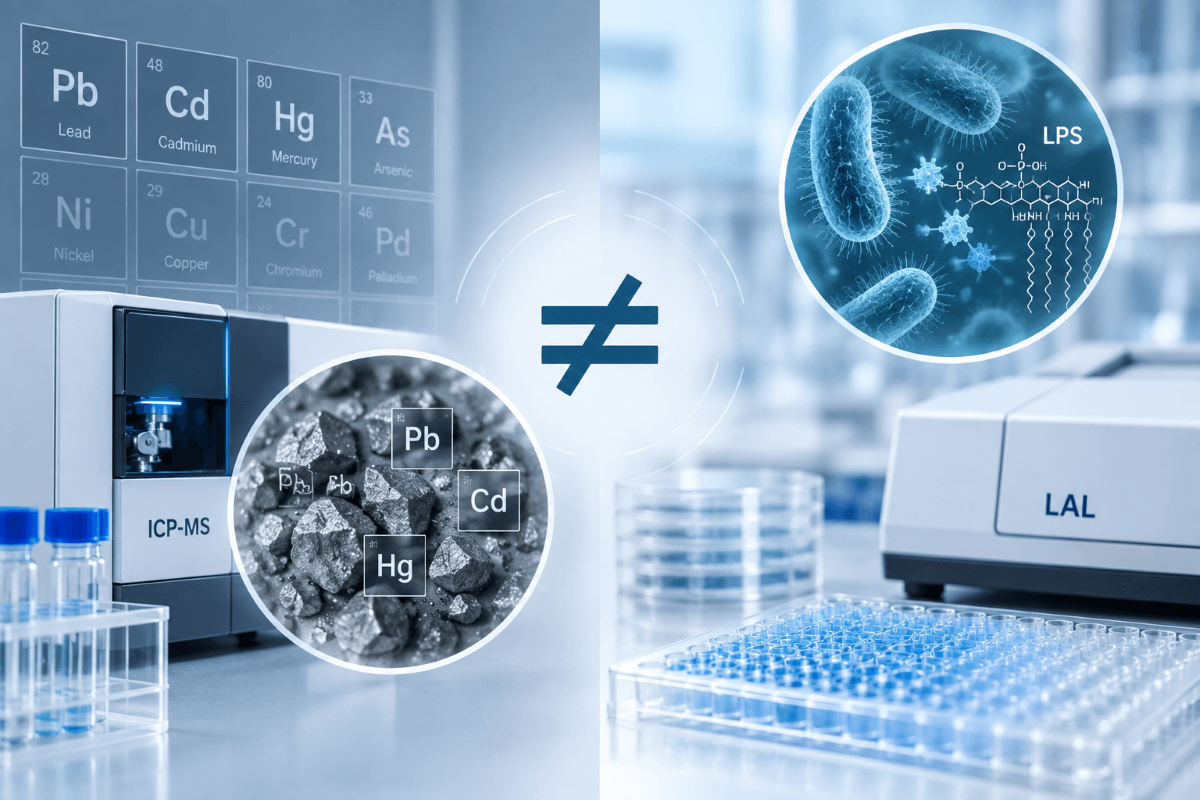
Elemental impurities and endotoxins are sometimes grouped together under the broad concept of contamination testing, but they are completely different quality parameters.
Heavy metal testing evaluates elemental contaminants such as lead, cadmium, arsenic, mercury, nickel, or palladium.
Endotoxin testing evaluates bacterial lipopolysaccharides associated with Gram-negative bacteria.
The analytical techniques are therefore different.
For example:
-
HPLC → chromatographic purity
-
Mass spectrometry → molecular identity
-
Peptide assay → peptide content
-
ICP-MS → elemental impurities
-
LAL or another validated bacterial endotoxin method → endotoxins
-
TAMC/TYMC → viable microbial contamination
None of these methods provides the same information.
This is why comprehensive quality control is based on multiple complementary analyses.
For more detail, see Endotoxin Testing: Why It Matters in Peptide Quality Assessment.
Why Comprehensive Peptide Testing Matters
No single analytical technique can provide a complete picture of peptide quality.
A comprehensive analytical evaluation may include:
-
HPLC purity - evaluates chromatographic purity
-
Mass spectrometry - confirms molecular identity
-
Peptide assay/content - determines the actual amount of peptide
-
ICP-MS - evaluates elemental impurities
-
Endotoxin testing - evaluates bacterial endotoxin contamination
-
TAMC/TYMC - evaluates microbial counts
-
Batch documentation - provides traceability between analytical results and the supplied material
Each test answers a different scientific question. Looking at these parameters together therefore provides substantially more information than relying only on a statement such as “99% pure.”
Looking Beyond HPLC Purity Alone
HPLC remains an essential tool in peptide analysis.
However, it should be interpreted within the limits of what the technique was designed to measure.
A high HPLC result does not answer questions such as:
-
Were elemental impurities evaluated?
-
Were endotoxins tested?
-
Was microbial contamination assessed?
-
Was molecular identity confirmed?
-
Was actual peptide content measured?
-
Does the laboratory report correspond to the current batch?
-
Was the material produced under appropriately controlled manufacturing conditions?
This is why quality assessment should extend beyond chromatographic purity. Purity is one quality parameter. It is not a complete quality system.
Frequently Asked Questions
What are heavy metals in peptide testing?
The term generally refers to trace elemental contaminants that may enter a sample through raw materials, reagents, catalysts, manufacturing equipment, water systems, processing, or other production-related sources.
Within modern pharmaceutical quality frameworks, the broader term elemental impurities is generally preferred.
Can HPLC detect heavy metals?
Routine peptide HPLC purity analysis does not reliably evaluate elemental impurities. Dedicated elemental analysis is required.
Can a peptide be 99% pure and still contain heavy metals?
Yes. HPLC purity and elemental impurity testing evaluate different characteristics of a sample.
A high chromatographic purity percentage therefore cannot demonstrate the absence of trace metals.
What is ICP-MS?
ICP-MS stands for Inductively Coupled Plasma Mass Spectrometry.
It is a highly sensitive analytical technique used to identify and quantify trace elements in a sample.
Why is ICP-MS used for heavy metal testing?
ICP-MS allows laboratories to evaluate multiple elements at very low concentrations and is widely used for trace elemental analysis.
Its sensitivity makes it particularly useful when contaminants need to be measured at low concentration levels.
Is ICP-MS the only method used for elemental impurities?
No. ICP-OES and other validated elemental analysis techniques may also be appropriate depending on the analytical requirements.
The important factor is whether the method is properly validated and suitable for the elements and concentration range being evaluated.
What is the difference between USP <232> and USP <233>?
USP <232> addresses limits for elemental impurities within its applicable pharmaceutical scope.
USP <233> addresses analytical procedures and validation requirements used to evaluate elemental impurities.
What does ICH Q3D cover?
ICH Q3D provides an internationally recognised framework for assessing and controlling elemental impurities in pharmaceutical products.
It includes elemental classification, potential contamination sources, risk assessment principles, control strategies and exposure-based limits.
Which heavy metals are most commonly monitored?
Lead, cadmium, arsenic and mercury are among the most widely recognised elements and form ICH Q3D Class 1.
Other elements may also need to be considered depending on the manufacturing process and risk assessment.
Should heavy metal results be batch-specific?
Batch-specific testing provides stronger traceability because the analytical result can be linked directly to the production lot being evaluated.
Conclusion
Heavy metal testing is an important independent component of comprehensive peptide quality assessment.
While HPLC provides valuable information about chromatographic purity, it does not determine whether elemental impurities such as lead, cadmium, arsenic, mercury, nickel, palladium, or other metals are present.
Dedicated analytical techniques such as ICP-MS provide a separate layer of information by measuring trace elements at very low concentrations.
Elemental impurity testing can also provide insight into the effectiveness of manufacturing controls involving raw materials, processing reagents, catalysts, equipment, water systems, and other potential sources of contamination.
When combined with:
-
HPLC purity,
-
molecular identity,
-
peptide content,
-
endotoxin testing,
-
microbiological analysis,
-
and batch-specific documentation,
heavy metal testing contributes to a substantially more complete analytical profile of a peptide material.
For researchers evaluating laboratory documentation, the central principle is straightforward:
High HPLC purity does not demonstrate the absence of elemental impurities.
Elemental contamination must be evaluated independently using an appropriate, validated analytical method.

Sources:
-
International Council for Harmonisation (ICH), Q3D(R2): Guideline for Elemental Impurities.
-
United States Pharmacopeia (USP), General Chapter <232> Elemental Impurities - Limits.
-
United States Pharmacopeia (USP), General Chapter <233> Elemental Impurities - Procedures.
-
European Pharmacopoeia, General Chapter 5.20 Elemental Impurities and related elemental impurity analytical framework.
-
U.S. Food and Drug Administration, Elemental Impurities in Drug Products: Guidance for Industry.
Research Quality Begins with Peptide Quality
At Particle Peptides, we believe that reliable research begins with reliable materials. That is why our research peptides are manufactured on cGMP-compliant production lines by a global pharmaceutical CDMO, and every batch undergoes independent third-party testing for:
- Purity
- Identity confirmation
- Peptide content
- Endotoxin levels
- Heavy metals (Class I & II)
- Microbial contamination (TAMC & TYMC)
Transparency and independently verified laboratory data form the foundation of high-quality scientific research.
Disclaimer: All Particle Peptides products are intended exclusively for scientific research and laboratory use. They are not intended for human or veterinary use, nor for the diagnosis, treatment, cure, or prevention of any disease.
Related products

BPC-157 5mgwith Mannitol
- In stock

GLP-3 10mgwith Mannitol
- In stock

Thymalin 20mg
- In stock
