
- today

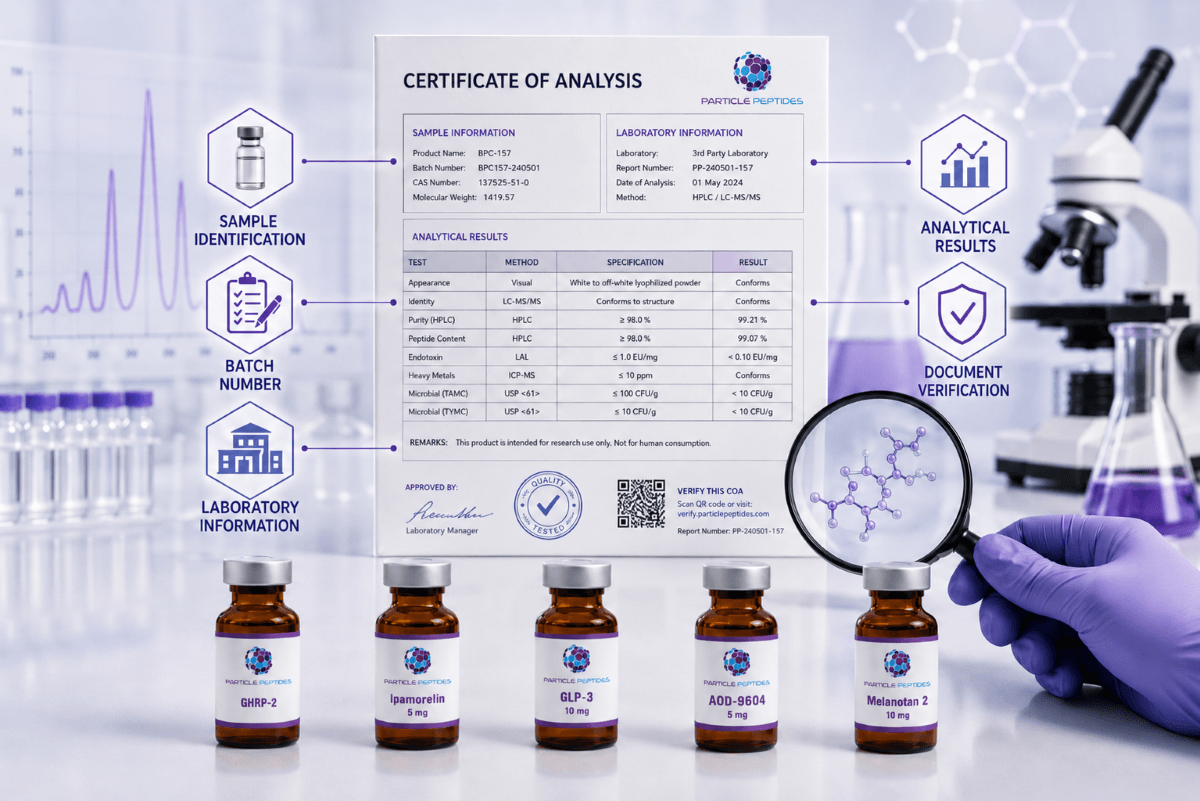
Peptide Certificate of Analysis (COA) is a key document used to summarize laboratory testing for a specific production batch. A reliable COA should provide clear sample identification, batch traceability, laboratory information, analytical results, and ideally a way to verify the report independently. Understanding how to review these elements can help researchers distinguish authentic laboratory documentation from altered, incomplete, or misleading certificates.
What Is a Peptide Certificate of Analysis?
A Peptide Certificate of Analysis (COA) is a laboratory document summarizing analytical results obtained for a specific peptide sample or production batch.
Unlike a general product specification, a COA should provide results related to the actual material that was tested. This distinction is important because peptide quality can vary between production batches, making batch-specific documentation significantly more informative than a generic specification sheet.
A professional COA may include information about chemical purity, molecular identity, peptide content, endotoxin levels, heavy metals, microbiological quality, and other relevant parameters depending on the scope of testing.
However, the presence of a PDF titled “Certificate of Analysis” does not automatically prove that the document is authentic, complete, or connected to the product being supplied.
For this reason, researchers should evaluate not only what results appear on a COA, but also whether the report can be traced back to the correct batch and laboratory.
Why COA Verification Matters
Laboratory documentation is increasingly important in the research peptide industry because analytical claims are often used to demonstrate product quality.
A COA can provide valuable evidence, but only if the document genuinely corresponds to the tested material.
Digital documents can be copied, edited, reused, or presented outside their original context. Values, batch numbers, company names, testing dates, and other details may potentially be changed without altering the overall appearance of the report.
This means that visual appearance alone should not be considered proof of authenticity.
Verification adds another layer of confidence by helping establish whether the report actually originated from the laboratory named on the document and whether it corresponds to the claimed sample or batch.
What Should a Reliable Peptide COA Include?
Although COA formats differ between laboratories, several elements are particularly useful when evaluating authenticity, traceability, and analytical value.
A comprehensive report should make it possible to identify:
- what material was tested,
- which batch or sample was analyzed,
- which laboratory performed the analysis,
- which analytical methods were used,
- what results were obtained,
- when the testing took place,
- and whether the report can be independently verified.
The more clearly these elements are documented, the easier it becomes to assess the report in context.
Sample and Batch Identification
One of the first areas to review is sample identification.
A COA should clearly indicate which material was submitted for testing. Depending on the laboratory, this may include:
- sample name,
- batch or lot number,
- laboratory sample ID,
- client reference,
- analysis date,
- report or publication date.
The batch number is particularly important.
If the report cannot be connected to a specific production batch, it becomes difficult to determine whether the laboratory results apply to the material currently being evaluated.
A batch-specific COA creates a direct link between the laboratory analysis and the production run from which the peptide originated.
Laboratory Information
A professional COA should also clearly identify the laboratory responsible for the analysis.
Relevant information may include:
- laboratory name,
- laboratory address or contact details,
- report identification number,
- date of issue,
- analyst information,
- authorized signatory,
- laboratory accreditation or other relevant credentials where applicable.
This information supports traceability and accountability.
If a report contains analytical results but provides little or no information about who performed the testing, additional verification may be appropriate.
The laboratory itself should ideally be independently identifiable rather than existing only as a logo on the PDF.
Analytical Results
The analytical results are the core of any COA.
The exact testing scope can vary, but comprehensive peptide analysis may include:
- HPLC purity
- Identity confirmation using Mass Spectrometry (MS)
- Peptide content
- Endotoxin testing
- Heavy metal analysis
- TAMC - Total Aerobic Microbial Count
- TYMC - Total Yeast and Mold Count
- Additional analytical methods where applicable
A COA containing only an HPLC purity result provides information about chromatographic purity, but it does not provide a complete quality profile.
Identity, peptide content, endotoxins, heavy metals, and microbiological parameters each answer different analytical questions.
For this reason, the scope of testing is just as important as the presence of a COA itself.
Check Whether the COA Is Batch-Specific
One of the most important questions when reviewing a report is:
Does this COA correspond to the actual batch being supplied?
A legitimate laboratory analysis may still be of limited value if it refers to a different production run.
Researchers should compare the batch or lot number shown on the report with the batch information associated with the physical product or supplier documentation.
Warning signs may include:
- the same COA being used for multiple batches,
- a report with no visible batch number,
- a batch number that does not match the supplied material,
- old reports presented for newer production runs,
- identical reports repeatedly used across different products.
Batch-specific documentation provides significantly better traceability than a generic certificate.
Modern COA Verification Systems
One of the most useful developments in laboratory documentation is the increasing use of digital verification systems.
Instead of relying exclusively on the PDF itself, some laboratories provide a way to verify the report through an independent digital record.
Common methods may include QR codes, certificate numbers, online verification portals, unique report identifiers, or other laboratory-controlled verification tools.
The exact system varies between laboratories, and the absence of a QR code does not automatically make a report unreliable.
What matters is whether the document can be connected back to an independent laboratory record.
QR Code Verification
Some laboratory reports contain a QR code that links directly to a verification page.
When scanning a QR code, researchers should check where the link actually leads.
Ideally, it should direct to an official laboratory domain or verification system where key report information can be compared with the PDF.
Relevant details may include:
- report number,
- sample identification,
- batch number,
- analytical results,
- date of analysis.
A QR code is useful only when it connects to a trustworthy source.
A QR code printed on a document is not, by itself, proof of authenticity.
Online Verification Portals
Some laboratories provide searchable databases or verification portals where reports can be checked independently.
Verification may require entering information such as:
- certificate number,
- report number,
- sample ID,
- batch number,
- verification code.
If the laboratory database returns a report matching the PDF, this provides stronger evidence that the document originated from that laboratory.
Researchers should compare the online record with the PDF rather than simply checking that a report number exists.
The product name, batch information, testing date, and analytical results should correspond.
Unique Verification Codes
Another common approach is the use of unique alphanumeric verification codes.
These codes may be generated for individual reports and linked to records stored within the laboratory's system.
When implemented correctly, this creates an additional barrier against unauthorized editing or reuse of certificates.
Instead of relying only on the appearance of a PDF, researchers can verify whether the report identifier corresponds to a record maintained by the testing laboratory.
Why Digital Verification Is Valuable
PDF documents can be modified using widely available software.
Potentially editable details include:
- purity values,
- peptide content,
- batch numbers,
- sample names,
- dates,
- company names,
- individual analytical results.
Digital verification changes the way authenticity is assessed.
Instead of treating the PDF as the primary source of truth, the researcher can compare it with information stored independently by the laboratory.
This provides a more reliable approach than relying exclusively on formatting, logos, signatures, or the visual appearance of a certificate.
Common Warning Signs When Reviewing a COA
Not every unusual report is fraudulent, and laboratory formats vary significantly.
However, certain characteristics may justify closer examination.
Generic or Reused Reports
A COA should normally relate to a specific sample or batch.
If exactly the same report appears repeatedly across multiple production runs with only minimal details changed, it may be worth verifying directly with the laboratory.
Missing Batch Number
Without a batch or sample identifier, the results cannot easily be connected to a specific production run.
This substantially reduces traceability.
Missing Laboratory Information
Reports that do not clearly identify the testing laboratory, report number, testing date, or responsible personnel may warrant additional verification.
Inconsistent Formatting
Potential indicators of document modification may include:
- inconsistent fonts,
- different text sizes,
- misaligned tables,
- irregular spacing,
- blurred or differently rendered numerical values,
- unusual page formatting.
None of these features proves that a document is fake, but they can be reasons to investigate further.
Identical Results Across Multiple Batches
Analytical results naturally vary to some degree between samples and production runs.
Exactly identical values repeatedly appearing across multiple supposedly independent batches may justify closer examination.
The appropriate response is not automatically to assume fraud, but to verify the underlying documentation.
Can an Authentic COA Still Be Misused?
Yes. A laboratory report can be genuine while still being presented in a misleading context.
For example, an authentic COA could potentially be:
- reused for a different production batch,
- associated with a product that was never tested,
- copied from another supplier,
- used for material produced at a different stage of manufacturing,
- presented without all pages of the original laboratory report,
- or separated from supporting analytical data.
This is why verifying only the laboratory logo or report format is not enough.
Researchers should also confirm that the sample, batch, date, testing scope, and analytical results correspond to the material being evaluated.
Bulk Material vs Finished Vial Testing
Another important point is understanding what stage of the material was actually tested.
A laboratory report may refer to bulk peptide material before filling, while the supplied product may consist of individually filled and lyophilized vials.
These are not necessarily the same analytical context.
A report should therefore make clear what material was submitted for testing.
When evaluating COAs, researchers should consider whether the report relates to:
- raw material,
- bulk peptide,
- lyophilized material,
- finished vial,
- or another specific stage of production.
Understanding this distinction helps prevent laboratory results from being interpreted outside their intended scope.
Supporting Analytical Data
A COA provides a summary of laboratory results, but some laboratories may also provide supporting analytical data.
Depending on the test, this may include:
- HPLC chromatograms,
- mass spectra,
- elemental analysis reports,
- microbiological results,
- endotoxin test documentation,
- additional instrument-generated data.
Supporting data can provide additional context and make it easier to understand how a reported result was obtained.
However, the data should also correspond to the same sample ID and batch information as the COA.
A chromatogram or mass spectrum without traceable sample identification provides less useful evidence than supporting data clearly linked to the report.
Questions to Ask When Reviewing a Peptide COA
A useful way to evaluate a Certificate of Analysis is to ask several simple questions:
- Is the report specific to the batch being supplied?
- Does the batch number match the product?
- Is the testing laboratory clearly identified?
- Can the report be independently verified?
- Which analytical parameters were actually tested?
- Does the COA include more than HPLC purity?
- Are the analytical methods identified?
- Are supporting chromatograms or laboratory data available?
- Does the testing date make sense for the production batch?
- Is the report complete?
- Can all pages and results be connected to the same sample?
No single question proves authenticity.
Together, however, they create a much stronger framework for evaluating laboratory documentation.
What Makes a Strong Peptide COA?
A strong Certificate of Analysis combines several layers of information.
These typically include:
- clear sample identification,
- specific batch or lot number,
- identifiable laboratory,
- report or certificate number,
- relevant analytical methods,
- multiple quality parameters,
- traceable testing dates,
- supporting analytical data where available,
- independent verification,
- clear connection between the report and supplied batch.
The goal is not simply to collect as many documents as possible.
The goal is to create a traceable chain of evidence connecting the material, batch, laboratory, analytical methods, and reported results.
Why a COA Should Include More Than Purity
HPLC purity is one of the most commonly reported parameters in peptide characterization, but it represents only one part of laboratory quality assessment.
A result of 99% purity alone does not confirm molecular identity, actual peptide content, endotoxin levels, heavy metals, or microbiological quality.
To learn more about why HPLC purity alone does not provide a complete picture of peptide quality, read our article: HPLC Purity: Why It Is Not Enough to Define Peptide Quality.
A more comprehensive COA provides significantly more information when it includes multiple independent analytical results. This is especially important when comparing documentation from different sources.
Two certificates may both report 99% purity while differing substantially in the scope of testing and the level of batch traceability they provide.
For a broader overview of individual quality parameters and their role in laboratory assessment, read our article: Peptide Quality: A Comprehensive Guide to Laboratory Quality Assessment.
COA Verification and Transparency
Transparency is one of the most important elements of laboratory quality documentation.
Researchers should ideally be able to understand:
- what was tested,
- which batch was tested,
- when it was tested,
- which laboratory performed the analysis,
- how the analysis was performed,
- and whether the report can be independently verified.
This allows laboratory documentation to function as more than a marketing claim.
It becomes a source of objective, traceable information.
The stronger the connection between the product, batch, laboratory, and original analytical report, the more useful the COA becomes when evaluating peptide quality.
Frequently Asked Questions
Is a PDF proof that a COA is authentic?
Not necessarily. Many legitimate laboratories issue reports as PDF files, but PDFs can also be copied or modified.
Where available, independent verification through the testing laboratory can provide an additional level of confidence.
Should every peptide batch have its own COA?
Ideally, analytical documentation should correspond to the specific production batch being evaluated.
Because laboratory results can vary between batches, batch-specific documentation provides better traceability than a generic report.
Does every legitimate COA need a QR code?
No. Laboratories use different verification systems. Some use QR codes, while others provide certificate numbers, report IDs, verification portals, digital records, or direct laboratory confirmation.
The absence of a QR code does not automatically indicate a problem.
Can a genuine laboratory report be used incorrectly?
Yes. A genuine COA may still be reused for another batch, another product, or material that was not represented by the original tested sample.
This is why batch matching and sample traceability remain important even when the report itself is authentic.
Should a COA include more than HPLC purity?
The appropriate scope depends on the testing program, but purity alone provides information about only one analytical quality attribute.
Identity, peptide content, endotoxins, heavy metals, and microbiological testing provide additional independent information.
How can researchers verify a laboratory report?
Where verification tools are available, researchers can compare the COA against the laboratory's official verification portal, QR-linked record, report identifier, or other laboratory-controlled system.
If necessary, the testing laboratory may also be contacted directly to confirm whether the report originated from its records.
Conclusion
A Peptide Certificate of Analysis is far more than a document displaying a purity percentage.
A useful COA provides a traceable connection between a specific sample, production batch, testing laboratory, analytical methods, and reported results.
When evaluating a report, researchers should look beyond its visual appearance and examine whether the batch number matches, whether the laboratory can be identified, what parameters were actually tested, and whether the document can be independently verified.
Digital verification systems, batch-specific documentation, supporting analytical data, and comprehensive testing can all strengthen the value of a COA.
Most importantly, the authenticity of the document and the relevance of the tested sample should be evaluated together.
Instead of asking only: “Does this product have a COA?”
A more useful question is: “Can this COA be independently verified and clearly connected to the batch being evaluated?”
Because a Certificate of Analysis is only as valuable as the traceability and analytical evidence behind it.
Sources:
- FDA / ICH Q7. Good Manufacturing Practice Guidance for Active Pharmaceutical Ingredients - Certificates of Analysis (Section 11.4).
- ICH Q6A. Specifications: Test Procedures and Acceptance Criteria for New Drug Substances and New Drug Products.
- European Pharmacopoeia, General Chapter 2.6.14. Bacterial Endotoxins.
- European Pharmacopoeia, General Chapter 2.6.12. Microbiological Examination of Non-Sterile Products: Microbial Enumeration Tests.
- United States Pharmacopeia (USP) <233>. Elemental Impurities: Procedures.
- ISO/IEC 17025. General Requirements for the Competence of Testing and Calibration Laboratories.
- Particle Peptides. Quality Documentation and Batch-Specific Certificates of Analysis (COAs).
Research Quality Begins with Peptide Quality
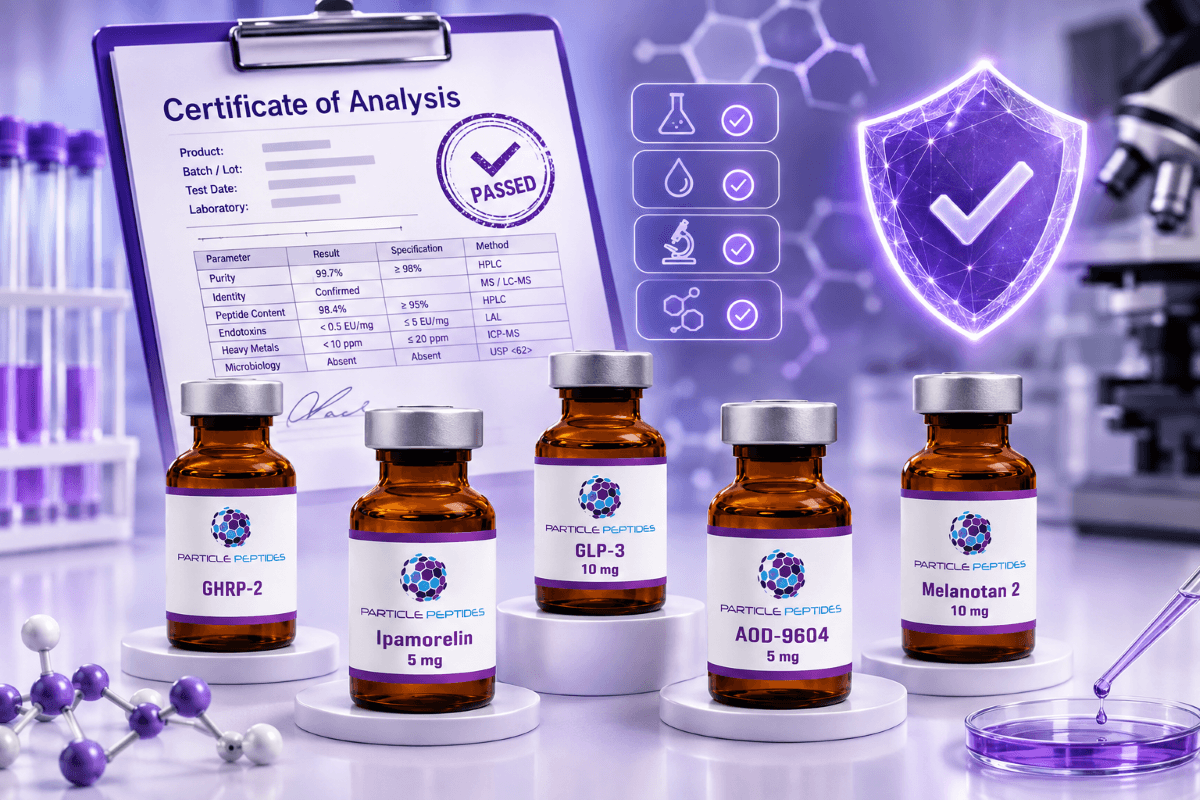
At Particle Peptides, we believe that reliable research begins with reliable materials. That is why our research peptides are manufactured on cGMP-compliant production lines by a global pharmaceutical CDMO, and every batch undergoes independent third-party testing for:
- Purity
- Identity confirmation
- Peptide content
- Endotoxin levels
- Heavy metals (Class I & II)
- Microbial contamination (TAMC & TYMC)
Transparency and independently verified laboratory data form the foundation of high-quality scientific research.
Disclaimer: All Particle Peptides products are intended exclusively for scientific research and laboratory use. They are not intended for human or veterinary use, nor for the diagnosis, treatment, cure, or prevention of any disease.
Related products

GHRP-2 5mg
- In stock

Melanotan 2 10mg
- In stock
