
- today
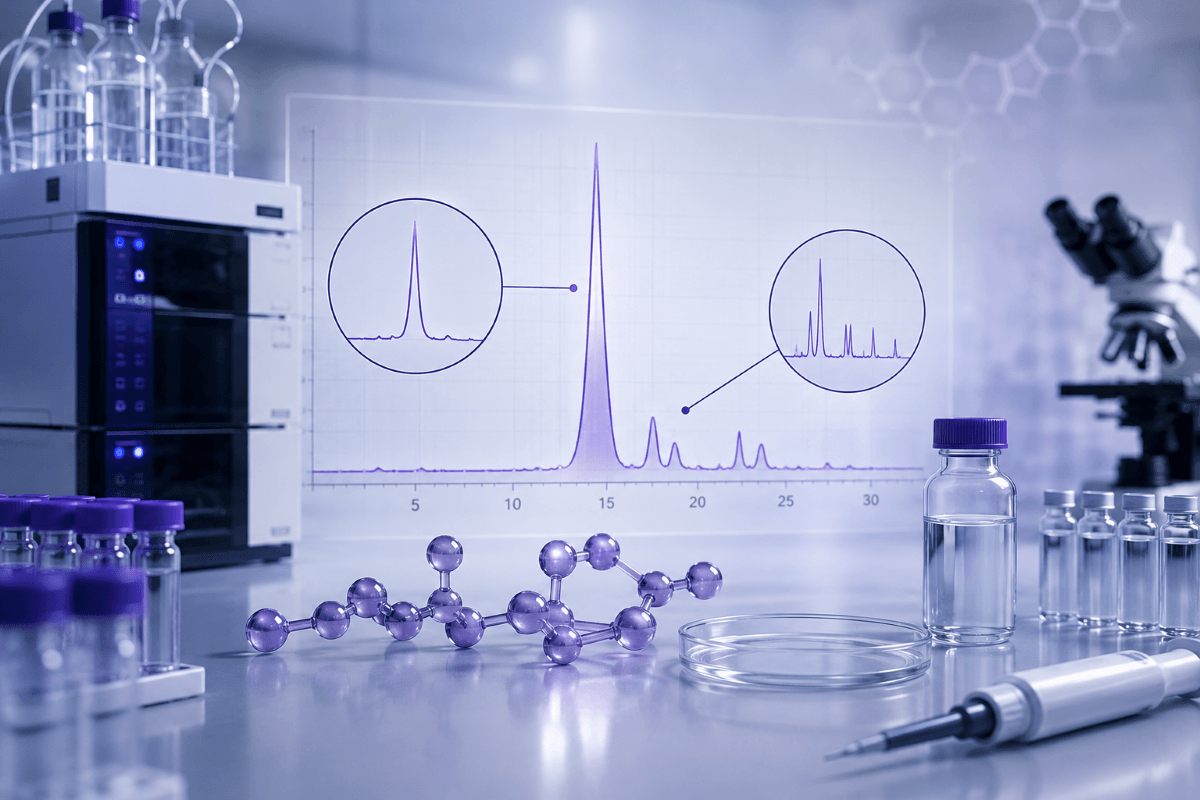
HPLC purity is an important measure of peptide quality, but it does not provide a complete picture on its own. A comprehensive laboratory assessment also considers molecular identity, peptide content, endotoxin levels, microbiological quality, heavy metals, batch consistency, and traceability. Understanding the role of each test helps researchers evaluate peptide documentation more accurately and look beyond a single purity percentage.
Why HPLC Purity Is Not Enough
When evaluating peptide quality, one of the first values researchers often look for is HPLC purity . Manufacturers frequently highlight figures such as 98%, 99%, or 99.5% purity because they are simple to understand and easy to compare.
However, a high purity percentage describes only one analytical characteristic of a peptide sample.
High-Performance Liquid Chromatography (HPLC) is an essential tool for evaluating chemical purity, but it does not independently confirm molecular identity, determine the actual peptide content, or evaluate endotoxins, microorganisms, and elemental contaminants.
For this reason, a complete peptide quality assessment requires several complementary analytical methods. Each method examines a different aspect of the material and contributes an additional piece of information to the overall quality profile.
A 99% HPLC result may therefore be an excellent chromatographic result, but it should not be interpreted as meaning that every relevant quality parameter has also been verified.
What Does HPLC Purity Actually Measure?
HPLC separates compounds according to their interactions with a chromatographic system. In peptide analysis, it is commonly used to evaluate the relative proportion of the intended peptide compared with other detectable peptide-related compounds.
During synthesis and purification, several types of impurities may potentially arise, including truncated sequences, deletion sequences, incomplete deprotection products, modified sequences, or other synthesis-related compounds.
HPLC helps laboratories distinguish the main peptide component from these impurities and estimate its relative chromatographic purity.
For example, a reported value of 99% HPLC purity generally indicates that approximately 99% of the relevant chromatographic signal under the applied analytical conditions corresponds to the principal component.
That result can provide valuable information about the effectiveness of synthesis and purification.
However, it does not automatically mean that the sample is:
-
confirmed to contain the correct molecule,
-
accurately quantified for peptide content,
-
free from elevated endotoxin levels,
-
microbiologically acceptable,
-
free from relevant heavy metal contamination,
-
or consistent with previous production batches.
These characteristics require separate analytical methods.
HPLC Cannot Evaluate Every Quality Parameter
One of the most common misunderstandings in peptide quality assessment is the assumption that a very high HPLC purity value automatically demonstrates overall product quality.
In reality, several important quality attributes fall outside the scope of conventional chromatographic purity testing.
HPLC is designed to answer a specific analytical question. Other tests are needed to answer different questions.
This is why comprehensive quality control combines multiple independent analytical techniques rather than relying exclusively on one chromatogram.
Endotoxin Testing
Endotoxins are bacterial lipopolysaccharides primarily associated with Gram-negative bacteria. They may potentially be introduced during manufacturing through raw materials, water systems, equipment, environmental exposure, or inadequate process controls.
Endotoxins are not peptide-related impurities, which means their presence cannot be reliably assessed simply by looking at an HPLC purity result.
A peptide may therefore demonstrate excellent chromatographic purity while still requiring independent endotoxin testing.
Dedicated bacterial endotoxin methods, including Limulus Amebocyte Lysate (LAL)-based testing , are used specifically to evaluate endotoxin levels.
This type of analysis provides information about a completely different quality category than chemical purity and contributes to a broader assessment of manufacturing cleanliness and process control.
Bioburden and Microbiological Testing
Bioburden refers to the presence and quantity of viable microorganisms in a sample.
Microbiological quality is another parameter that cannot be determined through HPLC analysis.
Typical microbiological testing may include:
-
TAMC - Total Aerobic Microbial Count
-
TYMC - Total Yeast and Mold Count
These tests help evaluate the microbiological condition of the material and can also provide information about manufacturing hygiene, environmental controls, handling procedures, and filling processes.
A high HPLC purity result therefore cannot be used as evidence of low microbial contamination.
Chemical purity and microbiological quality are separate analytical characteristics and must be evaluated independently.
Heavy Metal Analysis
Trace elemental contamination can potentially originate from multiple parts of the manufacturing process.
Possible sources include:
-
raw materials,
-
water systems,
-
synthesis reagents,
-
processing chemicals,
-
manufacturing equipment,
-
or environmental contamination.
Relevant elemental impurities may include substances such as lead, cadmium, mercury, arsenic, and other metals depending on the applicable testing protocol.
These contaminants are not appropriately evaluated using conventional HPLC purity analysis.
Instead, laboratories commonly use highly sensitive techniques such as ICP-MS - Inductively Coupled Plasma Mass Spectrometry.
ICP-MS is capable of detecting trace elemental contamination at very low concentrations and provides information about quality parameters that chromatographic purity cannot reveal.
This is another example of why a peptide can show excellent HPLC purity while still requiring additional laboratory assessment.
Molecular Identity
HPLC primarily evaluates chromatographic behavior. It does not, by itself, provide complete confirmation that the detected main component is definitely the intended peptide.
This distinction is critical.
A sample may produce a dominant chromatographic peak, but quality assessment must also establish what molecule that peak represents .
Peptide identity is commonly confirmed using Mass Spectrometry (MS) .
Mass spectrometry evaluates molecular mass and helps confirm whether the analyzed compound corresponds to the expected peptide.
In simple terms:
HPLC purity asks:
“How much of the detected peptide-related material corresponds to the main component?”
Identity testing asks:
“Is the main component actually the peptide we expect?”
These are different analytical questions, and both are important for comprehensive characterization.
Peptide Content
Peptide content and HPLC purity are also frequently confused.
They are not the same measurement.
Purity evaluates the proportion of peptide-related material associated with the intended peptide.
Peptide content determines how much peptide is actually present within the total sample.
The total mass of lyophilized material may include not only the peptide itself but also:
-
counter ions,
-
residual moisture,
-
salts,
-
residual solvents,
-
and other components related to manufacturing or formulation.
As a result, a sample may have very high HPLC purity while the actual peptide content is lower than the total physical mass of the lyophilized material.
This does not automatically indicate poor quality. It reflects the complete chemical composition of the sample.
For this reason, peptide content provides important quantitative information that chromatographic purity alone cannot provide.
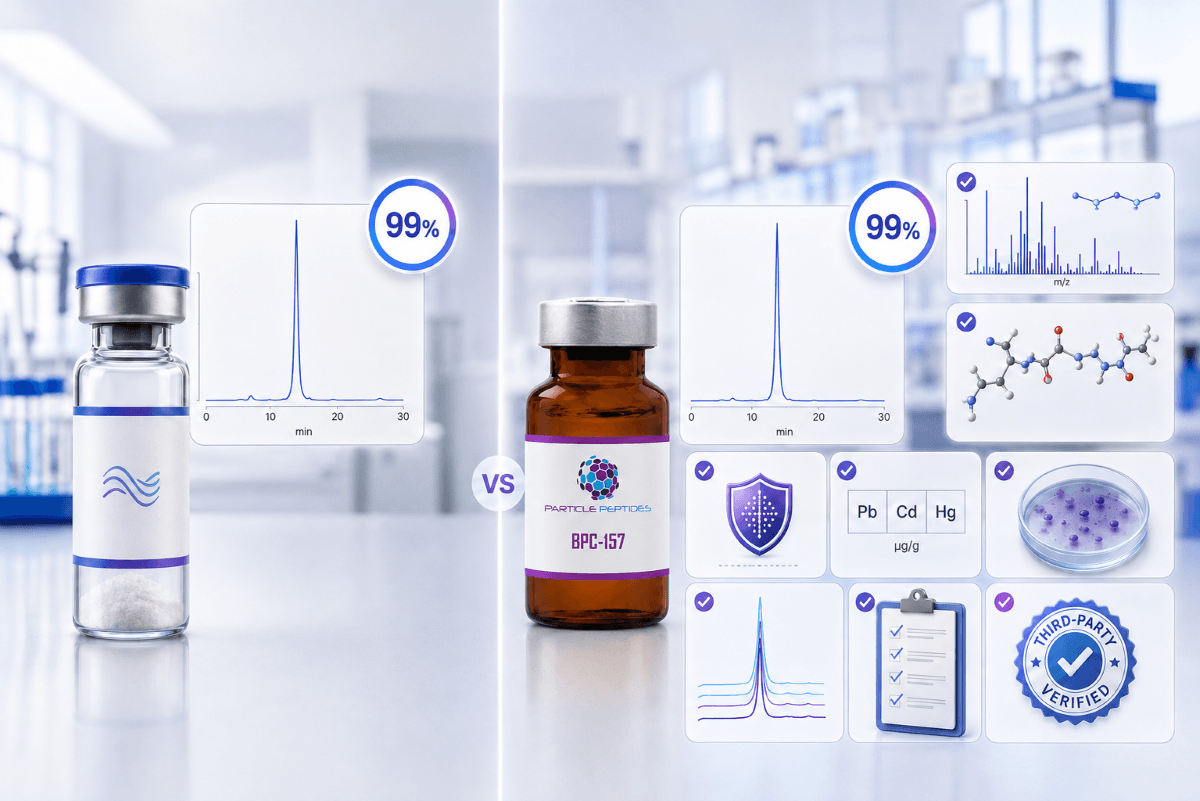
Why Two Peptides With 99% Purity May Not Be Equivalent
This is one of the most important practical points when interpreting peptide quality documentation.
Imagine two peptide batches, both reported as having 99% HPLC purity .
At first glance, they may appear equivalent.
However, the first batch may have been tested only for chromatographic purity, while the second may also have undergone:
-
identity confirmation,
-
peptide content determination,
-
endotoxin testing,
-
heavy metal analysis,
-
TAMC testing,
-
TYMC testing,
-
and batch-specific third-party verification.
Both may legitimately show 99% HPLC purity, but the amount of quality information available about each batch is very different.
This demonstrates why comparing products solely on the basis of a purity percentage can provide an incomplete picture.
The more useful question is not only:
“What is the HPLC purity?” but also: “What else has been independently tested and verified?”

Comprehensive Peptide Quality Testing
A complete laboratory quality assessment combines several complementary analytical methods.
|
Test |
What It Evaluates |
|
HPLC Purity |
Chemical / chromatographic purity |
|
Mass Spectrometry (MS) |
Molecular identity |
|
Peptide Content |
Actual amount of peptide present |
|
Endotoxin Testing |
Bacterial endotoxin levels |
|
ICP-MS |
Heavy metals and elemental impurities |
|
TAMC |
Total aerobic microbial count |
|
TYMC |
Total yeast and mold count |
Each test provides information that the others cannot fully replace.
HPLC cannot replace identity testing. Identity testing cannot determine peptide content. Peptide content testing does not evaluate endotoxins. Endotoxin testing does not measure heavy metals, and heavy metal testing does not assess viable microorganisms.
This is why comprehensive quality assessment is built from multiple independent analytical results rather than one dominant number .
Batch-to-Batch Consistency
Peptide quality should also be evaluated at the batch level.
A single excellent chromatographic result does not automatically demonstrate that every future production run will produce identical results.
Peptide manufacturing involves many variables, including raw materials, reagents, synthesis conditions, purification, lyophilization, filling, equipment, and storage.
Changes in any of these factors can potentially influence analytical results.
For this reason, reliable quality control evaluates individual production batches and monitors whether key quality parameters remain consistent over time.
Batch-specific testing may include purity, identity, peptide content, endotoxins, heavy metals, and microbiological parameters.
Consistent results across multiple batches provide stronger evidence of process reliability than a single historical test.
The Role of Certificates of Analysis
A Certificate of Analysis (COA) summarizes laboratory results for a specific production batch.
However, COAs can differ significantly in the amount of information they contain.
A basic COA may show only:
-
product name,
-
batch number,
-
HPLC purity.
A more comprehensive COA may include:
-
HPLC purity,
-
identity confirmation,
-
peptide content,
-
endotoxin testing,
-
heavy metal analysis,
-
TAMC,
-
TYMC,
-
testing date,
-
laboratory information,
-
and applicable acceptance criteria.
A more detailed COA therefore provides a broader understanding of the material than a single chromatographic purity value.
The document also becomes significantly more meaningful when it can be clearly linked to the actual batch being supplied.
Why Batch Traceability Matters
Quality documentation should ideally be connected to a specific production batch.
Batch traceability links the product to its batch number, laboratory results, manufacturing records, and supporting documentation.
Without this connection, even an authentic laboratory report may provide limited information if it cannot be confirmed that the report relates to the material actually being evaluated.
Batch-specific documentation creates a clearer connection between the physical product and its analytical results.
It can also make it easier to compare quality across different production runs and evaluate manufacturing consistency over time.
Independent Third-Party Testing
Independent third-party testing provides an additional layer of analytical verification by having samples evaluated by an external laboratory rather than relying only on manufacturer-generated results.
Depending on the scope of testing, independent analysis may include:
-
purity,
-
identity confirmation,
-
peptide content,
-
endotoxin levels,
-
heavy metals,
-
total aerobic microbial count (TAMC),
-
total yeast and mold count (TYMC).
However, the phrase “third-party tested” alone does not necessarily describe the scope of the quality program.
It is equally important to understand which parameters were tested, whether testing was performed on the actual production batch, and whether the resulting laboratory documentation can be independently verified.
The quality of third-party testing therefore depends not only on who performed the analysis, but also on what was tested and how transparently the results are documented .
Why Comprehensive Testing Matters
Modern peptide manufacturing involves a complex sequence of processes, including synthesis, purification, filtration, lyophilization, filling, packaging, storage, and quality control.
Potential quality issues can arise at different stages of this process.
Some may influence chromatographic purity, while others may have no meaningful effect on the HPLC result at all.
For example, elemental contamination may originate from equipment or raw materials. Microbiological contamination may be associated with manufacturing conditions. Endotoxins may require a dedicated biological test. Peptide content may differ from total lyophilized mass.
None of these characteristics can be fully evaluated through a single HPLC purity measurement.
A comprehensive testing strategy therefore provides a broader analytical framework and makes it possible to evaluate peptide quality from several independent perspectives.
If you would like a more comprehensive overview of peptide quality, read our article: Peptide Quality: A Comprehensive Guide to Laboratory Quality Assessment.
Looking Beyond a Single Number
HPLC purity remains one of the most valuable and widely used analytical parameters in peptide characterization.
The issue is not that HPLC purity is unimportant.
The issue is interpreting it as if it represents the complete quality profile of a peptide.
A value such as 99% purity should be understood for what it is: an important chromatographic result that describes one specific characteristic of the analyzed material.
A broader evaluation also considers:
-
whether the molecular identity was confirmed,
-
how much peptide is actually present,
-
whether endotoxins were tested,
-
whether microbiological quality was evaluated,
-
whether heavy metals were analyzed,
-
whether results are batch-specific,
-
and whether the supporting documentation is traceable.
This provides a much more informative basis for evaluating peptide quality than a single advertised percentage.
Frequently Asked Questions
Is 99% HPLC purity considered high?
A 99% HPLC purity result generally indicates a high level of chromatographic purity under the applied analytical conditions.
However, it does not independently evaluate molecular identity, peptide content, endotoxins, heavy metals, or microbiological contamination.
Does HPLC detect endotoxins?
No. HPLC purity testing does not provide an assessment of bacterial endotoxin levels.
Dedicated endotoxin testing methods are required.
Can a peptide have high HPLC purity and still fail another quality test?
Yes. Different tests evaluate different quality parameters. A sample may perform very well in chromatographic purity testing while producing a different result in endotoxin, heavy metal, microbiological, or peptide content analysis.
Does HPLC confirm peptide identity?
HPLC provides chromatographic information, but peptide identity is typically confirmed using an independent analytical method such as mass spectrometry.
Is HPLC purity the same as peptide content?
No. HPLC purity describes the relative chromatographic purity of the peptide-related material, while peptide content determines how much peptide is actually present in the total sample.
Why are TAMC and TYMC tested separately?
TAMC and TYMC evaluate viable microbial contamination.
TAMC measures the total aerobic microbial count, while TYMC measures the total yeast and mold count. These microbiological parameters cannot be determined from HPLC purity.
What should researchers look for besides HPLC purity?
A broader quality assessment may include molecular identity, peptide content, endotoxin levels, heavy metals, microbiological testing, batch-specific documentation, and independent laboratory verification.
Conclusion
HPLC purity is an essential analytical parameter, but it is not a complete definition of peptide quality.
It provides valuable information about chromatographic purity and the effectiveness of synthesis and purification, but it does not independently evaluate every quality attribute that may be relevant to the material.
A comprehensive peptide quality assessment combines several complementary analytical techniques, including molecular identity confirmation, peptide content determination, endotoxin testing, heavy metal analysis, and microbiological testing.
Batch-specific testing and traceable laboratory documentation provide additional context by connecting analytical results to the actual production batch.
For researchers evaluating peptide documentation, the goal should therefore not be to ignore HPLC purity, but to interpret it correctly.
Instead of asking only: “Is this peptide 99% pure?”
A more complete question is: “What independent analytical evidence supports the overall quality of this batch?”
Because HPLC purity is one important part of peptide quality - not the entire picture.
Sources:
-
U.S. Food and Drug Administration (FDA) / ICH Q6A. Specifications: Test Procedures and Acceptance Criteria for New Drug Substances and New Drug Products.
-
European Pharmacopoeia, General Chapter 2.6.14. Bacterial Endotoxins.
-
European Pharmacopoeia, General Chapter 2.6.12. Microbiological Examination of Non-Sterile Products: Microbial Enumeration Tests.
-
United States Pharmacopeia (USP) <233>. Elemental Impurities: Procedures.
-
ICH Q3D. Guideline for Elemental Impurities.
-
Particle Peptides. Quality Documentation and Batch-Specific Certificates of Analysis (COAs).
Research Quality Begins with Peptide Quality
At Particle Peptides, we believe that reliable research begins with reliable materials. That is why our research peptides are manufactured on cGMP-compliant production lines by a global pharmaceutical CDMO, and every batch undergoes independent third-party testing for:
- Purity
- Identity confirmation
- Peptide content
- Endotoxin levels
- Heavy metals (Class I & II)
- Microbial contamination (TAMC & TYMC)
Transparency and independently verified laboratory data form the foundation of high-quality scientific research.
Disclaimer: All Particle Peptides products are intended exclusively for scientific research and laboratory use. They are not intended for human or veterinary use, nor for the diagnosis, treatment, cure, or prevention of any disease.
Related products

GHRP-2 5mg
- In stock

Melanotan 2 10mg
- In stock
