
- today

Endotoxin testing is an important part of comprehensive peptide quality assessment because bacterial endotoxins cannot be evaluated through HPLC purity, molecular identity, or peptide content testing alone. Dedicated endotoxin analysis provides independent information about microbiological quality and manufacturing controls, helping researchers interpret peptide laboratory documentation more accurately.
What Is Endotoxin Testing?
Endotoxin testing is a dedicated laboratory analysis used to detect and quantify bacterial endotoxins in a sample. These contaminants are different from peptide-related impurities and therefore require analytical methods specifically designed for their detection.
When peptide quality is discussed, attention is often focused on parameters such as purity, molecular identity, or peptide content. These measurements are important, but none of them provides information about bacterial endotoxin levels.
For this reason, endotoxin testing represents a separate and independent component of a broader peptide quality assessment.
A peptide may demonstrate high HPLC purity, confirmed molecular identity, and appropriate peptide content while still requiring dedicated endotoxin analysis. This illustrates why comprehensive quality control relies on multiple complementary analytical techniques rather than a single laboratory result.
What Are Endotoxins?
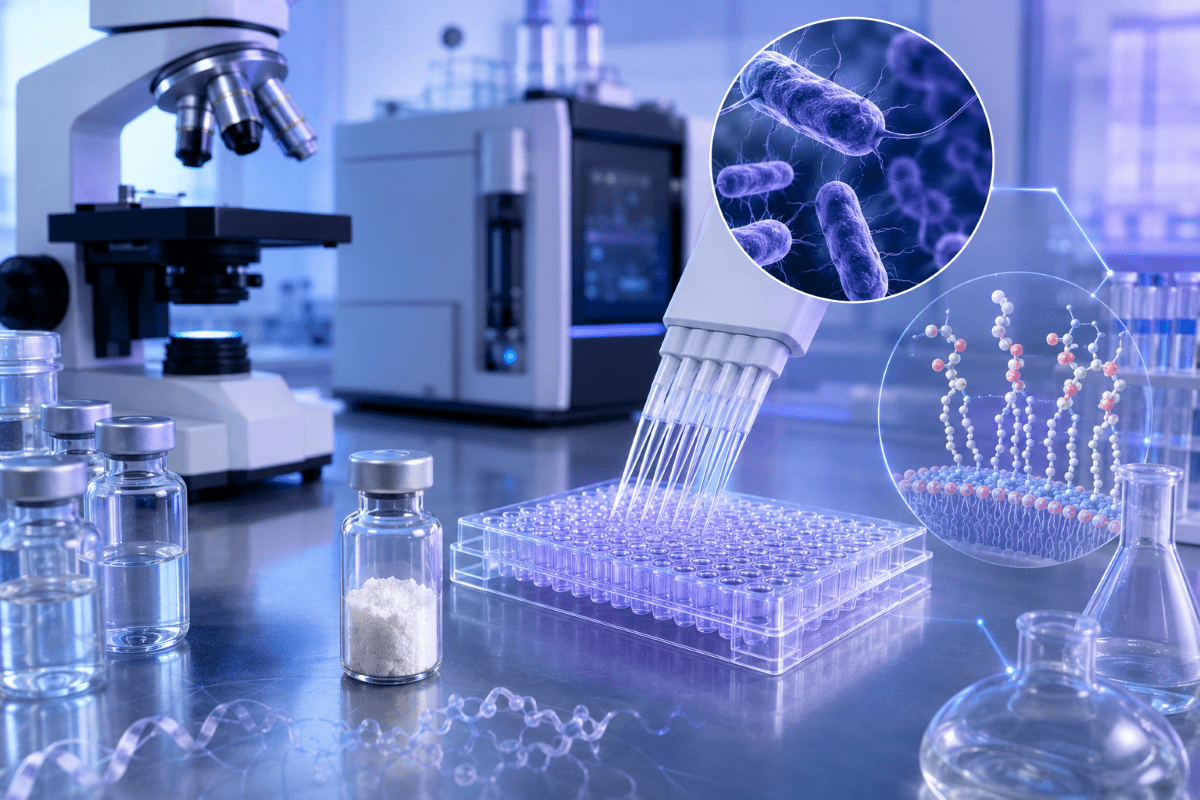
Endotoxins are molecules associated primarily with the outer membrane of Gram-negative bacteria.
Chemically, endotoxins are a type of lipopolysaccharide (LPS).
When Gram-negative bacteria grow, divide, or break down, lipopolysaccharides may be released into the surrounding environment. If manufacturing, water, equipment, or handling processes are not adequately controlled, endotoxin contamination may potentially be introduced into laboratory materials.
Importantly, endotoxins are not peptide impurities.
They exist independently of the peptide molecule itself, which is why analytical methods designed to evaluate peptide purity cannot be used as a substitute for dedicated endotoxin testing.

How Can Endotoxins Enter a Peptide Sample?
Endotoxin contamination may potentially arise at different stages of manufacturing and handling.
Possible sources include:
-
raw materials,
-
water systems,
-
manufacturing equipment,
-
production environments,
-
processing steps,
-
filling operations,
-
handling procedures.
Water systems are particularly relevant because Gram-negative bacteria can occur in aqueous environments if appropriate controls are not maintained.
Manufacturing quality systems therefore focus not only on testing the final material, but also on minimizing the opportunity for contamination throughout the production process.
Because endotoxins can remain present even after bacteria are no longer viable, preventing contamination requires appropriate process controls rather than relying solely on the absence of living microorganisms.
Why HPLC Cannot Detect Endotoxins
One of the most common misunderstandings in peptide quality assessment is the assumption that very high HPLC purity also demonstrates the absence of endotoxins.
It does not.
HPLC is primarily used to evaluate chromatographic purity by separating compounds according to their interactions within a chromatographic system.
Endotoxins are not conventional peptide-related impurities and are not reliably evaluated through routine HPLC purity analysis.
A peptide could therefore demonstrate:
-
excellent chromatographic purity,
-
confirmed molecular identity,
-
appropriate peptide content,
while still requiring separate endotoxin testing.
This distinction is important because HPLC and endotoxin testing answer completely different analytical questions.
This article explains in more detail why a high purity percentage cannot provide a complete picture of peptide quality: HPLC Purity: Why It Is Not Enough to Define Peptide Quality
How Are Endotoxins Measured?
Endotoxin testing requires analytical methods specifically designed to detect bacterial endotoxins.
One of the most established approaches is testing based on Limulus Amebocyte Lysate (LAL).
Traditional LAL-based techniques include:
-
gel-clot methods,
-
turbidimetric methods,
-
chromogenic methods.
These methods use a biological reaction that is highly sensitive to bacterial endotoxins.
Modern laboratory testing may also use validated recombinant methods, depending on the laboratory, applicable standards, and analytical procedure.
The important point is that endotoxin testing requires a dedicated analytical method. It cannot be inferred from HPLC purity, mass spectrometry, or peptide content results.
Why Endotoxin Testing Is an Independent Quality Parameter
Every analytical method evaluates a different characteristic of a peptide sample.
|
Test |
What It Evaluates |
|
HPLC |
Chemical / chromatographic purity |
|
Mass Spectrometry (MS) |
Molecular identity |
|
Peptide Content |
Actual amount of peptide present |
|
ICP-MS |
Heavy metals and elemental impurities |
|
TAMC |
Total aerobic microbial count |
|
TYMC |
Total yeast and mold count |
|
Endotoxin Testing |
Bacterial endotoxin levels |
None of these methods can completely replace the others.
For example, mass spectrometry can help confirm molecular identity, but it does not evaluate endotoxins. ICP-MS can detect elemental contamination, but it does not assess microbial quality. TAMC and TYMC evaluate viable microorganisms, but they do not measure endotoxin levels.
Comprehensive quality assessment therefore combines several independent methods to build a broader analytical profile of the material.
Endotoxins vs. Microbiological Contamination
Endotoxin testing and microbiological testing are often discussed together, but they do not measure the same thing.
Microbiological testing evaluates viable microorganisms present in the sample.
Typical parameters include:
-
TAMC - Total Aerobic Microbial Count
-
TYMC - Total Yeast and Mold Count
Endotoxin testing, on the other hand, measures bacterial endotoxin material associated with Gram-negative bacteria.
This distinction matters because endotoxins may remain present even when the bacteria from which they originated are no longer viable.
A sample may therefore require both microbiological testing and endotoxin testing to obtain a broader picture of microbiological quality.
These analyses are complementary rather than interchangeable.
Why Manufacturing Controls Matter
Endotoxin control begins during manufacturing.
Testing the final sample is important, but strong quality systems also aim to prevent contamination before it occurs.
Relevant manufacturing practices may include:
-
controlled production environments,
-
appropriate water system management,
-
equipment cleaning procedures,
-
validated production processes,
-
environmental monitoring,
-
controlled handling,
-
appropriate filling and packaging procedures.
When these controls are combined with analytical testing, laboratories can obtain more meaningful information about both the manufacturing process and the final material.
Endotoxin testing therefore does more than provide a single numerical result. It forms part of a wider quality control framework.
Understanding Endotoxin Results
Endotoxin results are commonly expressed in Endotoxin Units (EU).
The reported value represents the amount of endotoxin activity detected in the sample using the specified analytical method.
However, a number alone should not be interpreted without context.
Relevant factors may include:
-
the analytical method used,
-
sample preparation,
-
reporting units,
-
applicable specifications,
-
laboratory methodology,
-
intended research context.
Acceptance criteria may differ depending on the type of material and applicable quality standards.
For this reason, endotoxin values should always be interpreted alongside the laboratory method, specification, and supporting documentation.
Why Batch-Specific Endotoxin Testing Matters
A result from one production batch does not automatically describe every future batch.
Peptide manufacturing involves multiple production steps, raw materials, equipment systems, and handling processes. Small differences between production runs may influence individual quality parameters.
For this reason, endotoxin testing is more informative when it is connected to the specific batch being evaluated.
Batch-specific testing improves traceability by linking the analytical result to the material actually supplied.
Researchers should therefore consider whether the endotoxin result shown in laboratory documentation corresponds to the same batch number as the product being evaluated.
Endotoxin Testing and the Certificate of Analysis
Endotoxin results may form part of a broader Certificate of Analysis (COA).
A comprehensive COA may contain several independent analytical parameters, such as:
-
HPLC purity,
-
molecular identity,
-
peptide content,
-
endotoxin testing,
-
heavy metal analysis,
-
TAMC,
-
TYMC,
-
batch identification.
Including multiple tests provides more information than a certificate showing chromatographic purity alone.
However, the value of a COA also depends on whether the document is authentic, batch-specific, traceable, and connected to the actual laboratory analysis.
This guide explains how to evaluate batch numbers, laboratory information, digital verification systems, and other indicators of reliable COA documentation: Peptide Certificate of Analysis: How to Verify a COA and Identify Authentic Laboratory Reports
Why Comprehensive Peptide Testing Matters
Endotoxin testing is only one part of a broader peptide quality assessment.
A comprehensive laboratory evaluation may include:
-
HPLC purity,
-
identity confirmation,
-
peptide content,
-
endotoxin testing,
-
heavy metal analysis,
-
TAMC,
-
TYMC,
-
batch-specific documentation,
-
independent laboratory verification.
Each analytical result contributes different information.
Looking at these parameters together provides a more complete understanding of the material than relying on a single number such as HPLC purity.
This broader approach also makes it easier to distinguish between chemical quality, microbiological quality, elemental contamination, and manufacturing consistency.
For a broader overview of how purity, identity, peptide content, endotoxins, heavy metals, microbiological testing, and batch traceability work together, this guide explains the complete peptide quality framework: Peptide Quality: A Comprehensive Guide to Laboratory Quality Assessment
Looking Beyond Purity Alone
HPLC purity remains an important analytical parameter in peptide characterization.
However, it should not be treated as evidence that every other relevant quality characteristic has also been evaluated.
A high chromatographic purity result cannot answer questions such as:
-
Are endotoxins present?
-
Was microbiological contamination evaluated?
-
Were heavy metals tested?
-
Was molecular identity confirmed?
-
Was peptide content determined?
-
Does the result apply to the specific production batch?
Dedicated endotoxin testing fills one of these important analytical gaps.
Understanding the limitations of each laboratory method helps researchers interpret quality documentation more accurately and avoid drawing conclusions from analytical results that were never designed to answer those questions.
Frequently Asked Questions
What are endotoxins?
Endotoxins are lipopolysaccharides associated primarily with the outer membrane of Gram-negative bacteria.
They can be released into the surrounding environment and may potentially contaminate laboratory materials if production and handling controls are inadequate.
Can HPLC detect endotoxins?
No. Routine HPLC purity analysis does not provide a reliable assessment of bacterial endotoxin levels.
Dedicated endotoxin testing is required.
Can a peptide have high HPLC purity and still contain endotoxins?
Yes. HPLC purity and endotoxin testing evaluate different quality characteristics.
A sample may have excellent chromatographic purity while still requiring separate endotoxin analysis.
Is endotoxin testing the same as microbiological testing?
No. Microbiological testing such as TAMC and TYMC evaluates viable microorganisms, while endotoxin testing measures bacterial endotoxin material.
Both provide different information about microbiological quality.
What does EU mean in endotoxin testing?
EU stands for Endotoxin Units. It is commonly used to express the amount of endotoxin activity detected in a sample.
Why is endotoxin testing performed separately?
Endotoxins cannot be reliably evaluated through purity testing, molecular identity testing, heavy metal analysis, or microbial enumeration alone. A dedicated analytical method is therefore required.
Should endotoxin results be batch-specific?
Batch-specific results provide better traceability because they allow the laboratory result to be connected directly to the production batch being evaluated.
Conclusion
Endotoxin testing is an important independent component of comprehensive peptide quality assessment.
While HPLC, mass spectrometry, and peptide content analysis provide valuable information about chemical composition, identity, and quantity, they do not determine bacterial endotoxin levels.
Dedicated endotoxin testing provides a separate layer of analytical information that contributes to the broader evaluation of manufacturing quality and microbiological control.
When combined with HPLC purity, identity confirmation, peptide content, heavy metal analysis, TAMC, TYMC, and batch-specific documentation, endotoxin testing helps create a more complete analytical profile of the material.
For researchers reviewing peptide laboratory documentation, the key point is simple:
A high purity percentage cannot demonstrate the absence of endotoxins.
Endotoxin levels must be evaluated using a dedicated analytical method as part of a broader, evidence-based quality assessment.
Sources:
-
European Pharmacopoeia, General Chapter 2.6.14. Bacterial Endotoxins.
-
United States Pharmacopeia (USP) <85>. Bacterial Endotoxins Test.
-
United States Pharmacopeia (USP) <1085>. Guidelines on the Endotoxins Test.
-
European Pharmacopoeia, General Chapter 2.6.12. Microbiological Examination of Non-Sterile Products: Microbial Enumeration Tests.
-
U.S. Food and Drug Administration (FDA). Guidance for Industry: Pyrogen and Endotoxins Testing - Questions and Answers.
-
ICH Q6A. Specifications: Test Procedures and Acceptance Criteria for New Drug Substances and New Drug Products.
Research Quality Begins with Peptide Quality
At Particle Peptides, we believe that reliable research begins with reliable materials. That is why our research peptides are manufactured on cGMP-compliant production lines by a global pharmaceutical CDMO, and every batch undergoes independent third-party testing for:
- Purity
- Identity confirmation
- Peptide content
- Endotoxin levels
- Heavy metals (Class I & II)
- Microbial contamination (TAMC & TYMC)
Transparency and independently verified laboratory data form the foundation of high-quality scientific research.
Disclaimer: All Particle Peptides products are intended exclusively for scientific research and laboratory use. They are not intended for human or veterinary use, nor for the diagnosis, treatment, cure, or prevention of any disease.
Related products

GHRP-2 5mg
- In stock

Melanotan 2 10mg
- In stock
