
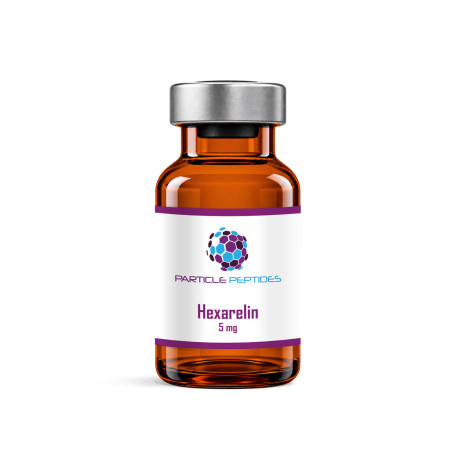
Hexarelin, also known as Examorelin, is a synthetic GH releasing hexapeptide, which activates growth hormone secretagogue receptor (GHSR) in the brain area. It is also ghrelin analog, similarly to other peptides such as GHRP-6. Beyond GH release and neuroendocrine effects, hexarelin might have also direct cardiovascular actions and cardioprotective effects. Compared with ghrelin, this peptide is chemically more stable and functionally more potent, therefore it could be potential future therapeutic medium. It can also improve fat measures and protect muscles.
[13]
The product is intended for scientific research and development purposes only. Chemical substances shall not be used as a drug, medicine, active substance, medical aid, cosmetic product, a substance for production of a cosmetic product neither for human consumption that is any food or food supplement or otherwise similarly used on humans or animals. Intended only for in-vitro research, such as Receptor-ligand binding studies, Enzyme activity assays, Cell proliferation assays, Cell signaling assays, Epitope mapping, ect.
Peptides in lyophilized form are supplied in glass vials by standard shipping methods and do not require refrigeration. Short-term temperature fluctuations during transport will not reduce their quality and efficacy. Even at high summer temperatures, the peptides in lyophilized form are stable for several weeks.
Lyophilized peptides should be stored in a dry place, protected from light and moisture. The following storage conditions are generally recommended:
Before use, allow the vial to reach room temperature after taking it out of the refrigerator or freezer.
Once reconstituted, peptide solutions are generally less stable than their lyophilized form and should be stored under refrigerated conditions whenever possible.
The following storage conditions are generally recommended:
To preserve peptide integrity, avoid repeated freeze–thaw cycles, as these may accelerate peptide degradation.
Important: Most manufacturers recommend using reconstituted peptides within 4 weeks when stored at 2–8 °C. This recommendation is intentionally conservative and may not reflect the actual chemical stability of every peptide. In our own stability studies, Ipamorelin reconstituted in 0.9 percent sodium chloride showed no detectable degradation after 12 weeks of refrigerated storage. As peptide stability is highly sequence- and formulation-dependent, this result should not be extrapolated to other peptides without supporting stability data.
The shelf life of peptide solutions is limited. Freezing the aliquots will prolong the storage life of the peptide. What is globally accepted for peptides in solution is that they are generally stable for 3 or more weeks at +4°C and for 3-4 months at -20°C. Avoid repeated freeze-thaw cycles, as this can degrade the peptides.
A synthetically produced peptide hexarelin was developed in the early 1990s by Italian pharmaceutical company Mediolanum Farmaceutici as a part of research aimed to find compounds able to stimulate the release of GH from pituitary gland. From that time it was a part of numerous researches for example on cardiostimulating and cardioprotecting effects. There was also anti-atherosclerotic activity of hexarelin observed in particular rat study, where this peptide suppressed formation of atherosclerotic plaques and neointima. Hexarelin also decreased calcium sedimentation specifically in aortic wall, and decreased cholesterol levels in obese rats. Let us now bring you some more information on hexarelin research topics.
[13]
Hexarelin has shown cardioprotective effects in rat models of myocardial ischemia/reperfusion (I/R) injury achieved through binding to growth hormone secretagogue receptor (GHSR) and receptor CD36. Treatment with hexarelin showed improvements in cardiac systolic function, a decreased level of malondialdehyde (a marker for oxidative stress), and a greater number of surviving cardiomyocytes compared to those treated with saline. The observed effects of hexarelin treatment were also shown to be slightly superior to those of equimolar ghrelin treatment.
Another study focused on the impact of hexarelin on male ghrelin-knockout mice after myocardial infarction, providing further evidence of its cardioprotective properties in research models. Hexarelin significantly reduced the mortality rate within 2 weeks compared to a control group, and improved various cardiac function parameters, such as ejection fraction and peak rates of pressure rise and decline. This effect on cardiac function, along with reduced heart cell death, was achieved by binding to GHSR and preventing apoptosis. Moreover, hexarelin treatment was also here shown to be more effective than ghrelin treatment in terms of heart function improvements.
In a study investigating its role in a disease model, rats with CAL-induced heart failure were treated with subcutaneous injections of hexarelin or saline. The results showed that hexarelin treatment significantly improved LV function, reduced oxidative stress, and ameliorated myocardial remodeling.
In both mouse and rat models of heart disease, hexarelin treatment resulted in improved left ventricular function, reduced cardiac fibrosis, and a decrease in interstitial collagen deposition. This cardioprotective effect was also observed in spontaneously hypertensive rats (SHRs), where hexarelin treatment reduced left ventricular hypertrophy, improved cardiac function, and lowered blood pressure. The mechanism behind these observed effects appears to be related to hexarelin's ability to modulate the expression of growth hormone secretagogue receptor (GHSR) and its impact on collagen synthesis and degradation.
Hexarelin's effects on cardiac function and fibrosis are accompanied by a shift from sympathetic to parasympathetic nervous system activity, leading to lower heart rates and reduced blood pressure. This shift was observed to reduce myocardial remodeling and support overall cardiac function in the studied models.
[1] - [5]
Thus hexarelin has demonstrated significant cardioprotective effects in various models of heart disease, whereas in one study, it was shown to improve cardiomyocyte function in streptozotocin-induced diabetic rats. This improvement was achieved by reversing changes in cardiomyocyte contraction and intracellular calcium ([Ca2+]i) transients, which are commonly disrupted in diabetic conditions. Additionally, hexarelin treatment corrected the abnormal action potential duration and transient outward potassium current (Ito) density seen in diabetic cardiomyocytes. The treatment was also associated with antiapoptotic changes, with upregulated GHSR expression and altered expression of apoptosis-related proteins, such as Bax, Bcl-2, caspase-3, and caspase-9. This suggests that hexarelin may be of research interest in the context of cardiac dysfunction in diabetic subjects.
[6] - [8]
Hexarelin appears to have potential also in research into lipid metabolic aberrations in nonobese insulin-resistant male mice. In a study, mice were given twice-daily intraperitoneal injections of hexarelin for 12 days, resulting in notable improvements in glucose and insulin tolerance, alongside decreased plasma and liver triglycerides. These findings are thought to be connected to hexarelin's ability to influence adipocyte differentiation and lipid metabolism in white adipose tissue. Although hexarelin-treated mice exhibited increased food intake, it did not affect their total body weight. Hexarelin treatment was associated with decreased fat mass and increased lean mass, suggesting that it may influence the abnormal body composition often linked to insulin resistance and metabolic syndrome in these models.
[9]
Furthermore, the peptide has been found to protect skeletal muscle from mitochondrial damage in rat models of cisplatin-induced cachexia, a common side effect of cancer chemotherapy. Cachexia is characterized by weight loss and muscle atrophy, and cisplatin treatment can cause a decrease in mitochondrial biogenesis, mass, and fusion index, along with increased oxidative stress. Studies showed that hexarelin could reverse these detrimental effects by antagonizing chemotherapy-induced mitochondrial dysfunction. This suggests that targeting mitochondrial health might be an area of interest in research strategies aimed at mitigating muscle wasting in cachexia.
In addition to its impact on mitochondria, hexarelin has also demonstrated effects in research on dysregulation of skeletal muscle calcium homeostasis in rat models. This dysregulation contributes to muscle atrophy and is associated with altered calcium signaling pathways. Cisplatin-treated rats displayed reduced muscle weight, smaller fiber diameter, increased intracellular calcium levels, and decreased calcium transients. Hexarelin treatments were observed to help normalize calcium homeostasis, preserving muscle function and reducing atrophic indicators in the studied models.
[10], [11]
Hexarelin, also known as Examorelin, is a synthetic GH releasing hexapeptide, which activates growth hormone secretagogue receptor (GHSR) in the brain area. It is also ghrelin analog, similarly to other peptides such as GHRP-6. Beyond GH release and neuroendocrine effects, hexarelin might have also direct cardiovascular actions and cardioprotective effects. Compared with ghrelin, this peptide is chemically more stable and functionally more potent, therefore it could be potential future therapeutic medium. It can also improve fat measures and protect muscles.
[13]
