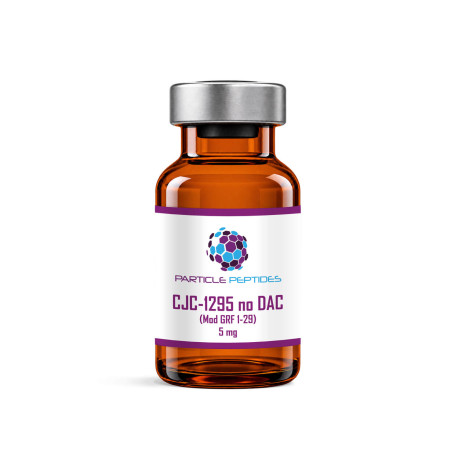
CJC-1295 no DAC (Mod GRF 1-29) is a synthetic peptide identical to CJC-1295 without DAC compound. It is truncated analogue of growth hormone releasing hormone (GHRH), which was developed in 1980s from original GRF 1-29, but with purposefully prolonged half-life to ensure better therapeutical use. This modified version was shown to have similar or even the same effects as GHRH, including muscle and bone growth, wound healing, fat burning or positive effects on heart functions, metabolism or immune system.
These vials contain nitrogen gas to help protect the peptide from oxidation. Some vials may have positive internal pressure, which can push the syringe plunger back or cause liquid to spray out during reconstitution.
What to do: Before adding the diluent, use an empty sterile syringe to carefully withdraw excess gas from the vial to equalize the pressure.
The product is intended for scientific research and development purposes only. Chemical substances shall not be used as a drug, medicine, active substance, medical aid, cosmetic product, a substance for production of a cosmetic product neither for human consumption that is any food or food supplement or otherwise similarly used on humans or animals. Intended only for in-vitro research, such as Receptor-ligand binding studies, Enzyme activity assays, Cell proliferation assays, Cell signaling assays, Epitope mapping, ect.
Peptides in lyophilized form are supplied in glass vials by standard shipping methods and do not require refrigeration. Short-term temperature fluctuations during transport will not reduce their quality and efficacy. Even at high summer temperatures, the peptides in lyophilized form are stable for several weeks.
Lyophilized peptides should be stored in a dry place, protected from light and moisture. The following storage conditions are generally recommended:
Before use, allow the vial to reach room temperature after taking it out of the refrigerator or freezer.
Once reconstituted, peptide solutions are generally less stable than their lyophilized form and should be stored under refrigerated conditions whenever possible.
The following storage conditions are generally recommended:
To preserve peptide integrity, avoid repeated freeze–thaw cycles, as these may accelerate peptide degradation.
Important: Most manufacturers recommend using reconstituted peptides within 4 weeks when stored at 2–8 °C. This recommendation is intentionally conservative and may not reflect the actual chemical stability of every peptide. In our own stability studies, Ipamorelin reconstituted in 0.9 percent sodium chloride showed no detectable degradation after 12 weeks of refrigerated storage. As peptide stability is highly sequence- and formulation-dependent, this result should not be extrapolated to other peptides without supporting stability data.
CJC-1295 no DAC (Mod GRF 1-29) had its way of development. When it was discovered that the first 29 amino acids of growth hormone releasing hormone (GHRH) are of the equal potential as its full 44 amino acid structure, the shortest possible fragment called GRF 1-29 was developed. It was also called Sermorelin, but had a very short half-life, less than 10 minutes. To enhance biological activity and reduce rapid clearance, modified versions were synthesized. Analogues got substituted amino acids within the peptide structure with more resistant to enzymatic cleavage ones. So, the modified Mod GRF 1-29 with increased binding affinity to GHRH receptors and prolonged half-life was developed, too. Originally it was called tetrasubstituted GRF 1-29, but in 2008 a researcher in his work created term modified GRF 1-29 (Mod GRF 1-29). Let us discuss now, how the Mod GRF 1-29 went throughout different research studies.
Researchers investigating growth hormone-releasing factor (GRF) analogues for potential research applications, such as in the context of Crohn's disease and short bowel syndrome, found unexpected gastrointestinal (GI) side effects in monkeys. One potent analogue caused severe diarrhea in monkeys during prolonged infusion, although it had no noticeable side effects in rats. Further analysis revealed that GRF-6 interacts with the vasoactive intestinal peptide receptor (VPAC1-R), suggesting this receptor is responsible for the diarrheal effects. Since VPAC1-R is found in the GI tract and affects smooth muscle activity, the interaction with this receptor could explain the observed changes in bowel motility in monkeys.
Another research exploring GRF and 14 GRF analogues' interactions with vasoactive intestinal peptide (VIP) receptors in rat pancreatic membranes found that some GRF analogues could inhibit VIP binding and activate adenylate cyclase. This interaction could suggest potential for side effects similar to those seen in monkeys, with GRF-6 causing severe diarrhea due to VPAC1-R interaction. The findings highlighted that alterations in specific positions within the peptide structure could markedly reduce receptor affinity and intrinsic activity, indicating how structural changes in GRF analogues could impact their receptor interactions and consequent side effects. The research underlines the complexity of receptor interactions with research peptides and the importance of carefully analyzing receptor activities in different species to avoid unwanted GI side effects.
[1] [2]
Growth hormone-releasing hormone (GHRH) agonists have been shown to have research potential beyond inducing pituitary growth hormone (GH) release. These agonists can promote cell proliferation and stimulate various tissues that express GHRH receptors (GHRH-Rs). Notably, GHRH agonists have demonstrated effects in pancreatic β-cell proliferation and metabolic function, suggesting their relevance to research into diabetes. Studies indicate that GHRH agonists can also influence the engraftment of islets after transplantation, presenting a novel area of investigation in diabetes research. Additionally, they have shown promise in research into cardiac tissue, as evidenced by improved ejection fraction, reduction of infarct size, and attenuation of cardiac hypertrophy in rodent models. This points to potential research applications in the context of cardiac function, especially in models of heart attack recovery and heart failure.
Beyond their relevance to diabetes and heart research, GHRH agonists have demonstrated effects in other areas. For instance, the presence of GHRH-Rs in ocular tissues and the neuroprotective effects of GHRH agonists in experimental diabetic retinopathy suggest possible research applications for eye diseases. GHRH agonists have also been found to influence wound healing, activate immune cells, and impact the central nervous system.
[3]
A common issue among individuals with hypothyroidism is the impaired release of growth hormone (GH). To better understand this, researchers conducted a study to evaluate the GH responses to growth hormone-releasing factor (GRF) in patients with primary hypothyroidism, both before and during thyroxine (T4) replacement therapy. The study involved fourteen patients, aged 26 to 60, who underwent GRF stimulation tests before and after T4 therapy (150 micrograms/day). The findings showed that thyroid hormone replacement therapy (T4) significantly enhanced GH responses to GRF in nine patients and in the group as a whole. Additionally, the area under the curve (AUC) measurements confirmed a general increase in GH response due to T4 therapy. These results suggest that T4 therapy enhances the responsiveness of somatotroph cells to GRF in patients with primary hypothyroidism.
The study provides valuable insights into the interaction between thyroid hormone and GH, indicating that thyroid hormone replacement therapy can influence GH responsiveness. This finding could inform further research into approaches for patients with hypothyroidism. However, when using modified GRF, some considerations need to be made regarding potential side effects, bioavailability, and dosage scaling. Although GRF exhibits moderate side effects, its bioavailability for subcutaneous administration is high, while its oral bioavailability is relatively low.
[4]
CJC-1295 no DAC (Mod GRF 1-29) is a synthetic peptide identical to CJC-1295 without DAC compound. It is truncated analogue of growth hormone releasing hormone (GHRH), which was developed in 1980s from original GRF 1-29, but with purposefully prolonged half-life to ensure better therapeutical use. This modified version was shown to have similar or even the same effects as GHRH, including muscle and bone growth, wound healing, fat burning or positive effects on heart functions, metabolism or immune system.
Click a star to leave your review.