
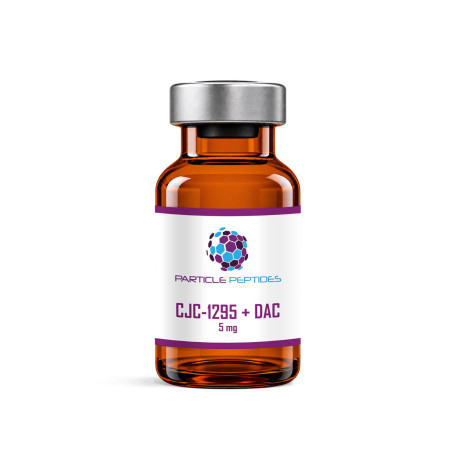
CJC-1295+DAC is one of modified synthetic analogues of growth hormone releasing hormone (GHRH). It acts as a growth hormone (GH) secretagogue stimulating levels of GH and insulin-like growth factor 1 (IGF-1), while preserving GH pulsatility. This stimulation in turn is the basis for its effects confirmed in various studies in animals and humans. This peptide contains an additive called DAC - Drug Affinity Complex, which is added to the CJC-1295 molecule via a lysine linker, and provides protection during circulation in the bloodstream. The DAC enhances the pharmacokinetics of the peptide, and allows it to bind to the blood protein albumin, thereby extending the half-life of CJC-1295 relative to other similar analogue molecules and natural GHRH itself.
[1]
The product is intended for scientific research and development purposes only. Chemical substances shall not be used as a drug, medicine, active substance, medical aid, cosmetic product, a substance for production of a cosmetic product neither for human consumption that is any food or food supplement or otherwise similarly used on humans or animals. Intended only for in-vitro research, such as Receptor-ligand binding studies, Enzyme activity assays, Cell proliferation assays, Cell signaling assays, Epitope mapping, ect.
Peptides in lyophilized form are supplied in glass vials by standard shipping methods and do not require refrigeration. Short-term temperature fluctuations during transport will not reduce their quality and efficacy. Even at high summer temperatures, the peptides in lyophilized form are stable for several weeks.
Lyophilized peptides should be stored in a dry place, protected from light and moisture. The following storage conditions are generally recommended:
Before use, allow the vial to reach room temperature after taking it out of the refrigerator or freezer.
Once reconstituted, peptide solutions are generally less stable than their lyophilized form and should be stored under refrigerated conditions whenever possible.
The following storage conditions are generally recommended:
To preserve peptide integrity, avoid repeated freeze–thaw cycles, as these may accelerate peptide degradation.
Important: Most manufacturers recommend using reconstituted peptides within 4 weeks when stored at 2–8 °C. This recommendation is intentionally conservative and may not reflect the actual chemical stability of every peptide. In our own stability studies, Ipamorelin reconstituted in 0.9 percent sodium chloride showed no detectable degradation after 12 weeks of refrigerated storage. As peptide stability is highly sequence- and formulation-dependent, this result should not be extrapolated to other peptides without supporting stability data.
The shelf life of peptide solutions is limited. Freezing the aliquots will prolong the storage life of the peptide. What is globally accepted for peptides in solution is that they are generally stable for 3 or more weeks at +4°C and for 3-4 months at -20°C. Avoid repeated freeze-thaw cycles, as this can degrade the peptides.
The CJC-1295+DAC peptide was made by ConjuChem Biotechnologies up of the first 29 amino acids of GHRH combined with a DAC supplement that allows to prolong the half-life and duration of action of the peptide CJC-1295. GHRH, the growth hormone releasing hormone, has been modified several times to create analogues that would have similar effects to GHRH, since its use is limited by short duration of action. This particular GHRH analogue was created in an attempt to find a more soluble GH secretagogue that could both be easily produced in large quantities and preserve or prolong the effects of GHRH action in the body. Although CJC-1295+DAC is chemically very similar to other GHRH analogues such as Sermorelin or even more to GRF (1-29), which is the most similar to it, they are not identical. Subcutaneous administration of CJC-1295 caused in healthy adults dose-dependent increase in GH and IGF-1 levels, which was well tolerated and safe.
[2]
Studies have confirmed that after a single injection of CJC-1295 it increases growth hormone (GH) levels in mice and also in healthy human adults by about 2-10-times, with GH reaching peak levels approximately 2 hours after administration of the peptide and the effects lasting for six or more days thereafter. GHRH analogue increases also the IGF-1 concentration by 1,5-3-fold for 9-11 days, whereas the half-life was 5,8-8,1 d.
Maintaining the physiological effect on GH release is critical in affecting the maximum concentration of the hormone in the blood without adverse reaction or increased side effects. Unlike other GH secretagogues, CJC-1295 preserves normal physiological growth hormone release with unchanged frequency and magnitude of GH secretory pulses when the peptide is administered. However, basal levels of growth hormone can be increased. The CJC-1295+DAC peptide has been shown in research to preserve the physiological effects of GH on protein synthesis, myocardial function, bone density, hyperplasia, blood sugar, lipid metabolism or hypertrophy.
[1] [2]
Research has indicated that the peptide may be of potential interest in the context of normalizing growth issues. Although children with GH deficiency have a good response to GHRH administration, its therapeutical effects are limited because of very short half-life.
Research has indicated that the peptide may be of potential interest in the context of normalizing growth issues. Although children with GH deficiency have a good response to GHRH administration, its therapeutical effects are limited because of very short half-life.
[3]
Scientists have found some in vivo and in vitro evidence that ovarian follicular cycle and ovulation is influenced and stimulated by IGF-1 hormones, and probably also by the release of growth hormone. It is for this reason that the CJC-1295 peptide, as well as other GHRH analogues, could be of research interest in the context of inducing ovulation in infertile women. This is suggested by research done back in the early 1990s and confirmed by another that investigated superovulation in animals. Growth hormone and IGF-1 levels rose significantly just during ovulation and exogenous administration of growth hormone secretagogues, such as CJC-1295, induced ovulation. It has also been suggested that the peptide and other GHRH analogues could potentially act on sperm production in men and may be relevant to research into male infertility. Further research will, hopefully, clearly define the precise role of GH in the induction of ovulation, and the minimum dose of GH needed to sensitize the ovary, as well as influences on men infertility.
[4]

CJC-1295+DAC is one of modified synthetic analogues of growth hormone releasing hormone (GHRH). It acts as a growth hormone (GH) secretagogue stimulating levels of GH and insulin-like growth factor 1 (IGF-1), while preserving GH pulsatility. This stimulation in turn is the basis for its effects confirmed in various studies in animals and humans. This peptide contains an additive called DAC - Drug Affinity Complex, which is added to the CJC-1295 molecule via a lysine linker, and provides protection during circulation in the bloodstream. The DAC enhances the pharmacokinetics of the peptide, and allows it to bind to the blood protein albumin, thereby extending the half-life of CJC-1295 relative to other similar analogue molecules and natural GHRH itself.
[1]