
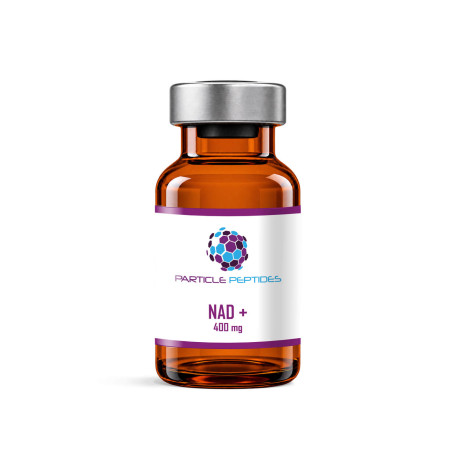
NAD+ (nicotinamide adenine dinucleotide) is a pivotal coenzyme present in all eukaryotic and prokaryotic cells. Its primary function lies in mediating electron transfer during redox reactions, thereby ensuring efficient cellular energy production within mitochondrial metabolism. Beyond its role in bioenergetic pathways, NAD+ critically modulates the activity of enzymes involved in DNA repair, epigenetic regulation, and circadian rhythm control. Moreover, NAD+ acts as an extracellular signaling molecule, facilitating intercellular communication between neurons and smooth muscle cells.
These vials contain nitrogen gas to help protect the peptide from oxidation. Some vials may have positive internal pressure, which can push the syringe plunger back or cause liquid to spray out during reconstitution.
What to do: Before adding the diluent, use an empty sterile syringe to carefully withdraw excess gas from the vial to equalize the pressure.
The product is intended for scientific research and development purposes only. Chemical substances shall not be used as a drug, medicine, active substance, medical aid, cosmetic product, a substance for production of a cosmetic product neither for human consumption that is any food or food supplement or otherwise similarly used on humans or animals. Intended only for in-vitro research, such as Receptor-ligand binding studies, Enzyme activity assays, Cell proliferation assays, Cell signaling assays, Epitope mapping, ect.
Peptides in lyophilized form are supplied in glass vials by standard shipping methods and do not require refrigeration. Short-term temperature fluctuations during transport will not reduce their quality and efficacy. Even at high summer temperatures, the peptides in lyophilized form are stable for several weeks.
Lyophilized peptides should be stored in a dry place, protected from light and moisture. The following storage conditions are generally recommended:
Before use, allow the vial to reach room temperature after taking it out of the refrigerator or freezer.
Once reconstituted, peptide solutions are generally less stable than their lyophilized form and should be stored under refrigerated conditions whenever possible.
The following storage conditions are generally recommended:
To preserve peptide integrity, avoid repeated freeze–thaw cycles, as these may accelerate peptide degradation.
Important: Most manufacturers recommend using reconstituted peptides within 4 weeks when stored at 2–8 °C. This recommendation is intentionally conservative and may not reflect the actual chemical stability of every peptide. In our own stability studies, Ipamorelin reconstituted in 0.9 percent sodium chloride showed no detectable degradation after 12 weeks of refrigerated storage. As peptide stability is highly sequence- and formulation-dependent, this result should not be extrapolated to other peptides without supporting stability data.
NAD+ levels are dynamically regulated and naturally decline with aging and under pathological conditions, thereby contributing to impaired cellular function and the acceleration of aging processes. This coenzyme was first identified in 1906 by Arthur Harden and William John Young during their investigations of alcoholic fermentation in yeast. In 1929, Harden, together with Hans von Euler-Chelpin, was awarded the Nobel Prize in Chemistry for elucidating the mechanistic role of NAD+ in mediating metabolic reactions.
At the molecular level, NAD+ functions as a central redox cofactor, undergoing cyclic interconversion between its oxidized (NAD+) and reduced (NADH) forms. This dynamic equilibrium enables electron transfer in pivotal metabolic pathways, including glycolysis, the tricarboxylic acid (Krebs) cycle, and oxidative phosphorylation. Beyond its fundamental role in mitochondrial bioenergetics, NAD+ is involved in the regulation of more than 500 enzymatic reactions, most notably through the activation of sirtuins and poly(ADP-ribose) polymerases (PARPs). Sirtuins utilize NAD+ as a substrate to modulate gene expression, epigenetic remodeling, and DNA repair, whereas PARPs depend on NAD+ to orchestrate the cellular response to DNA damage, thereby preserving genomic stability and preventing apoptosis.
Over the past decades, research has underscored the pleiotropic effects of NAD+ extending far beyond energy metabolism. Elevated NAD+ levels correlate with enhanced muscle strength, increased endurance, and neuroprotection. Moreover, NAD+ contributes to the activation of the transcriptional coactivator PGC-1α, which safeguards neurons against oxidative stress and has been associated with improved cognitive performance in aging.
[1] - [4]
One of the hallmarks of physiological aging is the progressive decline in mitochondrial function, manifested by reduced ATP production, disrupted redox homeostasis, and accumulation of reactive oxygen species. This phenomenon is closely associated with cellular senescence, chronic inflammation, and diminished regenerative capacity of stem cells. NAD+ levels naturally decrease with age, leading to impaired nuclear–mitochondrial communication and the development of a so-called pseudohypoxic state, which accelerates tissue and organ dysfunction. The consequence is reduced cellular resilience to stress and increased susceptibility to degenerative processes.
Experimental studies have demonstrated that supplementation with NAD+ precursors (e.g., nicotinamide riboside or nicotinamide mononucleotide) can restore mitochondrial bioenergetics and improve signaling between the nucleus and mitochondria. A key mechanism involves the activation of NAD+-dependent enzymes, particularly sirtuins (SIRT1) and poly(ADP-ribose) polymerases (PARPs). Activation of SIRT1 enhances the expression of longevity-associated genes, regulates metabolic pathways, and mitigates inflammatory responses. Restoration of mitochondrial integrity through NAD+ has been linked to improvements in muscle strength, endurance, and neuroprotection, underscoring its therapeutic potential in preventing age-related pathologies.
Beyond its bioenergetic and genomic effects, NAD+ exerts pleiotropic influences on organismal homeostasis. It contributes to the regulation of circadian rhythms, immune responses, and the maintenance of vascular elasticity. Experimental models have shown that elevating NAD+ levels can protect against atherosclerotic changes, support neural tissue regeneration, and enhance cognitive performance in advanced age. Collectively, these findings suggest that targeted augmentation of NAD+ represents a promising anti-aging strategy capable of slowing or partially reversing aging processes and extending the period of functional vitality.
[5] - [8]
The decline in NAD+ levels represents a critical factor influencing the aging of skeletal muscle. With advancing age, mitochondrial bioenergetics progressively deteriorates, oxidative phosphorylation is reduced, and the accumulation of reactive oxygen species increases. This cascade results in the loss of muscle mass, diminished contractile capacity, and impaired regenerative potential of muscle tissue. A key mechanism involves the disruption of nuclear–mitochondrial communication, leading to a pseudohypoxic state characteristic of advanced muscle dysfunction. Early intervention through NAD+ supplementation or its precursors can restore mitochondrial homeostasis and delay the onset of irreversible alterations.
Experimental studies indicate that supplementation with NAD+ precursors, such as nicotinamide mononucleotide (NMN) and nicotinamide riboside (NR), improves mitochondrial function and enhances the expression of genes linked to oxidative metabolism. Central to this effect is the activation of NAD+-dependent enzymes, most notably sirtuin 1 (SIRT1), which regulates gene transcription and maintains mitochondrial DNA integrity. Activation of these pathways supports the preservation of muscle contractile performance, augments resistance to oxidative stress, and mitigates degenerative processes associated with aging.
Beyond pharmacological interventions, regular physical activity has been shown to exert comparable effects on mitochondrial homeostasis to NAD+ supplementation. Exercise increases levels of PGC-1α, a transcriptional coactivator that drives mitochondrial biogenesis and angiogenesis within muscle tissue. The combination of endurance training and NAD+ precursor supplementation thus represents a promising strategy to synergistically attenuate age-related muscle loss, enhance metabolic flexibility, and sustain long-term skeletal muscle vitality throughout the aging process.
[9] - [11]
Alterations in NAD+ levels have emerged as a critical factor in the onset and progression of neurodegenerative disorders. A decline in this coenzyme disrupts mitochondrial bioenergetics, exacerbates oxidative stress, and reduces neuronal resilience against injury. Such perturbations are closely associated with progressive neurodegeneration observed in Alzheimer’s disease, Parkinson’s disease, and Huntington’s disease. Mitochondrial dysfunction, in conjunction with excessive production of reactive oxygen species (ROS), accelerates neuronal damage and promotes chronic neuroinflammation, which constitutes a hallmark of age-related neurological decline.
Experimental evidence indicates that supplementation with NAD+ precursors, such as nicotinamide riboside (NR) and nicotinamide mononucleotide (NMN), exerts robust neuroprotective effects. These interventions enhance oxidative phosphorylation, stabilize mitochondrial DNA, and activate NAD+-dependent enzymes, including sirtuins and poly(ADP-ribose) polymerases (PARPs). In particular, SIRT1 and SIRT3 orchestrate transcriptional programs that preserve mitochondrial integrity, attenuate inflammatory signaling, and enhance neuronal survival. Restoration of NAD+ levels has been shown to mitigate motor deficits and prevent dopaminergic neuronal loss in Parkinsonian models, while also ameliorating bioenergetic deficits associated with Huntington’s disease.
An additional dimension involves the kynurenine pathway of tryptophan metabolism. Under pathological conditions, dysregulation of this pathway diverts tryptophan away from neurotransmitter biosynthesis toward NAD+ production, thereby reducing the availability of serotonin and other essential metabolites. Imbalances in kynurenine-derived metabolites have been consistently linked not only to neurodegenerative diseases but also to psychiatric disorders. This underscores the notion that maintaining homeostasis in NAD+ and tryptophan metabolism may be essential for preventing or slowing neurodegenerative progression. Consequently, NAD+ supplementation or targeted modulation of the kynurenine pathway represents a promising therapeutic approach for preserving neuronal function.
[12] - [14]
A decline in NAD+ levels is closely linked to the dysregulation of nicotinamide phosphoribosyltransferase (NAMPT), a key enzyme in NAD+ biosynthesis that also functions as a potent mediator of inflammation. Under conditions of NAD+ depletion, NAMPT becomes aberrantly activated, thereby driving pro-inflammatory signaling pathways and increasing the risk of metabolic disorders such as obesity, type 2 diabetes mellitus, and non-alcoholic fatty liver disease. Moreover, NAMPT is frequently overexpressed in tumor cells, where it promotes cellular proliferation and survival, rendering it a promising target for antineoplastic therapies.
Available evidence suggests that supplementation with NAD+ or its precursors may attenuate pathological NAMPT activation, thereby contributing to the modulation of inflammatory responses. The balance between NAD+ and NAMPT represents a critical determinant of insulin sensitivity; disruption of this axis leads to enhanced lipolysis, accumulation of circulating free fatty acids, and impaired glucose metabolism in both liver and skeletal muscle. Restoring NAD+ homeostasis therefore emerges as a viable strategy to improve metabolic regulation, reduce inflammatory burden, and prevent chronic age-associated diseases.
[15], [16]
Substance use disorders, including chronic alcohol consumption and drug dependence, have long been associated with a decline in NAD+ levels, leading to impaired cellular bioenergetics and secondary nutritional deficiencies. These biochemical perturbations are tightly linked to dysregulation of neurotransmitter systems, manifesting as mood disturbances, cognitive dysfunction, and heightened vulnerability to stress.
As early as the 1960s, initial therapeutic attempts employing intravenous NAD+ administration in alcohol-dependent patients demonstrated improvements in withdrawal symptoms as well as restoration of metabolic homeostasis. According to subsequent scientific observations, NAD+ should be regarded as a pivotal cofactor that not only replenishes energy balance but also modulates neurochemical pathways implicated in the initiation, maintenance, and progression of addictive behaviors.
[17]
Experimental models have demonstrated that NAD+ exerts vasoprotective effects by mitigating atherosclerotic changes and preserving aortic elasticity. Furthermore, as an extracellular signaling molecule, NAD+ facilitates communication between neurons and smooth muscle cells, thereby influencing gastrointestinal motility and contributing to the regulation of vascular tone and blood pressure. Given the age-associated decline in NAD+ availability, current research on its precursors, including nicotinamide riboside (NR) and nicotinamide mononucleotide (NMN), highlights promising therapeutic avenues aimed at decelerating aging processes and sustaining cellular vitality.
NAD+ (nicotinamide adenine dinucleotide) is a pivotal coenzyme present in all eukaryotic and prokaryotic cells. Its primary function lies in mediating electron transfer during redox reactions, thereby ensuring efficient cellular energy production within mitochondrial metabolism. Beyond its role in bioenergetic pathways, NAD+ critically modulates the activity of enzymes involved in DNA repair, epigenetic regulation, and circadian rhythm control. Moreover, NAD+ acts as an extracellular signaling molecule, facilitating intercellular communication between neurons and smooth muscle cells.