
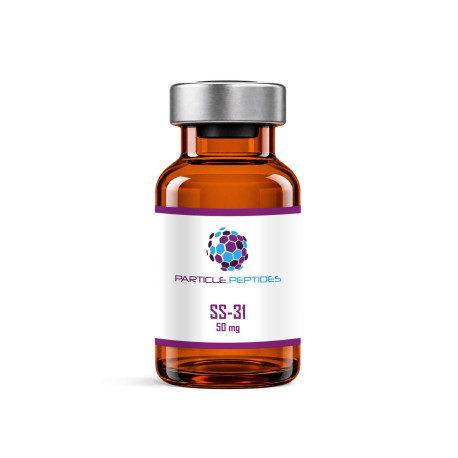
SS-31 (Elamipretide) is a synthetic tetrapeptide designed to support mitochondrial function. It selectively binds to cardiolipin in the inner mitochondrial membrane, thereby stabilizing mitochondrial structure and optimizing cellular energy (ATP) production. It is being investigated in the context of therapies for heart failure, mitochondrial diseases, and neurodegenerative conditions. This peptide is not available for purchase in the United States.
The product is intended for scientific research and development purposes only. Chemical substances shall not be used as a drug, medicine, active substance, medical aid, cosmetic product, a substance for production of a cosmetic product neither for human consumption that is any food or food supplement or otherwise similarly used on humans or animals. Intended only for in-vitro research, such as Receptor-ligand binding studies, Enzyme activity assays, Cell proliferation assays, Cell signaling assays, Epitope mapping, ect.
Peptides in lyophilized form are supplied in glass vials by standard shipping methods and do not require refrigeration. Short-term temperature fluctuations during transport will not reduce their quality and efficacy. Even at high summer temperatures, the peptides in lyophilized form are stable for several weeks.
Lyophilized peptides should be stored in a dry place, protected from light and moisture. The following storage conditions are generally recommended:
Before use, allow the vial to reach room temperature after taking it out of the refrigerator or freezer.
Once reconstituted, peptide solutions are generally less stable than their lyophilized form and should be stored under refrigerated conditions whenever possible.
The following storage conditions are generally recommended:
To preserve peptide integrity, avoid repeated freeze–thaw cycles, as these may accelerate peptide degradation.
Important: Most manufacturers recommend using reconstituted peptides within 4 weeks when stored at 2–8 °C. This recommendation is intentionally conservative and may not reflect the actual chemical stability of every peptide. In our own stability studies, Ipamorelin reconstituted in 0.9 percent sodium chloride showed no detectable degradation after 12 weeks of refrigerated storage. As peptide stability is highly sequence- and formulation-dependent, this result should not be extrapolated to other peptides without supporting stability data.
The shelf life of peptide solutions is limited. Freezing the aliquots will prolong the storage life of the peptide. What is globally accepted for peptides in solution is that they are generally stable for 3 or more weeks at +4°C and for 3-4 months at -20°C. Avoid repeated freeze-thaw cycles, as this can degrade the peptides.
SS-31, also known as the Szeto-Schiller (SS) peptide, is an innovative synthetic tetrapeptide developed around the year 2000 by scientists Hazel H. Szeto and Peter W. Schiller. Initially designed as a ligand for the μ-opioid receptor, it unexpectedly demonstrated a remarkable ability to selectively accumulate in mitochondria, where it interacts with the phospholipid cardiolipin in the inner mitochondrial membrane. This interaction stabilizes mitochondrial structure, influences efficient ATP production, and concurrently reduces the formation of reactive oxygen species (ROS), which are key contributors to cellular damage and aging. Due to its small molecular size and lipophilic properties, SS-31 readily crosses cellular and organelle membranes, allowing it to efficiently target mitochondria across diverse tissue types.
Mitochondrial dysfunction, often linked to the degradation or destabilization of cardiolipin, underlies a wide range of chronic and degenerative diseases, including neurodegenerative disorders (e.g., Alzheimer's and Parkinson's diseases), metabolic syndromes, cancer, cardiomyopathies, and mitochondrial myopathies. SS-31 is currently undergoing clinical trials as a research compound in the context of heart failure, primary mitochondrial myopathy, and other mitochondrial disorders. Recent research using chemical cross-linking and mass spectrometry has revealed that SS-31 interacts with multiple key mitochondrial proteins involved in oxidative phosphorylation and 2-oxoglutarate metabolism, further supporting its potential as a targeted mitochondrial research compound.
[1]
Primary mitochondrial diseases (PMDs) are a group of genetically determined disorders caused by dysfunction of the mitochondrial apparatus, which is responsible for the production of cellular energy in the form of ATP. These conditions primarily affect organ systems with high energy demands, such as skeletal muscle, the heart, nervous system, and kidneys. SS-31 (Elamipretide) is a mitochondria-targeted synthetic tetrapeptide that interacts with cardiolipin in the inner mitochondrial membrane, thereby stabilizing mitochondrial structure, reducing oxidative stress, and influencing ATP synthesis function. Initial preclinical evidence of SS-31's activity emerged from animal studies involving ischemia-reperfusion injury, where treatment was associated with accelerated ATP recovery, reduced necrosis and apoptosis, and changes in tissue function.
Important insights have also come from experiments investigating the effects of SS-31 on aging skeletal muscle. In older mice, a single dose of SS-31 led to changes in mitochondrial bioenergetics, reflected by increased ATP production, improved phosphorylation efficiency (P/O ratio), and enhanced cellular energy status. These effects were not observed in younger animals, suggesting a specific action of the tetrapeptide on age-related mitochondrial deficits. Moreover, SS-31 reduced redox stress, mitochondrial H₂O₂ emission, and influenced muscle fatigue resistance, resulting in increased physical endurance after 8 days of administration. These findings support its research potential in the context of sarcopenia and other forms of age-related mitochondrial dysfunction.
SS-31 has also demonstrated activity in research into kidney injury resulting from ischemia-reperfusion (I/R) stress, where rapid reactivation of mitochondrial function during the early phase of reperfusion is critical for the survival of tubular cells. The peptide inhibits the opening of the mitochondrial permeability transition (MPT) pore, thereby preventing mitochondrial depolarization, reducing ROS production, and attenuating inflammation. These multifactorial effects highlight its research potential not only for genetically driven mitochondrial diseases but also for acute and age-related mitochondrial dysfunctions.
Ischemia induces acute kidney injury (AKI) primarily due to ATP depletion, and rapid ATP recovery upon reperfusion is essential to minimize tissue damage. This recovery process is often impaired by the destruction of mitochondrial cristae, which are essential for efficient ATP synthesis. SS-31 binds with high affinity to cardiolipin in the inner mitochondrial membrane, stabilizing cristae structure and preventing cardiolipin peroxidation through inhibition of cytochrome c peroxidase activity. The resulting effects include mitochondrial protection during ischemia, accelerated ATP restoration following reperfusion, recovery of the actin cytoskeleton and cell polarity, inhibition of apoptosis, and an overall reduction in renal dysfunction. These mechanisms affirm SS-31's potential as a promising research candidate in the context of ischemia-reperfusion injury, which is currently being evaluated in clinical trials.
Although phase III clinical trials with the peptide SS-31 did not yield conclusive results, earlier phase II studies demonstrated encouraging signs of changes in physical performance in subjects with primary mitochondrial myopathy (PMM) after only five days of administration, without serious adverse effects. The peptide acts specifically on cardiolipin—an essential phospholipid of the mitochondrial membrane—stabilizing it and protecting it from oxidative damage, thereby potentially influencing mitochondrial function.
While the phase III study failed to meet its predefined primary endpoints (e.g., improvement in 6-minute walk distance and fatigue), the compound's safety profile remains favorable. Researchers and experts, such as Dr. Bruce Cohen, have suggested that the selected endpoints may not have been appropriate and that further investigations may reveal the research potential of elamipretide not only for PMM but also for other mitochondrial diseases, including Barth syndrome and age-related macular degeneration.
Currently, SS-31 is considered one of the few promising research candidates in the context of mitochondrial disorders. Ongoing research is being conducted through additional clinical trials involving new indications, extended durations, and alternative activity endpoints. In parallel, derivatives of SS-31 and other mitochondria-targeted molecules are also being investigated, fostering interest in whether significant advances in the research into mitochondrial dysfunctions may be achieved in the near future.
[2]–[8]
Mitochondrial dysfunction represents a key pathological component in heart failure and ischemia-reperfusion injury of the myocardium. The peptide SS-31 has emerged as a promising research compound capable of selectively targeting mitochondrial function, primarily through its interaction with cardiolipin. Studies on human cardiac tissue have demonstrated that SS-31 can influence mitochondrial oxygen flux and respiratory complex activity without requiring cardiolipin remodeling, suggesting the involvement of multiple mechanisms of action. These findings support the broader investigation of SS-31 in the context of mitochondrial dysfunction associated with cardiovascular diseases.
Animal model experiments, specifically in dogs with advanced heart failure, have confirmed the observed effects of chronic SS-31 administration on left ventricular function and mitochondrial ATP production. This correlation suggests that SS-31 may contribute to research into myocardial energy balance and cardiac tissue remodeling. Moreover, the peptide has also shown activity in acute settings, demonstrating the ability to reduce levels of HtrA2—a protease released from mitochondria during apoptosis, which is characteristic of ischemia-reperfusion injury.
Clinical and preclinical evidence indicates that SS-31 holds potential as a research compound in the context of both acute and chronic mitochondrial injury in cardiovascular diseases. In cases of ST-elevation myocardial infarction (STEMI), it has been shown to influence mitochondrial apoptosis, thereby affecting cardiomyocyte viability. These findings support the growing research interest in mitochondria as a target, with SS-31 emerging as one of the most promising candidates for further investigation in the context of myocardial ischemia.
[5], [9], [10]
Mitochondrial damage has emerged as a key factor in the pathogenesis of type 2 diabetes, with oxidative stress playing a central role in the development of complications such as microvascular disease. SS-31, a mitochondria-targeted peptide, has demonstrated activity in reducing the production of reactive oxygen species (ROS) associated with mitochondrial dysfunction in diabetes. Studies in both human and animal models have shown that SS-31 administration reduces oxidative damage, influences mitochondrial membrane potential, and increases levels of SIRT1, which are associated with insulin sensitivity. These effects suggest that SS-31 may be of research interest in the context of diabetic complications, including microvascular disease.
Further research indicates that SS-31 exerts effects relevant to oxidative stress and inflammation in subjects with type 2 diabetes mellitus, with potential relevance to cardiovascular risk—a common complication of this condition. Administration of SS-31 was found to reduce levels of pro-inflammatory markers such as NFκB-p65 and TNFα, while also influencing interactions between leukocytes and endothelial cells. These findings support the hypothesis that SS-31 may be of interest in research into mitochondrial function and inflammatory processes frequently associated with long-term diabetic complications, particularly in the context of cardiovascular health.
[11], [14]
SS-31 has emerged as a subject of research interest in the context of chronic inflammation, primarily through its impact on mitochondrial oxidative stress. This tetrapeptide demonstrates the ability to scavenge reactive oxygen species (ROS), thereby influencing the initiation of intracellular inflammatory cascades. Studies conducted on cell cultures and animal models have confirmed that SS-31 influences inflammatory pathways by downregulating the expression of proteins such as CD36, FIS1, and NF-κB p65, which are known to act as key triggers of inflammation. For instance, the suppression of FIS1—a regulator of mitochondrial fission—helps maintain mitochondrial integrity and influences activation of the inflammasome, a process frequently responsible for eliciting inflammatory responses. Additionally, SS-31 stabilizes mitochondrial morphology, exerting a protective effect particularly in neuroinflammatory conditions such as Alzheimer's disease or CNS injury during sepsis.
Another important property of SS-31 is its ability to suppress the activity of ROS-producing enzymes such as NADPH oxidase, while simultaneously influencing the expression of antioxidant defense mechanisms, including MnSOD and catalase. These effects result in reduced levels of pro-inflammatory cytokines such as TNF-α and suppression of the transcription factor NF-κB, which plays a central role in chronic inflammation. Furthermore, administration of SS-31 has been associated with decreased tissue damage and improved histological parameters, for example in the kidneys of diabetic mice, indicating its potential research interest in the context of inflammatory complications in chronic diseases. These findings support the investigation of SS-31 as a research compound with broad-spectrum anti-inflammatory effects, grounded in mitochondrial protection and restoration of cellular homeostasis.
[12], [13]


SS-31 (Elamipretide) is a synthetic tetrapeptide designed to support mitochondrial function. It selectively binds to cardiolipin in the inner mitochondrial membrane, thereby stabilizing mitochondrial structure and optimizing cellular energy (ATP) production. It is being investigated in the context of therapies for heart failure, mitochondrial diseases, and neurodegenerative conditions. This peptide is not available for purchase in the United States.
