
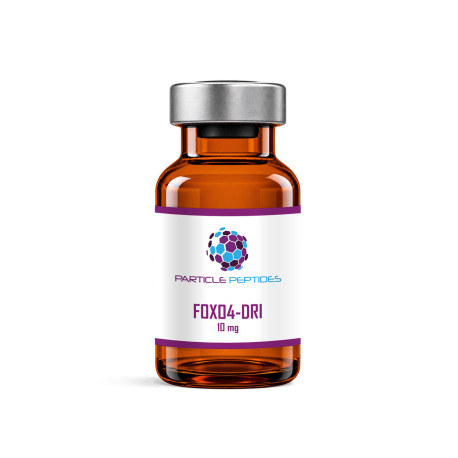
FOXO4-DRI (also known as Proxofim) is a synthetic peptide with a retro-inverso structure, developed by Dutch researchers as a modified version of the FOXO4 protein with an extended half-life. Its primary function is to disrupt the interaction between FOXO4 and the tumor suppressor protein p53, leading to the selective apoptosis of senescent cells and a deceleration of biological aging. Studies have demonstrated that FOXO4-DRI modulates multiple regulatory pathways, including insulin signaling, cell cycle control, and oxidative stress response. It also shows potential in eliminating the pro-inflammatory phenotype of senescent cells and improving the functional microenvironment of tissues.
The product is intended for scientific research and development purposes only. Chemical substances shall not be used as a drug, medicine, active substance, medical aid, cosmetic product, a substance for production of a cosmetic product neither for human consumption that is any food or food supplement or otherwise similarly used on humans or animals. Intended only for in-vitro research, such as Receptor-ligand binding studies, Enzyme activity assays, Cell proliferation assays, Cell signaling assays, Epitope mapping, ect.
Peptides in lyophilized form are supplied in glass vials by standard shipping methods and do not require refrigeration. Short-term temperature fluctuations during transport will not reduce their quality and efficacy. Even at high summer temperatures, the peptides in lyophilized form are stable for several weeks.
Lyophilized peptides should be stored in a dry place, protected from light and moisture. The following storage conditions are generally recommended:
Before use, allow the vial to reach room temperature after taking it out of the refrigerator or freezer.
Once reconstituted, peptide solutions are generally less stable than their lyophilized form and should be stored under refrigerated conditions whenever possible.
The following storage conditions are generally recommended:
To preserve peptide integrity, avoid repeated freeze–thaw cycles, as these may accelerate peptide degradation.
Important: Most manufacturers recommend using reconstituted peptides within 4 weeks when stored at 2–8 °C. This recommendation is intentionally conservative and may not reflect the actual chemical stability of every peptide. In our own stability studies, Ipamorelin reconstituted in 0.9 percent sodium chloride showed no detectable degradation after 12 weeks of refrigerated storage. As peptide stability is highly sequence- and formulation-dependent, this result should not be extrapolated to other peptides without supporting stability data.
The shelf life of peptide solutions is limited. Freezing the aliquots will prolong the storage life of the peptide. What is globally accepted for peptides in solution is that they are generally stable for 3 or more weeks at +4°C and for 3-4 months at -20°C. Avoid repeated freeze-thaw cycles, as this can degrade the peptides.
FOXO4-DRI is a synthetic peptide designed as a retro-inverso analog of the transcription factor FOXO4, in which naturally occurring L-amino acids are substituted with their D-enantiomers. This structural modification significantly extends its half-life and enhances resistance to proteolytic degradation, thereby enabling prolonged biological activity in vivo. The mechanism of action of FOXO4-DRI lies in its ability to competitively interfere with the binding of endogenous FOXO4 to the p53 protein—a central regulator of the cell cycle and apoptosis. This FOXO4–p53 interaction is essential for maintaining the viability of senescent cells. By inhibiting this interaction, FOXO4-DRI allows reactivation of the apoptotic pathway in non-proliferative senescent cells, leading to their selective elimination without damaging healthy tissue.
Preclinical studies in animal models have yielded several noteworthy findings. In addition to a significant reduction in senescent cell burden within tissues treated with FOXO4-DRI, restoration of functional integrity was observed in organs such as the kidneys, liver, and skin. Interestingly, aged mice exhibited a re-emergence of several youthful phenotypic traits following treatment—including increased physical activity, improved cognitive performance, and enhanced fur density.
Further experiments have demonstrated that the peptide is capable of suppressing the activity of pro-inflammatory and fibrotic factors characteristic of the senescence-associated secretory phenotype (SASP), thereby contributing to the restoration of damaged tissue microenvironments. A significant finding is its effect in pathological scarring models, such as keloids, where it promoted apoptosis in resistant fibroblasts and reduced cell proliferation during the G0/G1 phase of the cell cycle. These findings underscore its potential as a senolytic agent with research applications in degenerative diseases, dermatology, and regenerative medicine. The following sections will provide a detailed overview of research findings across these domains.
[2], [4]
Retro-inverso peptides (also referred to as D-retro-inverso or DRI peptides) are specially engineered molecules in which the amino acid sequence is reversed and composed of D-amino acids, which are mirror images of the naturally occurring L-amino acids. These peptides mimic the spatial conformation of the parent (native) molecules while exhibiting significantly enhanced resistance to enzymatic degradation, thereby enabling prolonged biological activity and reduced immunogenicity. Due to these properties, they represent promising candidates for the development of more stable and efficacious research compounds, particularly when targeting protein–protein interactions. Although the retro-inverso approach may fail to accurately reproduce biological function in the context of helical structures (e.g., p53 or HIV-1 proteins), certain exceptions—such as the binding of a p53-derived retro-inverso peptide to its regulator MDM2—demonstrate that well-designed D-peptides can, in specific cases, effectively mimic the function of the original peptide.
[3]
The relationship between the transcription factor FOXO4 and aging processes is highly complex; however, research suggests that this molecule plays a pivotal role in regulating longevity, cellular stress resistance, and genomic integrity. FOXO4 is a member of the broader FOXO protein family, which has preserved both structural and functional characteristics across various animal species and has long been associated with pathways influencing aging. A key aspect of FOXO4's function lies in its involvement in insulin and insulin-like growth factor (IGF) signaling pathways, which regulate metabolism, cell cycle progression, and apoptosis. Studies in the model organism Caenorhabditis elegans have demonstrated that different FOXO isoforms—particularly DAF-16A—exert a significant influence on lifespan extension by activating or repressing specific genes such as gst-20 and srr-4, which either promote or inhibit longevity-associated mechanisms.
Particularly noteworthy is that FOXO4 influences not only lifespan but also the quality of aging through its interaction with the protein p53—commonly referred to as the "guardian of the genome." This interaction regulates whether cells remain in a senescent, metabolically inactive state or undergo programmed cell death (apoptosis). This specific property has become the focus of numerous research strategies, such as the development of senolytic agents like FOXO4-DRI, which selectively disrupt the FOXO4–p53 interaction, thereby enabling the targeted elimination of dysfunctional cells. These findings not only provide deeper insight into the molecular foundations of aging but also open promising avenues for research into interventions aimed at extending healthspan and investigating age-associated diseases.
Studies show that the transcription factor FOXO4 plays a protective role in senescent cells by maintaining the protein p53 in a sequestrated state within nuclear structures, thereby inhibiting its ability to initiate apoptosis. While this mechanism prevents premature cell death, it simultaneously promotes the accumulation of damaged and dysfunctional cells, which disrupt tissue homeostasis and contribute to the progression of age-related diseases. The synthetic peptide FOX04-DRI selectively disrupts this interaction, thereby restoring the apoptotic activity of p53 and leading to the elimination of senescent cells. This process contributes to improved tissue functional status, analogously to the biological principle where the removal of dysfunctional structures allows for more efficient resource utilization by healthy cells. The elimination strategy targeting senescent cells thus represents a promising area of research in the context of various pathologies, including cancer, cardiovascular, and neurodegenerative diseases, by targeting the very biological foundation of aging.
[5], [6], [7]
Transcription factors of the FOXO family – specifically FOXO1, FOXO3, FOXO4, and FOXO6 – are key mediators of insulin and IGF signaling, participating in the regulation of a wide range of cellular processes, including metabolism, cell growth and differentiation, response to oxidative stress, autophagy, senescence, and aging-related processes. Experimental models demonstrate that FOXO proteins mediate the inhibitory effects of insulin/IGF on target genes and are essential for maintaining metabolic homeostasis. Mutations in the genes encoding these proteins, as well as their abnormal expression, are associated with the pathogenesis of several diseases, including type 2 diabetes, insulin resistance, cancer, and neurodegenerative disorders.
FOXO6, as the most evolutionarily divergent member of this group, exhibits tissue-specific expression, particularly in liver, muscle, and neural tissues, and its effects on insulin signaling significantly differ from the other isoforms. Abnormalities in the expression or function of FOXO6 have been identified as a pathophysiological basis for the development of fasting hyperglycemia and hyperlipidemia, which are serious metabolic complications in diabetic patients. In this context, research strategies aimed at the selective inhibition of FOXO proteins – including the use of peptide analogs such as FOXO4-DRI – represent a promising approach for investigating the modulation of metabolic pathways, with potential relevance to diabetes-related complications.
[8]
With advancing age, there is a decline in proteasome activity in cardiac tissue, which represents a significant mechanism contributing to the increased susceptibility of older organisms to cardiovascular diseases. Proteasomes play a crucial role in the degradation of oxidized and ubiquitinated proteins, thus maintaining protein homeostasis and ensuring an adequate cellular stress response. Experimental studies in rat models have shown that the activity of the 20S proteasome decreases with age, which is accompanied not only by a reduction in its quantity but also by changes in the composition and structure of its subunits. These changes lead to the accumulation of damaged proteins in myocytes, thereby reducing their ability to adapt to physiological stress and increasing the risk of heart disease in old age.
FOXO transcription factors, particularly FOXO4, play a crucial role in regulating cellular mechanisms associated with longevity and tissue protection against damage. In addition to regulating insulin and insulin-like growth factor signaling pathways, these factors are also involved in the control of autophagy and proteasome activity – key mechanisms responsible for the degradation of damaged or oxidized proteins. Increased FOXO4 expression correlates with enhanced proteasomal activity, leading to a reduction in the accumulation of damaged proteins, particularly in cardiovascular tissue. These findings suggest that research into the therapeutic modulation of FOXO4 activity, such as through the use of the synthetic peptide FOXO4-DRI, could provide insight into the heart's natural protective mechanisms and degenerative changes associated with aging.
[9], [10]
Age-related changes in cognitive function have a multifactorial origin, with proteasomal dysfunction potentially playing a significant role. This system, responsible for the degradation of damaged and unnecessary proteins through ubiquitin-mediated mechanisms, regulates numerous fundamental cellular processes. Disruption of its function has been identified in several neurodegenerative diseases, including Alzheimer's, Parkinson's, Huntington's, and prion diseases, as well as in amyotrophic lateral sclerosis (ALS). While it has not been conclusively established whether this dysfunction is a cause or consequence of the pathological processes, growing evidence suggests that reduced proteasomal activity may contribute to the accumulation of toxic protein aggregates and the progression of neurodegeneration. These insights open new avenues for research into pathogenesis and the investigation of targeted approaches based on the modulation of proteasomal function.
FOXO transcription factors play a crucial role in the regulation of processes related to aging and longevity, with increasing evidence suggesting their significance in the pathogenesis of neurodegenerative diseases (NDDs). These diseases are characterized by progressive neuronal damage and worsening neurological function, with effective research targets remaining limited. FOXO proteins undergo various post-translational modifications (phosphorylation, acetylation, ubiquitination, methylation, glycosylation) that influence their biological function in the central nervous system. Research indicates that FOXO factors may have both protective and detrimental effects in the context of neurodegeneration, depending on how they are regulated. A promising direction appears to be the study of the research potential of exogenous forms, such as FOX04-DRI, which could provide insight into the progression of neurodegenerative disorders. In this context, there is an emphasis on the need for a deeper understanding of the functions of FOXO in the nervous system, which could lead to the development of targeted research approaches for these severe diseases.
[11], [12]


FOXO4-DRI (also known as Proxofim) is a synthetic peptide with a retro-inverso structure, developed by Dutch researchers as a modified version of the FOXO4 protein with an extended half-life. Its primary function is to disrupt the interaction between FOXO4 and the tumor suppressor protein p53, leading to the selective apoptosis of senescent cells and a deceleration of biological aging. Studies have demonstrated that FOXO4-DRI modulates multiple regulatory pathways, including insulin signaling, cell cycle control, and oxidative stress response. It also shows potential in eliminating the pro-inflammatory phenotype of senescent cells and improving the functional microenvironment of tissues.
