
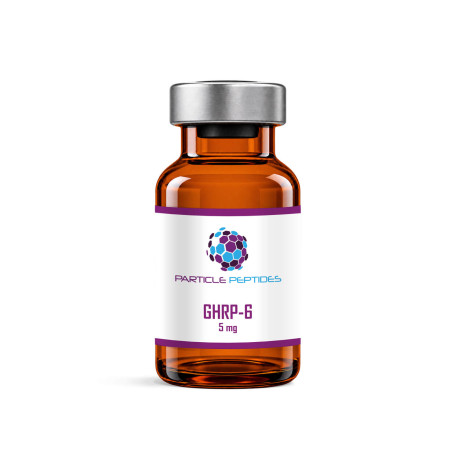
Peptide GHRP-6, also known as growth hormone-releasing peptide 6, is a synthetic hexapeptide that specifically stimulates natural growth hormone release from the anterior pituitary gland by pituitary somatotrophs. It acts by binding to ghrelin receptors and mimics the effects of ghrelin – natural endogenous hormone. It has been researched for several functions and effects as memory improvement, enhancement of tissue viability, scars regeneration, heart function or Parkinson’s disease neurons protection.
The product is intended for scientific research and development purposes only. Chemical substances shall not be used as a drug, medicine, active substance, medical aid, cosmetic product, a substance for production of a cosmetic product neither for human consumption that is any food or food supplement or otherwise similarly used on humans or animals. Intended only for in-vitro research, such as Receptor-ligand binding studies, Enzyme activity assays, Cell proliferation assays, Cell signaling assays, Epitope mapping, ect.
Peptides in lyophilized form are supplied in glass vials by standard shipping methods and do not require refrigeration. Short-term temperature fluctuations during transport will not reduce their quality and efficacy. Even at high summer temperatures, the peptides in lyophilized form are stable for several weeks.
Lyophilized peptides should be stored in a dry place, protected from light and moisture. The following storage conditions are generally recommended:
Before use, allow the vial to reach room temperature after taking it out of the refrigerator or freezer.
Once reconstituted, peptide solutions are generally less stable than their lyophilized form and should be stored under refrigerated conditions whenever possible.
The following storage conditions are generally recommended:
To preserve peptide integrity, avoid repeated freeze–thaw cycles, as these may accelerate peptide degradation.
Important: Most manufacturers recommend using reconstituted peptides within 4 weeks when stored at 2–8 °C. This recommendation is intentionally conservative and may not reflect the actual chemical stability of every peptide. In our own stability studies, Ipamorelin reconstituted in 0.9 percent sodium chloride showed no detectable degradation after 12 weeks of refrigerated storage. As peptide stability is highly sequence- and formulation-dependent, this result should not be extrapolated to other peptides without supporting stability data.
The shelf life of peptide solutions is limited. Freezing the aliquots will prolong the storage life of the peptide. What is globally accepted for peptides in solution is that they are generally stable for 3 or more weeks at +4°C and for 3-4 months at -20°C. Avoid repeated freeze-thaw cycles, as this can degrade the peptides.
GHRP-6 is one of the earliest, synthetic, peptidyl growth hormone secretagogues that has also been studied for its effects on tissue viability in different organs. GHRP-6 was developed in 1980s as a synthetic hexapeptide with a strong GH release response. It's generally known that GH receptors are found throughout the body and are responsible for many metabolic functions including promoting children growth, increasing lipolysis, stimulating protein synthesis, and antagonizing insulin. Growth hormone is generally regulated by 3 hypothalamic hormones: growth hormone releasing hormone (GHRH), somatostatin, and ghrelin. GHRP-6 as an agonist of ghrelin receptor binds to it, and mimics similar functions as ghrelin hormone does. There are several effects of GHRP-6 researched in numerous studies.
GHRP-6 activates the GHSR receptor in the central nervous system, and it has unique additional effects. One notable area of research into GHRP-6 is its potential to influence memory, to the extent that it has been investigated as a nootropic compound. Studies with mice suggest that GHRP-6 may facilitate the process of converting short-term memories into long-term ones. This could be especially relevant to spatial learning research, as GHRP-6-treated mice were able to learn and remember maze patterns more quickly than those that did not receive the treatment.
It seems that blocking the ghrelin receptor type 1a in the rat brain impairs memory encoding, acquisition and consolidation, as shown in studies using also GHRP-6 administration. Endogenous hormone ghrelin is essential for memory encoding in rats, and intracerebral administration of ghrelin affected learning and memory. Ghrelin brain signaling is thus involved in cognitive processes.
Other study showed that acylated-ghrelin modifies memory and learning by basolateral nucleus of amygdala (ABL), which participates in the regulation of memory and learning mechanism. In conclusion, the processes of place learning linked memory are assisted by acylated-ghrelin in rat ABL.
[1] - [3]
GHRP-6 has been studied for its notable effects on the brain and related tissues. One of the key observations of GHRP-6 in research is the increased expression of Insulin-Like Growth Factor-1 (IGF-1) mRNA in specific brain regions such as the hypothalamus, cerebellum, and hippocampus. IGF-1 plays a crucial role in promoting neuronal growth, survival, and synaptic plasticity. Furthermore, GHRP-6 activates intracellular signaling pathways that are essential for cell survival. Specifically, it stimulates the phosphorylation of Akt and Bad, two proteins that are involved in cell survival pathways, and it activates the phosphatidylinositol kinase pathways associated with growth factors. Additionally, GHRP-6 augments the antiapoptotic protein Bcl-2 in brain areas where IGF-1 is increased.
In addition to its role in influencing IGF-1 expression and activating cell survival pathways, GHRP-6 exhibits neuroprotective effects in research models. Studies in animal models have shown that GHRP-6 can protect neurons and other central nervous system cells from damage caused by inadequate blood flow, such as during a stroke. Research suggests that if administered promptly after an acute stroke, GHRP-6 may influence memory-related outcomes. The peptide also appears to have mood-relevant effects in animal research, with studies in mice suggesting that GHRP-6 can reduce signs of depression and influence mood-related brain regions, especially in conditions of stress. This broad range of observed effects positions GHRP-6 as a compound of considerable research interest in the field of neuroscience, warranting further investigation to understand its mechanisms and potential applications.
A preclinical study was also done on stroke therapy by coadministration of GHRP-6 with the results of significantly improved survival and neurological outcome, and reduced infarct volume compared with vehicle treatment. On the other hand, ghrelin has been found to have neuroprotective effects. Pre-clinical evidence indicated that ghrelin administration may be of research interest in the context of protecting the brain from injury following ischemic stroke. Findings show that ghrelin can improve neuronal cell survival in animal models of focal cerebral ischemia and can influence memory-related outcomes. The proposed mechanisms of action include anti-apoptotic and anti-inflammatory effects, suggesting that ghrelin could be a subject of further research in the context of stroke in clinical settings.
[4], [5]
Parkinson's disease (PD) is a widespread and disabling neurodegenerative condition linked to a gradual decline in motor function. The disease is marked by the continuous loss of dopamine (DA) neurons, with the most affected DA neurons being those that primarily extend to the substantia nigra pars compacta (SNc).
Down-regulation of ghrelin receptors (GHSRs) on dopaminergic neurons in the substantia nigra pars compacta (SNc) is associated with motor dysfunction similar to Parkinson's disease. Studies found that Parkinson's disease (PD) patients with mutations in the parkin gene (PARK2) had significantly reduced expression of GHSRs in iPSC-derived dopaminergic neurons compared to healthy controls. Similarly, CRISPR Cas9-engineered PARK2-iPSC lines mimicking PARK2 gene loss exhibited decreased GHSR expression in dopaminergic neurons. Additionally, injecting a GHSR1a antagonist into normal mice caused cataleptic behaviors and motor coordination issues, indicating that down-regulation of these receptors in the substantia nigra may be a trigger for motor dysfunction leading to extrapyramidal disorders. These findings suggest that the reduction in GHSR expression on dopaminergic neurons in the substantia nigra may contribute to Parkinson's-like motor dysfunction and indicates a potential area for further research investigation. By binding ghrelin receptors, the peptide GHRP-6 may represent a subject of research interest in the context of Parkinson's disease progression.
[6]
GHRP-6 has shown notable findings in research related to wound healing and scarring. In studies with rats, it was found that GHRP-6 could influence wound healing by increasing the rate of wound closure, reducing inflammation, and promoting the formation of essential extracellular matrix (ECM) proteins like collagen. By engaging with the CD36 receptor, which plays a role in promoting blood vessel growth, GHRP-6 was observed to influence wound healing and tissue regeneration. This was associated with better organization at the wound site and reduced scar tissue formation in the studied models.
Additionally, GHRP-6 has demonstrated an ability to reduce the development of hypertrophic scars in research models, which are a type of excessive scarring caused by abnormal deposition of ECM proteins. Studies using rabbit models of hypertrophic scars showed that GHRP-6 was associated with reduced hypertrophic scarring, making it a compound of research interest as a potential alternative to traditional treatments like triamcinolone acetonide (TA), without inducing adverse reactions.
[7], [8]
GHRP-6 has demonstrated potential in research related to myocardial damage and cardiomyocyte survival after acute myocardial infarct (heart attack). In a study involving Cuban Creole pigs, GHRP-6 was administered after acute coronary occlusion and its effects were compared with a control group receiving normal saline. The results indicated that GHRP-6 reduced myocardial infarct size by 78% and thickness by 50%, with a substantial decrease in markers of myocardial necrosis, such as CK-MB (creatine kinase MB) and CRP (C-reactive protein). Additionally, more than half of the GHRP-6 treated pigs showed no pathological Q waves in any ECG leads, suggesting a significant reduction in heart tissue damage.
The study also found that GHRP-6 has antioxidant properties, which may contribute to its cardioprotective effects observed in the model. Levels of oxidative stress markers indicated a decrease in reactive oxygen species and a preservation of antioxidant defense systems in the GHRP-6 treated group. Although GHRP-6 did not influence myocardial IGF-1 transcription compared to the increase induced by the ischemic episode, its observed capacity to reduce oxidative stress and limit myocardial necrosis represents a promising area for further research investigation in the context of acute myocardial infarction.
[9]
Ghrelin has been also found to play an important role in modulating sexual motivation and behavior in male rats. Studies suggest that the stimulation of ghrelin receptors in the central nervous system (CNS) can have a direct impact on sexual behavior and reward-seeking activities. In particular, the effects of ghrelin appear to be site-dependent, with stimulation in different brain regions leading to varying outcomes. For example, ghrelin administered into the ventral tegmental area (VTA) can increase sexual motivation, while stimulation in the medial preoptic area (mPOA) may have the opposite effect. Additionally, the use of ghrelin receptor antagonists, such as D-Lys3-GHRP-6, revealed a further decrease in sexual anticipation in rats, suggesting that ghrelin receptor signaling plays a crucial role in the full expression of appetitive sex behaviors.
Beyond its effects on sexual motivation, ghrelin may also have implications for mood regulation and neuroprotection that are of research interest. Research on mice has demonstrated that ghrelin administration can reduce depression-like behaviors induced by chronic unpredictable mild stress (CUMS) and increase neurogenesis and spine density in the hippocampus.
[10], [11]
Peptide GHRP-6, also known as growth hormone-releasing peptide 6, is a synthetic hexapeptide that specifically stimulates natural growth hormone release from the anterior pituitary gland by pituitary somatotrophs. It acts by binding to ghrelin receptors and mimics the effects of ghrelin – natural endogenous hormone. It has been researched for several functions and effects as memory improvement, enhancement of tissue viability, scars regeneration, heart function or Parkinson’s disease neurons protection.
