
- today

Peptides for joints is a term used to describe various peptide molecules studied in connection with the regeneration of connective tissues, tendons, ligaments, and other structures of the musculoskeletal system. Research focuses, for example, on cell migration, angiogenesis, inflammatory signalling, extracellular matrix formation, and processes involved in the healing of damaged tissue. Molecules studied in this area include primarily BPC-157, Thymosin Beta-4, and KPV. A separate area of interest is the combination of BPC-157 + TB-500, which is being investigated for the potential interaction of mechanisms associated with tissue repair.
How are peptides related to joints and regeneration?
A joint is not made up of just one type of tissue. Its proper function depends on the coordinated interaction of cartilage, ligaments, tendons, synovial tissue, bones, muscles, and other structures.
For this reason, research into peptides for joints does not focus solely on cartilage itself.
Research may focus, for example, on:
- tendon and ligament healing,
- repair of connective tissues,
- extracellular matrix formation and remodelling,
- migration of cells into damaged tissue,
- angiogenesis and the formation of new blood vessels,
- inflammatory signalling,
- fibroblast activity,
- organisation of collagen fibres,
- processes associated with wound healing,
- regeneration following tissue damage.
This is also why the broader topic of peptides for regeneration is often associated with this field. Regeneration is not a single isolated process, but a complex biological response involving an inflammatory phase, cell proliferation, formation of new tissue, and its subsequent remodelling.
If you are interested in a broader explanation of what peptides are, how they work, and why they are studied across different areas of biology, you can read more in the article: Peptides: What They Are, How They Work, and Why They Are the Subject of Scientific Research.
Which Peptides for Joints Are Being Studied?
Individual molecules differ in both their structure and mechanisms of action. They therefore cannot be considered a single group with identical effects.
In connection with the musculoskeletal system and tissue regeneration, the following are studied in particular:
- BPC-157,
- Thymosin Beta-4 (TB-500),
- KPV,
- the combination of BPC-157 + TB-500.
However, each of these peptides is involved in regenerative processes in a different way.
BPC-157: Research on Tendons, Ligaments, and Tissue Healing
BPC-157 is a synthetic pentadecapeptide consisting of 15 amino acids. In scientific literature, it is also referred to as a stable gastric pentadecapeptide, and research has long focused on mechanisms associated with the protection and repair of damaged tissues.
BPC-157 is among the most frequently studied peptides in research related to joints and musculoskeletal regeneration.
In preclinical studies, its effects have been investigated, for example, in injuries involving:
- tendons,
- ligaments,
- muscle tissue,
- muscle–tendon junctions,
- muscle–bone junctions,
- other types of soft tissue.
In one well-known study in rats, BPC-157 was associated with improvements in functional, biomechanical, and histological parameters during the healing of a surgically injured medial collateral ligament.
Research on BPC-157 has also been linked to angiogenesis, granulation tissue formation, collagen, and other mechanisms important to the healing process. Experimental studies have observed changes in blood vessel formation, tissue organisation, and the strength of healing tissue.
A broader overview of BPC-157, its mechanisms, and research relating to tissue regeneration, the nervous system, and the gastrointestinal tract can be found in the article: BPC-157: Scientific Perspective on Its Role in Tissue, Nerve, and Intestinal Regeneration.

Thymosin Beta-4 (TB-500): Cell Migration and Tissue Repair
Thymosin Beta-4, also known as TB-500, is a peptide studied primarily in connection with the regeneration of damaged cells and tissues, cell migration, angiogenesis, and healing processes. It occurs naturally in the body, and its biological activity is associated, among other things, with its interaction with actin, one of the fundamental proteins of the cellular cytoskeleton.
Its interaction with actin is important in processes that allow cells to change shape, move, and migrate into areas of damaged tissue. Thymosin Beta-4 is therefore studied in connection with soft-tissue repair and mechanisms that may also be relevant to musculoskeletal regeneration.
Research on TB-500 focuses primarily on:
- cell migration,
- cytoskeletal organisation,
- formation of new blood vessels,
- soft-tissue regeneration,
- extracellular matrix remodelling,
- inflammatory responses,
- healing of tendons and muscle tissue.
Experimental models also investigate its role in processes associated with the formation of new blood vessels and the repair of damaged tissue. These mechanisms are also important in the healing of tendons, ligaments, and other musculoskeletal structures, which is why Thymosin Beta-4 (TB-500) is frequently discussed in the context of regeneration research.
However, a large proportion of the available data still comes from cellular and animal experiments. When evaluating its potential effects, it is therefore important to distinguish between preclinical research findings and clinical data in humans.
If you are interested in how BPC-157 and Thymosin Beta-4 (TB-500) may complement each other from the perspective of research into regeneration and tissue repair, we explore this topic in greater detail in the article: BPC-157 + Thymosin Beta-4 (TB-500): Why Is This Combination Among the Most Studied in Tissue Regeneration Research?

BPC-157 + TB-500: Why Is Their Combination Being Studied?
The combination of BPC-157 + TB-500 brings together two peptides that are investigated through partially different regenerative mechanisms.
BPC-157 is studied primarily in relation to:
- tendon and ligament healing,
- angiogenesis,
- vascular response,
- remodelling of damaged tissue.
TB-500 is studied primarily in connection with:
- cell migration,
- actin signalling,
- angiogenesis,
- extracellular matrix organisation,
- tissue regeneration.
From a mechanistic perspective, the combination therefore provides an interesting model for investigating how different regenerative pathways may act simultaneously.
KPV: Research on Inflammatory Signalling
KPV is a short tripeptide with the amino acid sequence Lys-Pro-Val, derived from the C-terminal region of alpha-melanocyte-stimulating hormone, or α-MSH.
Its research profile differs significantly from that of BPC-157 or TB-500.
KPV is studied primarily for its anti-inflammatory and immunomodulatory properties. Experimental studies suggest that it may influence the production of pro-inflammatory cytokines and other mechanisms involved in the inflammatory response.
Research focuses particularly on:
- inflammatory signalling pathways,
- cytokines and chemokines,
- inflammatory bowel diseases,
- wound healing,
- skin and mucosal tissues,
- antibacterial mechanisms.
KPV therefore cannot simply be described as a peptide directly intended for “joint repair.” Its relevance to the musculoskeletal field lies primarily in the broader investigation of inflammatory mechanisms, which are an important part of the tissue response to injury.
As with KPV, however, most available data comes from experimental models, and its effects cannot automatically be translated into specific clinical outcomes in humans.

Peptides for Regeneration: What Actually Happens When Tissue Is Damaged?
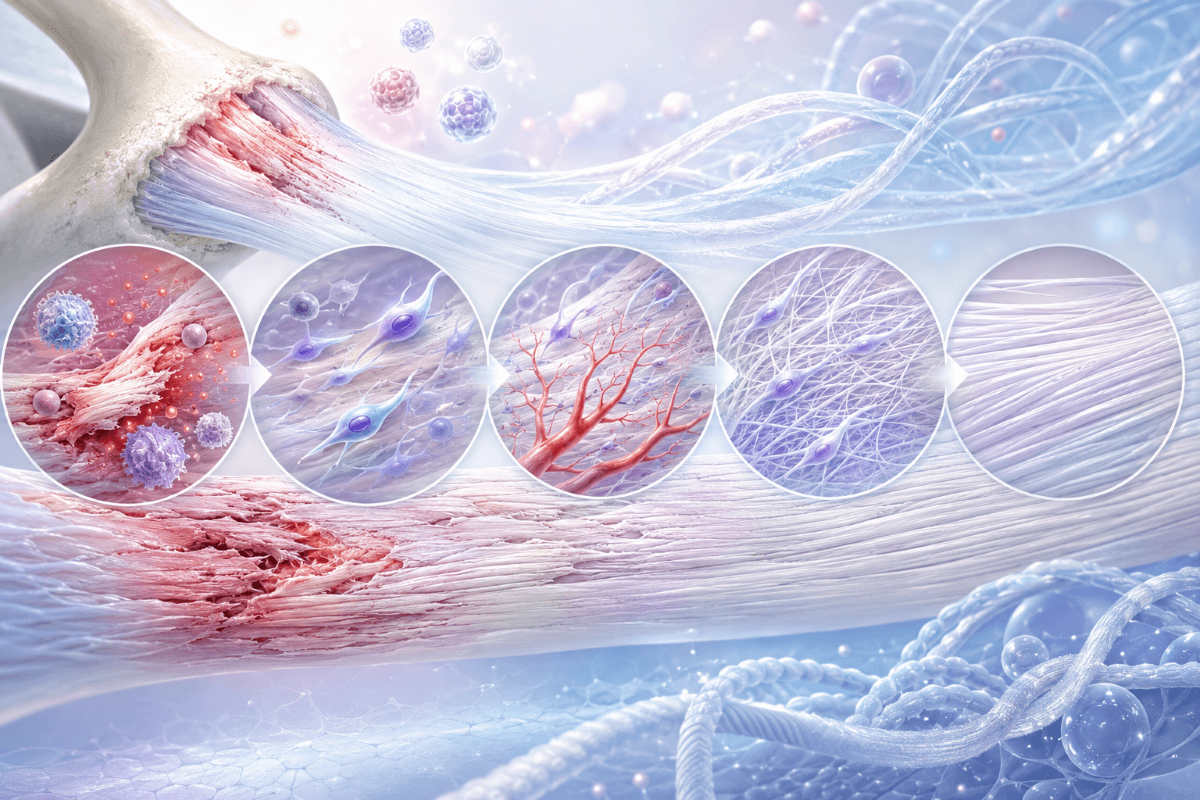
When a tendon, ligament, or another type of connective tissue is damaged, a single “regenerative process” does not begin. Healing proceeds through several interconnected stages.
Inflammatory Phase
Immediately after injury, the inflammatory response is activated. Immune cells migrate into the affected area, and signalling molecules are released to regulate subsequent stages of healing.
Inflammation is therefore not automatically a negative process. It is part of the body's natural biological response to tissue damage.
Proliferation and Cell Migration
Cells required for the formation of new tissue subsequently migrate into the damaged area.
Cell migration is one of the mechanisms studied in relation to Thymosin Beta-4 and TB-500.
Angiogenesis
Regenerating tissue requires a supply of oxygen and nutrients. The formation and remodelling of blood vessels are therefore important.
Angiogenesis is studied in connection with several regenerative peptides, including BPC-157 and Thymosin Beta-4.
Extracellular Matrix Formation
Fibroblasts produce collagen and other components of the extracellular matrix, which form the structural foundation of new tissue.
Remodelling
Newly formed tissue is gradually organised and mechanically adapted to its environment. In tendons and ligaments, the orientation and organisation of collagen fibres are particularly important.
These processes help explain why peptides for regeneration are studied through multiple biological mechanisms rather than according to a single parameter.
Why Does the Type of Tissue Being Studied Matter?
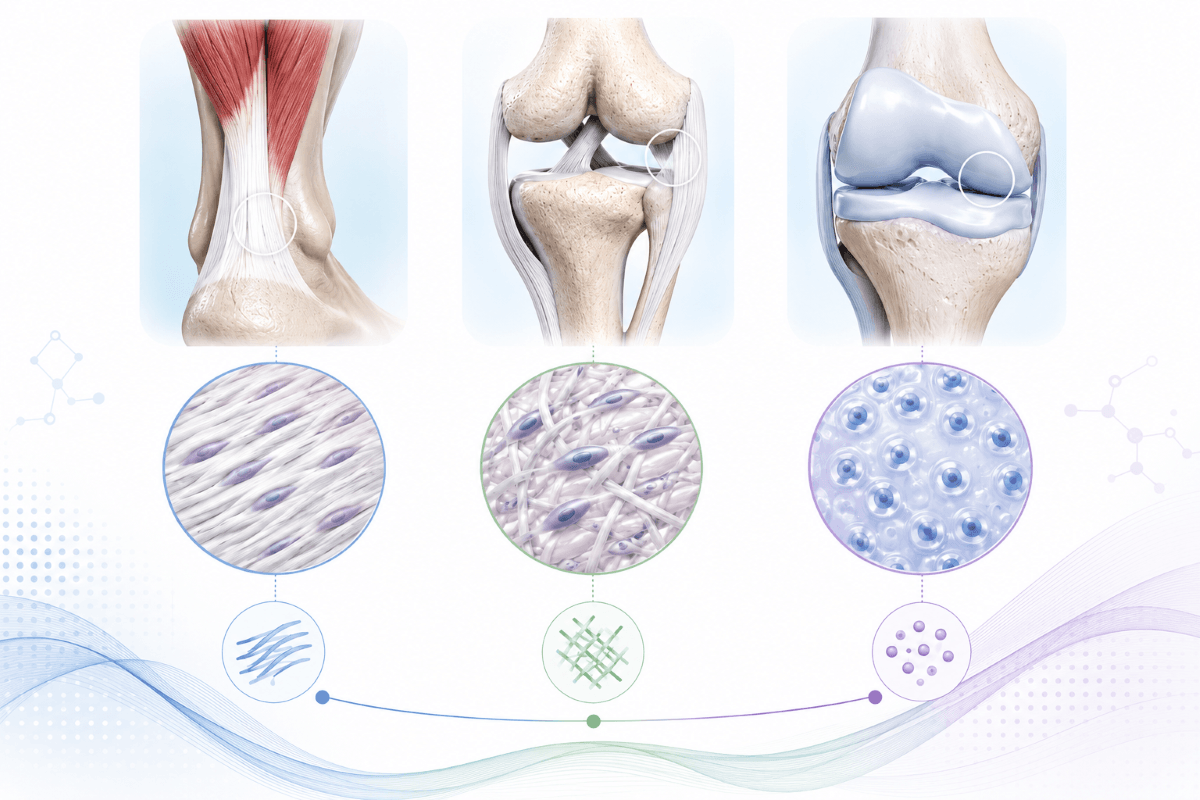
In musculoskeletal regeneration research, tendons, ligaments, and cartilage cannot be evaluated in the same way. Each of these tissues has a different structure, blood supply, and capacity for natural repair.
Tendons transmit force from muscles to bones, and their mechanical properties depend largely on the organisation of collagen fibres. Research may therefore evaluate factors such as tissue strength, collagen organisation, or fibroblast activity.
Ligaments stabilise joints and connect individual bones. Following injury, not only the formation of new tissue is important, but also whether the repaired ligament can maintain the necessary mechanical strength and organisation.
Articular cartilage represents an even more distinct type of tissue. It has a very limited blood supply, and its capacity for spontaneous repair is therefore considerably different from that of soft tissues.
For this reason, a particular peptide may be studied in relation to tendons or ligaments without automatically having the same research profile in cartilage. When evaluating individual peptides, it is therefore important to consider not only the molecule itself but also the specific tissue type in which it has been studied.
Peptides and Their Effects: Why Can They Not All Be Evaluated in the Same Way?
When discussing peptides and their effects, it is always necessary to begin with the specific molecule.
Although BPC-157, KPV, and TB-500 are all peptides, their biological mechanisms are not identical.
Their primary areas of research can be summarised as follows:
| Molecule | Main Areas of Research |
|---|---|
| BPC-157 | tendon and ligament healing, angiogenesis, vascular response, soft-tissue regeneration |
| Thymosin Beta-4 / TB-500 | cell migration, actin, angiogenesis, tissue healing and remodelling |
| KPV | inflammatory signalling, cytokines, immunomodulation, wound healing |
| BPC-157 + TB-500 | combined research into mechanisms of tissue repair |
For this reason, it is not possible to create one universal list of effects that would apply to every peptide.
Quality of Research Peptides: Purity Alone Is Not Enough
When selecting research material, it is not only important which peptide is being studied. The quality of the sample itself may also significantly influence experimental results.
Declared HPLC purity alone does not provide a complete picture of quality.
For research peptides, factors to consider include:
- identity confirmation,
- purity,
- actual peptide content,
- endotoxin levels,
- heavy metals,
- microbial contamination,
- manufacturing standards,
- batch-to-batch consistency,
- batch traceability,
- authenticity of analytical documentation.
At Particle Peptides, quality is therefore not assessed solely according to a declared purity percentage. Products are manufactured on GMP production lines by a global pharmaceutical CDMO, and individual batches undergo independent laboratory testing across multiple parameters, including identity, purity, peptide content, endotoxins, heavy metals, and microbial contamination. Analytical documentation and traceability are also available for specific batches.
Frequently Asked Questions About Peptides for Joints
What Are Peptides for Joints?
Peptides for joints include various peptide molecules studied in connection with processes such as tendon, ligament, and connective-tissue regeneration, inflammatory signalling, angiogenesis, and other mechanisms relevant to the musculoskeletal system. They do not represent a single group of substances with the same mechanism of action.
Which Peptides Are Studied in Connection With Joints?
BPC-157 and Thymosin Beta-4 (TB-500) are among the peptides most frequently studied in connection with healing, regeneration, and connective-tissue repair. KPV is studied primarily for mechanisms associated with inflammatory signalling.
What Is BPC-157?
BPC-157 is a synthetic peptide consisting of 15 amino acids. A substantial part of its research focuses on tendon, ligament, and muscle healing, angiogenesis, and other processes associated with tissue repair. However, most of these data come from preclinical models.
What Is TB-500?
Thymosin Beta-4 (Tβ4), also referred to as TB-500, is a synthetic version of a naturally occurring peptide consisting of 43 amino acids. It is studied primarily in connection with cell migration, angiogenesis, and tissue regeneration.
What Is KPV?
KPV is a tripeptide derived from the C-terminal region of α-MSH. It is studied primarily for anti-inflammatory and immunomodulatory mechanisms, and its research profile therefore differs from that of BPC-157 or TB-500.
Why Is the Combination of BPC-157 + TB-500 Studied?
The BPC-157 + TB-500 combination is of interest because it brings together two molecules studied in connection with different mechanisms of tissue regeneration. Research therefore focuses on their potential interaction in healing, angiogenesis, and the repair of damaged tissues.
Do All Peptides Have the Same Side Effects?
No. The safety profile depends on the specific molecule and the extent of available data. For many research peptides, clinical safety data in humans remain limited.
Conclusion
When considering peptides for joints, it is important to focus primarily on the specific molecule and the biological mechanism being investigated.
BPC-157 is studied primarily in connection with tendon and ligament healing, angiogenesis, and soft-tissue repair. Thymosin Beta-4 and TB-500 are investigated through processes associated with actin, cell migration, and regeneration. KPV represents a different research area focused primarily on inflammatory signalling and immunomodulation.
Although several preclinical studies have produced interesting findings, the level of evidence varies significantly between individual molecules, and extensive clinical data in humans remain insufficient for many of them.
Peptides for joints should therefore not be evaluated according to general claims about regeneration. A more accurate assessment considers the specific molecule, its mechanism of action, the type of experiment, and the quality of the available scientific evidence.
Sources
- Pevec D. et al. Pentadecapeptide BPC 157 improves ligament healing in the rat. Journal of Orthopaedic Research. 2010.
- Sikiric P. et al. BPC 157's effect on healing - experimental studies of angiogenesis, collagen, and tissue healing.
- Emerging Use of BPC-157 in Orthopaedic Sports Medicine: A Systematic Review. 2025.
- Peptide Supplements and Their Therapeutic Applications in Sports Medicine. A systematic review of musculoskeletal research on BPC-157, thymosin beta-4/TB-500, and other peptides. 2026.
- Safety and Efficacy of Approved and Unapproved Peptide Therapies for Musculoskeletal Injuries and Athletic Performance. 2026.
- Effects of BPC-157 and TB-500 on Achilles tendon healing in rats: A histopathological and biomechanical study. 2026.
- Ho E. N. M. et al. Doping control analysis of TB-500, a synthetic version of an active region of thymosin β4. Journal of Chromatography A. 2012.
- Brzoska T. et al. Terminal signal: anti-inflammatory effects of α-MSH related peptides beyond the pharmacophore. Research on KPV and anti-inflammatory mechanisms.
- Particle Peptides Overview - internal scientific documentation of Particle Peptides.
- Particle Peptides - Brand Positioning & Marketing Guidelines (2026).
Research Quality Begins with Peptide Quality
At Particle Peptides, we believe that reliable research begins with reliable materials. That is why our research peptides are manufactured on cGMP-compliant production lines by a global pharmaceutical CDMO, and every batch undergoes independent third-party testing for:
- Purity
- Identity confirmation
- Peptide content
- Endotoxin levels
- Heavy metals (Class I & II)
- Microbial contamination (TAMC & TYMC)
Transparency and independently verified laboratory data form the foundation of high-quality scientific research.
Disclaimer: All Particle Peptides products are intended exclusively for scientific research and laboratory use. They are not intended for human or veterinary use, nor for the diagnosis, treatment, cure, or prevention of any disease.
Related products

BPC-157 + TB-500 Blend 5mg / 5mgwith Mannitol
- In stock

BPC-157 5mgwith Mannitol
- In stock

KPV 5mg
- In stock