
- today
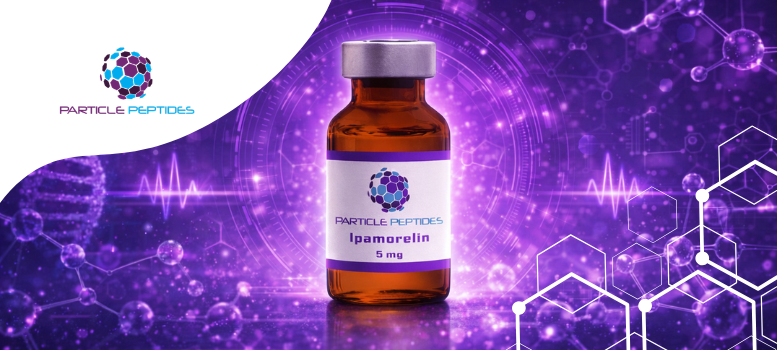
Ipamorelin is a synthetic pentapeptide belonging to the class of growth hormone secretagogues (GHS). It was originally developed as a chemically modified ligand designed to stimulate the release of growth hormone (GH) while exerting minimal influence on other endocrine axes. It is particularly notable for its receptor selectivity, pharmacodynamic profile, and preclinical effects on endocrine systems, distinguishing it from earlier growth hormone–releasing peptides (GHRPs).
Molecular Structure and Receptor Selectivity
Ipamorelin is a pentapeptide with the amino acid sequence Aib-His-D-2-Nal-D-Phe-Lys-NH₂, derived from the original GHRP-1 structure. As an agonist of the growth hormone secretagogue receptor (GHS-R)—the same receptor targeted by ghrelin, often referred to as the ghrelin receptor—it stimulates the release of GH from the anterior pituitary gland.
This receptor belongs to the family of G-protein–coupled receptors (GPCRs), which, upon activation, initiate intracellular signaling cascades that lead to GH secretion.
A key property of Ipamorelin is its selective increase in GH levels without significant stimulation of other hormones, such as cortisol, prolactin, or somatostatin. This differentiates it from earlier molecules (e.g., GHRP-6), which may exert broader endocrine effects.
Endogenous Signaling Effects and Pharmacodynamics
Several preclinical and human models have demonstrated a rapid yet pulsatile increase in GH levels following subcutaneous or intravenous administration of Ipamorelin. Studies conducted in 1998 showed that Ipamorelin stimulates GH secretion in mammals with efficacy comparable to earlier GHRPs but with a reduced effect on cortisol levels.
Pharmacokinetic–pharmacodynamic modeling in healthy volunteers demonstrated that the peptide is rapidly absorbed, producing a measurable increase in GH concentrations shortly after administration without significantly altering levels of other hormones such as cortisol or prolactin.
Hypothalamic and Endocrine Signaling
Beyond stimulating somatotroph cells in the pituitary gland, activation of the GHS-R receptor also influences complex regulatory mechanisms in the hypothalamus. These mechanisms modulate the release of additional signaling peptides, including somatostatin.
Ipamorelin appears to attenuate the inhibitory effects of somatostatin, thereby allowing the natural pulsatile secretion of GH without excessive activation of inhibitory feedback pathways.
Such regulation is crucial for maintaining the physiological pulsatility of GH, characterized by short bursts of hormone release that are essential for metabolic homeostasis and anabolic processes.
Effects in Preclinical Models
Preclinical research has also explored several additional pathways mediated by the GHS receptor:
Metabolic effects:
Ipamorelin has been investigated as a ghrelin receptor agonist in models of gastroparesis, where it significantly accelerated gastric emptying and improved gastrointestinal motility. These effects are thought to occur through activation of cholinergic neurons.
Endocrine functions:
Animal studies have suggested that Ipamorelin may influence insulin secretion through calcium-dependent channels and adrenergic signaling pathways, although its primary target remains GH stimulation.
Skeletal metabolism:
Long-term administration in animal models has been associated with an increase in bone mineral content, suggesting that elevated GH levels may support bone homeostasis and tissue remodeling.
These findings indicate that the peptide’s biological effects are not limited to pituitary GH secretion but may involve broader endocrine and metabolic pathways.
Safety and Limitations of Existing Studies
Although preclinical and early human studies suggest that Ipamorelin stimulates growth hormone selectively and without major adverse effects, its clinical use has not been approved by regulatory authorities for routine medical treatment.
Some discontinued clinical trials (for example in postoperative ileus) failed to demonstrate sufficient efficacy in primary endpoints, although certain biological signaling effects remained measurable and scientifically relevant.
Conclusion
Ipamorelin represents a highly selective growth hormone secretagogue with receptor specificity that enables effective GH stimulation without substantial activation of other endocrine pathways.
Its scientific relevance lies primarily in:
-
precise GH stimulation through GHS-R agonism with minimal influence on cortisol and prolactin levels,
-
its mechanistic value for studying the growth hormone axis and metabolic regulation,
-
preclinical effects on IGF-1 signaling, bone homeostasis, and gastrointestinal function, which provide useful models for further research.
While Ipamorelin remains primarily a research ligand, its well-characterized mechanisms of action and relative selectivity make it a valuable tool in endocrine and pharmacological biology.

Sources
- Raun K. et al. Ipamorelin, the first selective growth hormone secretagogue. Eur J Endocrinol. 1998.
- Johansen PB. et al. Ipamorelin, a new growth-hormone-releasing peptide. PubMed. 1999.
- Gobburu JV. et al. Pharmacokinetic-pharmacodynamic modeling of ipamorelin. PubMed. 1999.
- Adeghate E. et al. Mechanism of ipamorelin-evoked insulin release. PubMed. 2004.
- Greenwood-Van Meerveld B. et al. Efficacy of ipamorelin on gastric dysmotility. PMC. 2012.
- Svensson J. et al. The GH secretagogues ipamorelin and GHRP-6. J Endocrinol. 2000.
- Ipamorelin – Wikipedia (encyclopedic synthesis of peer-reviewed literature).
Research Quality Begins with Peptide Quality
At Particle Peptides, we believe that reliable research begins with reliable materials. That is why our research peptides are manufactured on cGMP-compliant production lines by a global pharmaceutical CDMO, and every batch undergoes independent third-party testing for:
- Purity
- Identity confirmation
- Peptide content
- Endotoxin levels
- Heavy metals (Class I & II)
- Microbial contamination (TAMC & TYMC)
Transparency and independently verified laboratory data form the foundation of high-quality scientific research.
Disclaimer: All Particle Peptides products are intended exclusively for scientific research and laboratory use. They are not intended for human or veterinary use, nor for the diagnosis, treatment, cure, or prevention of any disease.
Related products

Ipamorelin 5mg
- In stock