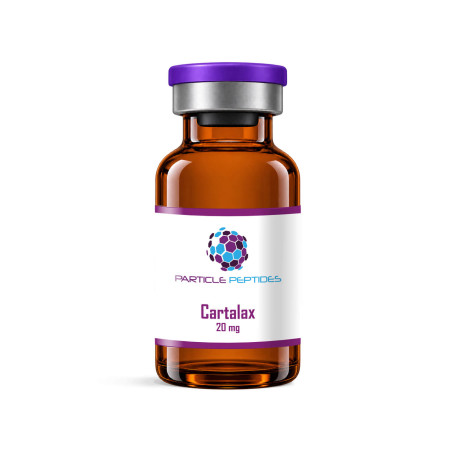
Cartalax (Ala-Glu-Asp, AED) is a synthetic tripeptide and peptide bioregulator, investigated primarily for its potential role in the biology of cartilage and connective tissue. Preclinical research focuses on its impact on cellular processes related to tissue maintenance and regeneration, as well as age-related changes, including the regulation of gene expression in mesenchymal stem cells. Studies have noted effects on molecular pathways involving NF-κB, IGF-1, and TNKS2, which are associated with cell proliferation, differentiation, inflammation, and tissue homeostasis. These findings have sparked interest in Cartalax as a research agent for studying cartilage metabolism, connective tissue function, and regenerative processes. However, available evidence remains predominantly preclinical; there is currently a lack of high-quality, controlled clinical trials in humans to confirm its efficacy and safety. The formulation contains 20 mg of Cartalax with mannitol as an excipient.
These vials are sealed under vacuum to help protect the peptide. The negative pressure may pull liquid into the vial automatically or make withdrawal more difficult.
What to do: If necessary, use a sterile syringe to introduce a small amount of air into the vial to gradually equalize the pressure.
The product is intended for scientific research and development purposes only. Chemical substances shall not be used as a drug, medicine, active substance, medical aid, cosmetic product, a substance for production of a cosmetic product neither for human consumption that is any food or food supplement or otherwise similarly used on humans or animals. Intended only for in-vitro research, such as Receptor-ligand binding studies, Enzyme activity assays, Cell proliferation assays, Cell signaling assays, Epitope mapping, ect.
Peptides in lyophilized form are supplied in glass vials by standard shipping methods and do not require refrigeration. Short-term temperature fluctuations during transport will not reduce their quality and efficacy. Even at high summer temperatures, the peptides in lyophilized form are stable for several weeks.
Lyophilized peptides should be stored in a dry place, protected from light and moisture. The following storage conditions are generally recommended:
Before use, allow the vial to reach room temperature after taking it out of the refrigerator or freezer.
Once reconstituted, peptide solutions are generally less stable than their lyophilized form and should be stored under refrigerated conditions whenever possible.
The following storage conditions are generally recommended:
To preserve peptide integrity, avoid repeated freeze–thaw cycles, as these may accelerate peptide degradation.
Important: Most manufacturers recommend using reconstituted peptides within 4 weeks when stored at 2–8 °C. This recommendation is intentionally conservative and may not reflect the actual chemical stability of every peptide. In our own stability studies, Ipamorelin reconstituted in 0.9 percent sodium chloride showed no detectable degradation after 12 weeks of refrigerated storage. As peptide stability is highly sequence- and formulation-dependent, this result should not be extrapolated to other peptides without supporting stability data.
Cartalax (Ala-Glu-Asp, AED) is a synthetic tripeptide belonging to the group of short peptide bioregulators investigated primarily in relation to cartilage biology, connective tissue, and cellular aging. Experimental research has focused on its potential influence on chondrocytes and mesenchymal stem cells, particularly on molecular processes involved in chondrogenesis, cellular proliferation, differentiation, and age-associated changes in cartilage tissue.
In cellular research models, AED has been observed to influence the expression and synthesis of several proteins involved in cartilage formation and maintenance, including SOX9, aggrecan, type II collagen, and cartilage oligomeric matrix protein (COMP). Additional studies have investigated its effects on molecular markers associated with cellular senescence and the senescence-associated secretory phenotype (SASP), suggesting that Cartalax may represent an interesting research compound for studying age-related changes in cartilage and connective tissue. However, the available evidence remains predominantly preclinical, and further independent research is required to establish the biological relevance of these findings.
[1]–[3]
One of the principal areas of Cartalax research concerns chondrogenesis—the process by which mesenchymal stem cells differentiate toward cartilage-producing chondrocytes. This process is regulated by several transcription factors and extracellular matrix proteins, including SOX9, aggrecan, type II collagen, and COMP, which are widely used as molecular markers of chondrogenic differentiation.
In a study using human mesenchymal stem cells undergoing replicative aging, the AED peptide was investigated for its influence on gene expression and protein synthesis of these chondrogenic markers. At a concentration of 200 ng/ml, AED increased the expression and synthesis of SOX9, aggrecan, type II collagen, and COMP in the experimental cell model. These proteins are involved in chondrocyte differentiation and formation of the cartilage extracellular matrix, making their regulation an important subject of cartilage biology research.
These observations suggest that AED may influence molecular pathways associated with chondrogenic differentiation in aging mesenchymal stem cells. The findings provide a basis for further investigation of Cartalax in experimental models of cartilage aging and osteoarthritis, although they do not establish a therapeutic effect in humans.
[1]
Cellular senescence is an important area of cartilage research because aging chondrocytes can develop a senescence-associated secretory phenotype (SASP). This phenotype is characterized by alterations in proteins associated with cell-cycle regulation, apoptosis, and inflammatory signaling and may contribute to age-related changes in cartilage tissue.
Experimental research examining AED in aging chondrocytes reported changes in several SASP-associated markers. Senescent chondrocytes demonstrated increased synthesis of p16, p21, and p53, as well as the pro-inflammatory cytokines TNF-α and IL-1α, together with reduced Sirt1 synthesis. Exposure to AED was associated with normalization of the synthesis of molecules involved in this senescence-associated phenotype.
These findings have generated interest in AED as an experimental compound for investigating mechanisms of cartilage aging and cellular senescence. Nevertheless, the results originate from cellular research models and require further confirmation in independent preclinical and clinical studies.
[2]
The biological activity of short peptides such as AED has also been investigated in the broader context of gene regulation and cellular aging. Research using human bone marrow mesenchymal stem cells evaluated the effects of AED and other short peptides on genes involved in cellular growth, differentiation, metabolism, inflammatory signaling, and aging-related processes.
In these experimental models, AED was associated with modulation of genes including IGF1, TNKS2, and NF-κB. IGF1 participates in cellular growth and differentiation pathways, while TNKS2 is involved in processes including Wnt signaling, telomere regulation, metabolism, and cell-cycle control. NF-κB represents an important transcriptional regulator involved in cellular stress and inflammatory signaling. The observed modulation of these pathways suggests that AED may influence several molecular processes relevant to the biology of aging cells.
Taken together, current experimental findings position Cartalax as a research peptide of interest for studying chondrogenesis, cartilage aging, cellular senescence, and gene-regulatory mechanisms. However, published evidence remains largely limited to cellular and preclinical research, and robust controlled human clinical studies are required before any conclusions regarding clinical efficacy or safety can be established.
[3], [4]
Cartalax (Ala-Glu-Asp, AED) is a synthetic tripeptide and peptide bioregulator, investigated primarily for its potential role in the biology of cartilage and connective tissue. Preclinical research focuses on its impact on cellular processes related to tissue maintenance and regeneration, as well as age-related changes, including the regulation of gene expression in mesenchymal stem cells. Studies have noted effects on molecular pathways involving NF-κB, IGF-1, and TNKS2, which are associated with cell proliferation, differentiation, inflammation, and tissue homeostasis. These findings have sparked interest in Cartalax as a research agent for studying cartilage metabolism, connective tissue function, and regenerative processes. However, available evidence remains predominantly preclinical; there is currently a lack of high-quality, controlled clinical trials in humans to confirm its efficacy and safety. The formulation contains 20 mg of Cartalax with mannitol as an excipient.
Click a star to leave your review.