
- today

Peptides for hair represent a group of peptide molecules studied in connection with the hair follicle, cell migration, angiogenesis, dermal fibroblast activity, and other processes that may influence the scalp environment. Among the most interesting molecules in this field are GHK-Cu and Thymosin Beta-4 (TB-500). Research on these peptides focuses on different mechanisms - from the extracellular matrix and the formation of new blood vessels to the activity of hair follicle cells.
However, it is important to distinguish between mechanisms observed in cell cultures or animal models and confirmed clinical effects in humans. Research on peptides in relation to hair is still developing, and the level of evidence varies significantly between individual molecules.
If you would first like to familiarize yourself with the basics, you can learn more about what peptides are, how they work, and why they are the subject of scientific research in our article: Peptides - What They Are, How They Work, and Why They Are The Subject of Scientific Research.
How are peptides related to hair and the hair follicle?
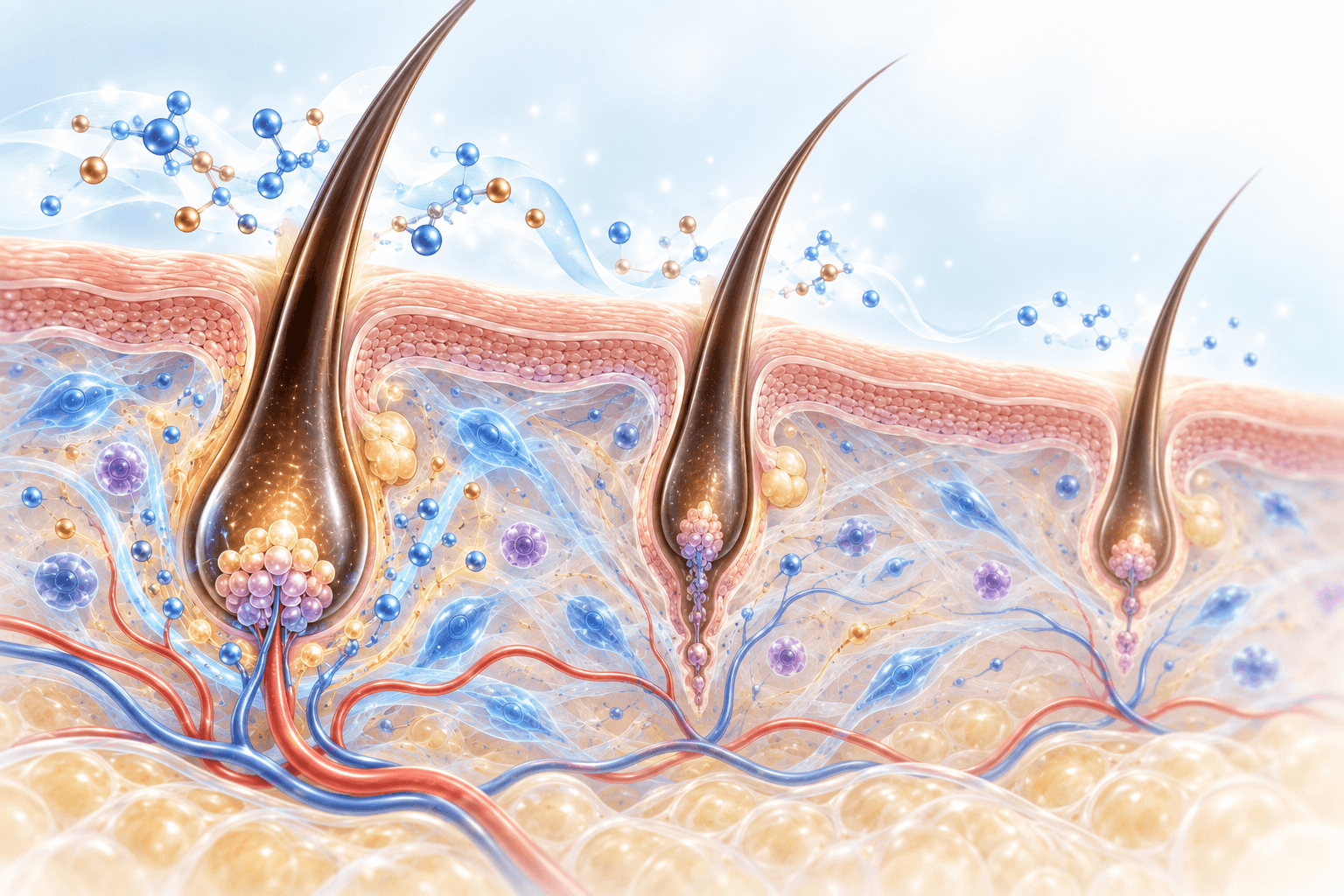
Hair is not merely a lifeless keratin structure growing out of the skin. Beneath the surface lies a complex hair follicle that functions as a small biological organ composed of several different cell types.
Important roles are played by dermal papilla cells, keratinocytes, follicular stem cells, fibroblasts, and the surrounding blood vessels.
Research on peptides for hair may therefore focus on areas such as:
-
the hair cycle,
-
dermal papilla cell activity,
-
cell migration and differentiation,
-
hair follicle stem cell activity,
-
angiogenesis and microcirculation around the follicle,
-
VEGF and other growth factors,
-
the extracellular matrix,
-
fibroblast activity,
-
skin tissue remodeling,
-
inflammatory signaling.
Together, these processes create the biological environment in which the hair follicle progresses through the different phases of its life cycle.
How does the hair growth cycle work?
The hair follicle does not produce hair continuously. Throughout life, it repeatedly passes through several phases.
Anagen - the growth phase
Anagen is the active growth phase. Hair follicle cells divide intensively and the hair shaft becomes longer.
Mechanisms associated with follicular cell activation, angiogenesis, and growth-related signaling pathways are an important part of research into certain peptides.
Catagen - the transition phase
During catagen, hair follicle activity gradually decreases and the lower part of the follicle undergoes regression.
Telogen - the resting phase
During the telogen phase, the follicle remains relatively inactive for a period of time. It may later re-enter the anagen phase and begin a new growth cycle.
The regulation of transitions between these phases is one of the areas studied in relation to molecules associated with hair follicle growth and development.
Which peptides for hair are being studied?
Among the molecules for which there is research relevant to the hair follicle are GHK-Cu and Thymosin Beta-4 (TB-500).
However, these peptides should not be regarded as two molecules with the same mechanism of action.
GHK-Cu is studied mainly in connection with:
-
fibroblast activity,
-
the extracellular matrix,
-
collagen synthesis,
-
VEGF,
-
angiogenesis,
-
skin and tissue remodeling.
Thymosin Beta-4 (TB-500) is studied mainly in connection with:
-
cell migration,
-
the actin cytoskeleton,
-
hair follicle stem cells,
-
angiogenesis,
-
VEGF,
-
hair follicle development and the hair growth cycle.
It is precisely the difference between these mechanisms that makes both molecules interesting subjects of research.
GHK-Cu: a copper peptide in skin and hair follicle research
GHK-Cu, also referred to as Copper Peptide, is a complex of the naturally occurring tripeptide glycyl-L-histidyl-L-lysine with copper.
GHK was originally identified in human plasma, and its biological activity has been studied for many years, particularly in connection with skin regeneration, tissue healing, fibroblast activity, and extracellular matrix remodeling.
Research indicates that GHK-Cu may influence processes associated with:
-
collagen production,
-
elastin,
-
glycosaminoglycans,
-
fibroblast activity,
-
VEGF,
-
angiogenesis,
-
extracellular matrix remodeling,
-
keratinocyte proliferation.
These mechanisms are also of interest when studying the biological environment of the hair follicle.
Review literature has linked GHK-Cu not only with skin remodeling, but also with hair follicle enlargement, angiogenesis, and processes that may be relevant to the biological conditions involved in hair growth.
GHK-Cu and the dermal papilla: why is it important?
The dermal papilla is located at the base of the hair follicle. Its cells are among the key regulatory elements of the hair cycle and communicate with other follicular cells through a wide range of signaling molecules.
Copper tripeptides have been studied for their potential ability to influence dermal papilla cell proliferation and the growth of isolated human hair follicles.
One experimental study, for example, investigated the copper tripeptide AHK-Cu. In an ex vivo model of human hair follicles, stimulation of hair follicle elongation was observed, while increased proliferation of dermal papilla cells was observed in cell cultures. However, this study investigated AHK-Cu rather than GHK-Cu directly, so the findings cannot automatically be considered evidence of the same effect for every form of copper peptide.
With GHK and GHK-Cu themselves, scientific interest is focused mainly on broader mechanisms involving skin regeneration, VEGF, angiogenesis, and the extracellular matrix.
GHK-Cu, VEGF, and angiogenesis
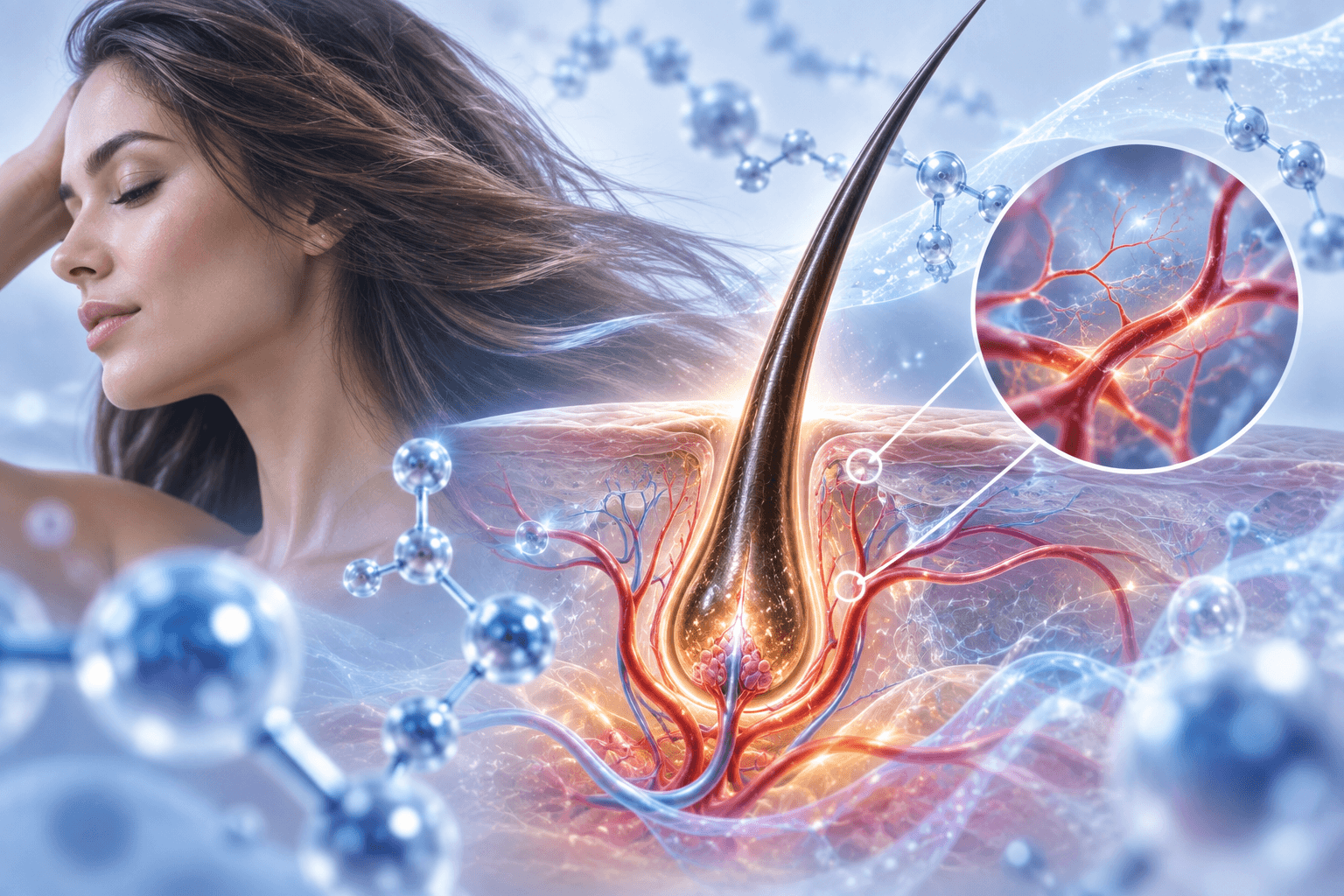
A growing hair follicle is a metabolically active structure, and its surroundings contain a dense microvascular network. One of the signaling molecules important for blood vessel formation is VEGF - vascular endothelial growth factor.
GHK-Cu has been studied in connection with increased VEGF production in dermal fibroblasts and the promotion of angiogenesis. At the same time, it has been associated with extracellular matrix remodeling, collagen production, and other processes relevant to skin structure.
This is one of the reasons why GHK-Cu appears in scientific literature concerning peptides for hair and the biological environment of the hair follicle. However, this does not automatically mean that GHK-Cu represents a clinically confirmed treatment for hair loss.
Thymosin Beta-4 (TB-500): cell migration and the hair follicle
Thymosin Beta-4 (Tβ4), also referred to as TB-500, is a synthetic version of a naturally occurring peptide consisting of 43 amino acids. Its biological activity is closely associated with actin, one of the fundamental components of the cellular cytoskeleton.
Actin influences the ability of cells to:
-
change shape,
-
migrate,
-
organize the cytoskeleton,
-
divide,
-
differentiate,
-
respond to tissue damage.
Cell migration is one of the mechanisms that connects Thymosin Beta-4 (TB-500) with hair follicle research.
Thymosin Beta-4 (TB-500) and hair follicles: what has research shown?
Thymosin Beta-4 has been the subject of several studies focused on hair follicles. Research has investigated its relationship with the migration and differentiation of hair follicle stem cells, extracellular matrix remodeling, VEGF, and regulation of the hair cycle.
Other studies have also examined the Wnt/β-catenin/Lef-1 signaling pathways, VEGF, and MMP-2, which are associated with hair follicle development and activity.
These findings make Thymosin Beta-4 (TB-500) an interesting molecule in the study of biological processes associated with hair follicle growth and regeneration.
Thymosin Beta-4 (TB-500), stem cells, and the hair cycle
One area of research involves the relationship between Thymosin Beta-4 (TB-500) and cells located in the so-called bulge region of the hair follicle. This part of the follicle contains a population of stem cells that contribute to its repeated regeneration.
Research focuses mainly on:
-
stem cell migration,
-
cell differentiation,
-
transition of the hair follicle into the active growth phase,
-
the extracellular matrix,
-
angiogenesis around the follicle.
These mechanisms help provide a better understanding of the role of Thymosin Beta-4 (TB-500) in biological processes associated with the hair follicle and its growth cycle.
GHK-Cu vs. TB-500: which mechanisms are being studied?
Both molecules are associated with tissue regeneration, but their research profiles are not identical.
|
Molecule |
Areas of research relevant to the hair follicle |
|
GHK-Cu |
fibroblasts, VEGF, angiogenesis, collagen, extracellular matrix, skin remodeling |
|
Thymosin Beta-4 (TB-500) |
follicular stem cells, cell migration, actin, VEGF, angiogenesis, hair cycle |
|
Both molecules |
tissue regeneration, cellular environment, angiogenesis, and remodeling |
From a research perspective, it is therefore not appropriate to speak of one universal mechanism through which all peptides for hair would work. Each molecule influences different biological processes and has a different level of scientific evidence.
If you are interested in the shared research context of both molecules beyond the hair follicle, you can read more about their investigation in relation to skin regeneration and tissue remodeling in our article: GHK-Cu + Thymosin Beta-4 (TB-500): A Research Combination for the Study of Skin Regeneration and Tissue Remodeling.
Why is angiogenesis important for hair?
During the active anagen phase, the hair follicle becomes highly metabolically active. The vascular network surrounding the growing follicle therefore changes as well. VEGF is one of the main molecules regulating the formation and function of blood vessels.
VEGF represents one of the shared research points between GHK-Cu and Thymosin Beta-4.
With GHK-Cu, research investigates its influence on VEGF production and dermal fibroblast activity. With Tβ4, experiments have suggested a connection between its expression, VEGF, angiogenesis, and hair follicle development.
However, this still represents mechanistic research - not evidence that influencing VEGF with a particular peptide will automatically resolve a specific type of hair loss in humans.
Peptides for hair and alopecia: why is it important to distinguish the cause?
The term “hair loss” includes several biologically distinct conditions.
These include, for example:
-
androgenetic alopecia,
-
alopecia areata,
-
telogen effluvium,
-
scarring forms of alopecia,
-
hair loss associated with disease or nutrient deficiencies,
-
changes in the hair cycle caused by medications or hormonal factors.
Each of these conditions has a different biological background and may involve different mechanisms within the hair follicle. Therefore, when evaluating research, it is important to consider not only the peptide itself, but also the type of model, cells, or hair-related condition investigated in a particular study.
Research into peptides for hair often focuses on processes such as dermal papilla cell activity, angiogenesis, cell migration, or regulation of the hair cycle. These mechanisms help researchers better understand how the hair follicle functions, but their significance may differ between individual forms of alopecia.

What do the clinical data say?
When evaluating research, it is important to distinguish between laboratory, preclinical, and clinical data. Each type of study provides a different level of information about the mechanism of action, biological activity, and potential use of the molecule being investigated.
Laboratory research
At this stage, researchers examine how a specific molecule influences cells, hair follicles, or selected biological processes. Such studies help clarify mechanisms such as cell migration, dermal papilla activity, angiogenesis, or signaling pathways associated with the hair cycle.
Preclinical research
Preclinical studies make it possible to observe the effects of a peptide in a more complex biological environment and to gain a better understanding of its potential mechanisms and regenerative potential.
Clinical research
Clinical studies evaluate the effects and safety of a specific intervention in humans. For both GHK-Cu and Thymosin Beta-4, there are interesting data on mechanisms relevant to the hair follicle, although the extent of clinical data differs between individual molecules and research in this field is ongoing.
Frequently asked questions about peptides for hair
What are peptides for hair?
“Peptides for hair” is an informal term for peptide molecules studied in connection with the hair follicle, skin tissue, cell migration, angiogenesis, the extracellular matrix, and other mechanisms that may be relevant to the hair growth cycle. They do not represent a single uniform group with one shared mechanism of action.
Which peptides are studied in relation to hair?
Interesting molecules include GHK-Cu and Thymosin Beta-4. GHK-Cu is studied mainly in connection with fibroblasts, the extracellular matrix, VEGF, and angiogenesis. Research on Thymosin Beta-4 has also focused directly on hair follicles, follicular stem cells, and the hair cycle.
What is GHK-Cu?
GHK-Cu is a complex of the tripeptide glycyl-L-histidyl-L-lysine with copper. It is studied mainly in connection with skin regeneration, fibroblast activity, synthesis of extracellular matrix components, angiogenesis, and other processes associated with tissue remodeling.
Is GHK-Cu related to hair follicles?
Research on GHK-Cu and other copper tripeptides includes mechanisms relevant to hair follicles, such as VEGF, angiogenesis, the dermal papilla, and the extracellular matrix. However, the level of evidence varies depending on the specific molecule and experimental model.
What is TB-500?
Thymosin Beta-4 (Tβ4), also referred to as TB-500, is a synthetic version of a naturally occurring peptide consisting of 43 amino acids. It is studied mainly in connection with actin, cell migration, angiogenesis, tissue regeneration, and processes associated with the hair follicle.
Has Thymosin Beta-4 (TB-500) been studied directly in relation to hair?
Yes. Research on Thymosin Beta-4 has also examined processes associated with the hair follicle, including cell migration, cell differentiation, VEGF, and regulation of the hair cycle. These findings help provide a better understanding of its potential activity within the hair follicle environment, while research in this area continues.
Are peptides for hair a clinically confirmed treatment for hair loss?
It is not appropriate to generalize in this way. The level of evidence depends on the specific molecule, the type of alopecia, and the way in which it has been studied. For many research peptides, a significant proportion of the available data comes from cellular and animal models, while extensive clinical data in humans remain limited.
Conclusion
When discussing peptides for hair, the most important approach is to look at the specific molecule and the biological mechanism being investigated.
GHK-Cu belongs to a group of copper peptides studied in connection with fibroblasts, VEGF, angiogenesis, collagen, and extracellular matrix remodeling. These processes may also be relevant to the biological environment of the hair follicle.
Thymosin Beta-4 (TB-500) has a different research profile. Its biological activity is associated with actin, cell migration, and angiogenesis, while experimental studies have also investigated its role in hair follicle stem cells, VEGF, and the hair cycle.
However, when evaluating peptides for hair, it is not sufficient to rely only on general claims about hair growth. It is important to distinguish between a cellular experiment, an animal model, and clinical research in humans.
The specific molecule, its mechanism of action, the type of experiment, and the quality of the scientific evidence provide the most accurate perspective on what current research on GHK-Cu and Thymosin Beta-4 actually shows about hair follicles.
Sources:
-
Philp D. et al. Thymosin beta4 increases hair growth by activation of hair follicle stem cells.
-
Philp D. et al. Thymosin beta 4 induces hair growth via stem cell migration and differentiation.
-
Dai X. et al. Thymosin Beta-4 Induces Mouse Hair Growth.
-
Role of thymosin beta 4 in hair growth.
-
Multiple potential roles of thymosin β4 in the growth and development of hair follicles.
-
Pickart L., Margolina A. The human tri-peptide GHK and tissue remodeling.
-
Pickart L. et al. GHK Peptide as a Natural Modulator of Multiple Cellular Pathways in Skin Regeneration.
-
Pyo H.K. et al. The effect of tripeptide-copper complex on human hair growth in vitro.
-
Morgan B.A. The dermal papilla and hair follicle regeneration.
-
The Regenerative Potential of GHK-Cu in Aesthetic Medicine.
Research Quality Begins with Peptide Quality
At Particle Peptides, we believe that reliable research begins with reliable materials. That is why our research peptides are manufactured on cGMP-compliant production lines by a global pharmaceutical CDMO, and every batch undergoes independent third-party testing for:
- Purity
- Identity confirmation
- Peptide content
- Endotoxin levels
- Heavy metals (Class I & II)
- Microbial contamination (TAMC & TYMC)
Transparency and independently verified laboratory data form the foundation of high-quality scientific research.
Disclaimer: All Particle Peptides products are intended exclusively for scientific research and laboratory use. They are not intended for human or veterinary use, nor for the diagnosis, treatment, cure, or prevention of any disease.
Related products

GHK-Cu 50mg
- In stock
Thymosin Beta-4 (TB-500) 10mgwith Mannitol
- In stock