
- today

Hexarelin, also known as Examorelin, is a synthetic peptide consisting of six amino acid residues. It belongs to the group of growth hormone secretagogues (GHS), which are capable of activating the GHS-R1a receptor and stimulating the release of growth hormone (GH).
Hexarelin’s ability to induce GH release has also been observed in human studies. However, other areas of research - such as cardioprotection, lipid metabolism, or skeletal muscle protection - are based predominantly on cellular and animal models.
It is therefore important to distinguish between a demonstrated biological mechanism and potential therapeutic effects that have not yet been sufficiently confirmed in clinical studies.
What Is Hexarelin?
Hexarelin is a synthetic hexapeptide, meaning a short molecule composed of six amino acid residues.
Its sequence is:
His-D-2-methyl-Trp-Ala-Trp-D-Phe-Lys-NH₂
It belongs to a group of compounds known as growth hormone secretagogues (GHS).
These compounds were developed and investigated for their ability to stimulate the release of growth hormone from the pituitary gland.
Research into Hexarelin began to expand more intensively during the 1990s. Early studies in healthy volunteers already demonstrated that it could induce a pronounced and dose-dependent growth hormone response.
Over time, however, it became apparent that Hexarelin was scientifically interesting for another reason as well.
Some of its experimental effects cannot be explained solely by increases in GH concentrations.
Research therefore expanded to include:
-
the cardiovascular system,
-
cardiomyocyte protection,
-
cardiac tissue remodeling,
-
glucose and lipid metabolism,
-
mitochondrial function,
-
skeletal muscle.
How Does Hexarelin Work?
One of the most important mechanisms of Hexarelin is the activation of the growth hormone secretagogue receptor type 1a - GHS-R1a.
This is the same receptor system through which the naturally occurring hormone ghrelin exerts its effects.
GHS-R1a is found, among other locations, in the hypothalamus and pituitary gland, where it participates in the regulation of growth hormone release.
When Hexarelin activates this receptor system, GH secretion may increase.
Is Hexarelin the Same as Ghrelin? No.
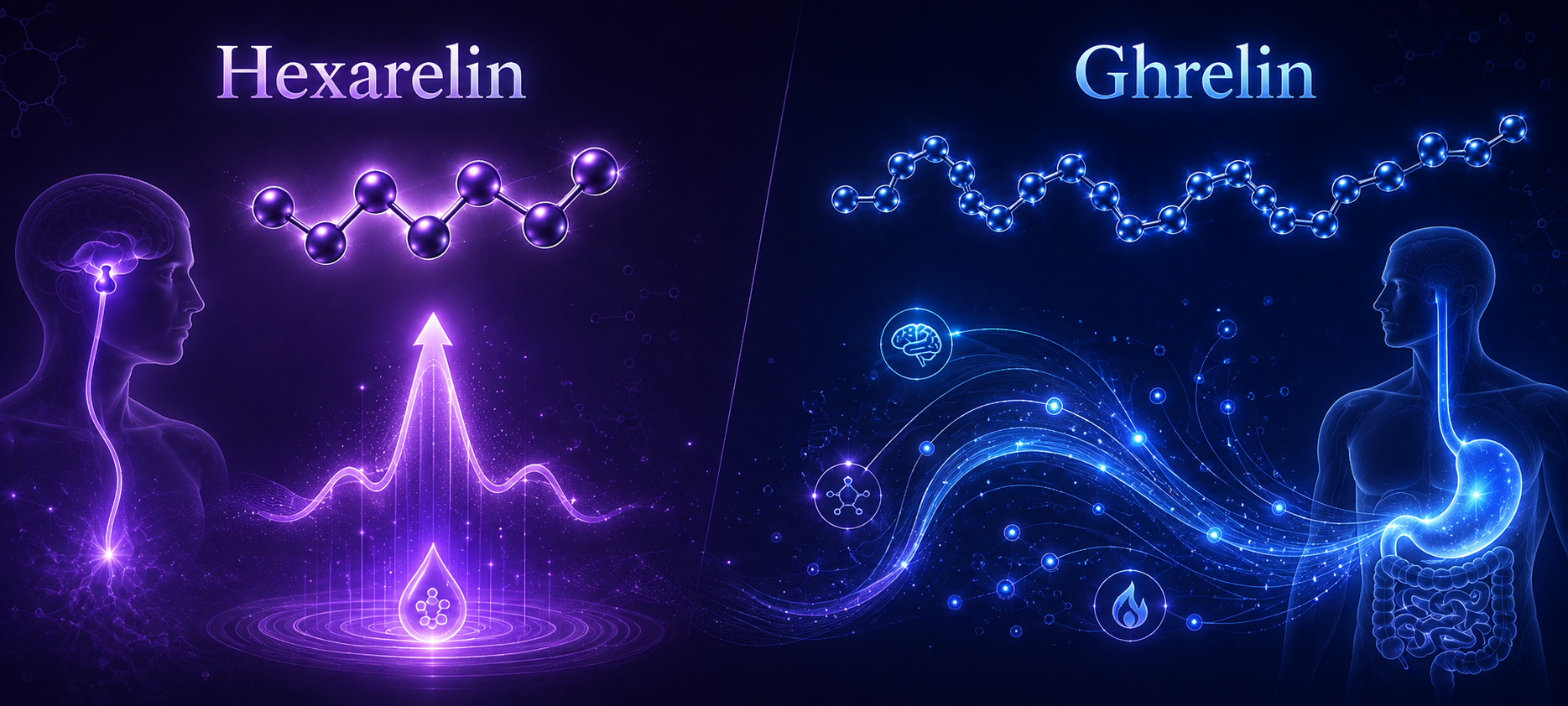
Ghrelin is a naturally produced hormone consisting of 28 amino acids, whereas Hexarelin is a synthetic peptide composed of six amino acid residues.
Their main common feature is their interaction with the GHS-R1a receptor system.
It would therefore be inaccurate to simply describe Hexarelin as “synthetic ghrelin.”
A more scientifically precise description is:
a synthetic growth hormone secretagogue acting through the ghrelin receptor system.
Hexarelin and Growth Hormone: What Have Human Studies Shown?
The ability to stimulate growth hormone release is among the best-documented biological effects of Hexarelin in humans.
One early double-blind, placebo-controlled study involved 12 healthy men.
The results showed that intravenous administration of Hexarelin induced a dose-dependent increase in growth hormone levels.
Similar findings were reported in other studies.
Research has also shown that its endocrine effects may not be entirely selective for GH alone.
Some human studies also observed changes in:
-
prolactin,
-
ACTH,
-
cortisol.
This is important when interpreting the effects of Hexarelin.
It is not merely a simple “switch” for growth hormone secretion. Its effects on the neuroendocrine system are more complex.
Why Are Scientists Interested in Hexarelin and the Heart?
Cardiovascular research is one of the most interesting areas of Hexarelin investigation.
This interest stems from observations suggesting that some experimental cardiac effects may not be mediated solely by growth hormone.
Researchers therefore began investigating the possibility of direct effects of Hexarelin on cardiac tissue.
In addition to GHS-R1a, the CD36 receptor is also discussed in this area of research. CD36 is found in various tissues, including those of the cardiovascular system.
Research into Ischemia-Reperfusion Injury of the Heart
When blood supply to part of the heart is temporarily interrupted, the tissue suffers from a lack of oxygen. This condition is known as ischemia.
When blood flow is subsequently restored, additional cellular damage may paradoxically occur. This process is referred to as ischemia-reperfusion injury.
Animal experimental models have suggested that Hexarelin may influence the response of cardiac tissue to this type of injury.
Researchers have examined parameters such as:
-
cardiomyocyte survival,
-
oxidative stress,
-
cardiac function,
-
cellular damage,
-
mechanisms of apoptosis.
Some studies suggest that part of these effects may be related to activation of GHS-R1a and CD36.
Importantly, however: these findings are derived predominantly from experimental models. They cannot automatically be interpreted as evidence that Hexarelin is an established treatment for ischemic heart disease in humans.
What Have Experimental Models of Myocardial Infarction Shown?
Hexarelin has also been investigated in models of experimentally induced myocardial infarction.
In a study involving rats, the following parameters were monitored after myocardial infarction:
-
stroke volume,
-
cardiac output,
-
peripheral vascular resistance,
-
left ventricular function.
The results showed improvements in some of the monitored parameters in animals exposed to Hexarelin.
Other experimental studies in mice also investigated:
-
the extent of injury,
-
left ventricular remodeling,
-
cardiomyocyte apoptosis,
-
fibrosis,
-
cardiac function following myocardial infarction.
These findings are among the reasons why Hexarelin continues to be investigated in cardioprotective research.
However, these data remain predominantly preclinical.
Hexarelin, Fibrosis, and Cardiac Remodeling
Following cardiac injury or prolonged high blood pressure, the structure of the heart may gradually change.
This process is known as myocardial remodeling.
Remodeling may involve fibrosis - excessive deposition of collagen and other components of the extracellular matrix.
In a study involving spontaneously hypertensive rats, chronic Hexarelin administration was associated with changes in interstitial and perivascular collagen deposition.
Researchers also observed changes in the expression of type I and type III collagen.
Other animal models of heart failure have investigated its effects on:
-
myocardial remodeling,
-
oxidative stress,
-
left ventricular function,
-
fibrosis.
The findings support further investigation of Hexarelin in cardiovascular biology, but they do not currently constitute evidence of a therapeutic effect in humans.
Are There Cardiovascular Studies in Humans?
Yes. However, the amount of human data is considerably smaller than the body of preclinical research.
Smaller studies have investigated the acute effects of Hexarelin on parameters of left ventricular function.
In one study, administration of Hexarelin was followed by a short-term increase in ejection fraction without a significant change in heart rate or blood pressure.
Hexarelin has also been studied in patients with:
-
dilated cardiomyopathy,
-
coronary artery disease.
These studies are scientifically interesting, but their small sample sizes and short-term nature do not allow Hexarelin to be regarded as a clinically established therapy for cardiovascular diseases.
Hexarelin and Fat Metabolism
Another area under investigation is the relationship between Hexarelin and lipid metabolism.
One frequently cited study used a genetic model of non-obese, insulin-resistant MKR mice.
During the experiment, Hexarelin administration was associated with:
-
improved glucose tolerance,
-
improved insulin tolerance,
-
reduced plasma triglycerides,
-
reduced hepatic triglycerides.
Researchers also examined changes in white adipose tissue metabolism and adipocyte differentiation.
The findings suggested that Hexarelin may influence how adipose tissue processes lipids under experimental conditions.
However, these results were obtained from a specific model of insulin-resistant mice.
It would therefore not be scientifically appropriate to extrapolate these findings directly to humans or to claim that Hexarelin has been proven to reduce body fat in humans.
Hexarelin and Insulin Resistance
The same experimental model also produced interesting findings regarding insulin resistance.
Following Hexarelin treatment, MKR mice demonstrated improved glucose and insulin tolerance.
This research raised the question of whether receptor mechanisms influenced by Hexarelin may also be involved in the regulation of glucose and lipid metabolism.
Further studies are required, however, to determine the relevance of these mechanisms in humans.
Hexarelin and Skeletal Muscle
Another interesting area of research is the protection of skeletal muscle in experimental cachexia.
Cachexia is a complex metabolic condition associated with substantial loss of body mass, particularly muscle mass. It occurs in certain severe chronic diseases and may also be associated with anticancer treatment.
In experimental rat models, researchers investigated muscle damage induced by cisplatin.
Particular attention was given to mitochondria.
Mitochondrial Function in Muscle Cells
Mitochondria are cellular structures responsible for a large proportion of energy production.
When muscle tissue is damaged, disturbances may occur in:
-
mitochondrial biogenesis,
-
mitochondrial dynamics,
-
redox balance,
-
cellular energy metabolism.
In a rat model of cisplatin-induced cachexia, Hexarelin together with another growth hormone secretagogue was associated with attenuation of some alterations in mitochondrial homeostasis.
This is one of the reasons why Hexarelin is being studied as a tool for better understanding the mechanisms involved in muscle atrophy.
Calcium and Muscle Homeostasis
Calcium is absolutely essential for muscle contraction.
Muscle cells must precisely regulate its concentration and movement between different cellular structures.
In models of cisplatin-induced cachexia, dysregulation of this calcium homeostasis has been observed.
Experimental studies have shown that growth hormone secretagogues, including Hexarelin, partially attenuated some of these alterations.
Research therefore suggests a possible link between GHS signaling, mitochondrial function, and calcium regulation in muscle cells.
These findings, however, are also preclinical.
What Is the Difference Between Hexarelin and Ghrelin?
Hexarelin and ghrelin are often discussed together because both interact with the GHS-R1a receptor system.
However, they are not the same.
|
Hexarelin |
Ghrelin |
|
synthetic peptide |
naturally produced hormone |
|
hexapeptide |
28-amino-acid peptide |
|
activates GHS-R1a |
natural ligand of GHS-R1a |
|
used primarily in research |
physiological hormone of the human body |
|
interactions with CD36 are also under investigation |
complex metabolic and neuroendocrine functions |
It is therefore more accurate to describe Hexarelin as a synthetic growth hormone secretagogue, rather than as a synthetic version of ghrelin.
What Does the Scientific Evidence Show So Far?
When reading about research peptides, it is important to distinguish between three levels of evidence.
Findings from Human Studies
The best-documented effect of Hexarelin is:
stimulation of growth hormone release.
Human studies have also investigated acute neuroendocrine and cardiovascular responses.
Findings from Preclinical Research
Cellular and animal models have investigated its potential effects on:
-
ischemia-reperfusion injury,
-
cardiac function following myocardial infarction,
-
myocardial remodeling,
-
fibrosis,
-
lipid metabolism,
-
insulin resistance,
-
mitochondria,
-
skeletal muscle.
What Cannot Yet Be Considered Established?
Based on the available evidence, it is not scientifically appropriate to claim that Hexarelin has been proven in humans to:
-
treat heart disease,
-
prevent myocardial infarction,
-
burn body fat,
-
treat insulin resistance,
-
protect muscle mass,
-
extend lifespan.
These areas represent research hypotheses and preclinical observations, not established clinical indications.
Why Does This Peptide Attract Scientific Interest?
The most interesting characteristic of Hexarelin may not be its ability to increase growth hormone alone.
What is important is the combination of several biological mechanisms.
Research therefore focuses primarily on:
1. GHS-R1a Signaling
This makes it possible to investigate mechanisms involved in growth hormone regulation and the ghrelin receptor system.
2. Direct Effects on Cardiovascular Tissue
Some experimental findings suggest mechanisms that may not depend solely on GH.
3. CD36
This receptor is one of the potential mechanisms being investigated in relation to the cardiovascular effects of Hexarelin.
4. Glucose and Lipid Metabolism
Animal models suggest interactions with metabolic processes in adipose tissue.
5. Mitochondrial Biology
Preclinical muscle research suggests a relationship between Hexarelin and mitochondrial homeostasis.
It is precisely this combination of mechanisms that makes Hexarelin an interesting research molecule.
Frequently Asked Questions About Hexarelin
What Is Hexarelin?
Hexarelin is a synthetic hexapeptide and growth hormone secretagogue. It acts primarily through the GHS-R1a receptor and is capable of stimulating growth hormone release.
Is Hexarelin the Same as Examorelin?
Yes. Examorelin is an alternative name used for Hexarelin.
Is Hexarelin a Ghrelin Analogue?
Hexarelin and ghrelin act through the same GHS-R1a receptor system, but they are not the same molecules. Ghrelin is a naturally produced hormone, whereas Hexarelin is a synthetic hexapeptide.
Does Hexarelin Increase Growth Hormone?
Yes. The ability of Hexarelin to stimulate GH secretion has been observed in several human studies.
Has Hexarelin Been Studied in Humans?
Yes. Human studies have primarily investigated its effects on growth hormone secretion and certain acute neuroendocrine and cardiovascular responses. However, most research into its other potential effects comes from animal or cellular models.
Is Hexarelin Studied in Cardiovascular Research?
Yes. Preclinical studies have investigated its effects in ischemia-reperfusion injury, myocardial infarction, cardiac remodeling, and fibrosis. However, these findings cannot currently be considered evidence of an established treatment for cardiovascular disease in humans.
Does Hexarelin Affect Fat Metabolism?
Changes in lipid metabolism and triglyceride levels have been observed in experimental mouse models. However, there is insufficient evidence to claim that Hexarelin has been proven to reduce body fat in humans.
Why Is Hexarelin Studied in Muscle Research?
In animal models of cachexia, researchers have investigated its effects on mitochondrial function, calcium homeostasis, and muscle damage. This remains a preclinical area of research.
Conclusion: What Does Current Research Tell Us About Hexarelin?
Hexarelin (Examorelin) is a synthetic growth hormone secretagogue with a well-documented ability to stimulate GH secretion.
Its scientific significance, however, extends beyond the regulation of growth hormone alone.
Preclinical research suggests interesting associations with:
-
cardiac function,
-
cardiomyocyte protection,
-
myocardial remodeling,
-
lipid metabolism,
-
insulin signaling,
-
mitochondrial function,
-
skeletal muscle homeostasis.
When interpreting these findings, however, it is essential to distinguish between results obtained in humans and experimental findings from cellular and animal models.
Further high-quality research will determine which of Hexarelin’s preclinical mechanisms are also relevant to human physiology.
Hexarelin from Particle Peptides
For research peptides, declared purity represents only one aspect of quality assessment.
Particle Peptides therefore uses a broader batch-control system that includes independent laboratory testing.
Each batch is independently tested for:
-
purity,
-
identity confirmation,
-
peptide content,
-
endotoxin levels,
-
Class 1 and Class 2 heavy metals,
-
TAMC and TYMC microbial contamination.
All applicable limits comply with the standards of the European Pharmacopoeia (Ph. Eur.).
Disclaimer: All Particle Peptides products are intended exclusively for scientific research and development purposes. They are not intended for human consumption.
References:
- Imbimbo BP et al. Growth hormone-releasing activity of hexarelin in humans. European Journal of Clinical Pharmacology, 1994.
-
Ghigo E et al. Growth hormone-releasing activity of hexarelin, a new synthetic hexapeptide, after intravenous, subcutaneous, intranasal, and oral administration in man. Journal of Clinical Endocrinology & Metabolism, 1994.
-
Loche S et al. The growth hormone-releasing activity of hexarelin, a new synthetic hexapeptide, in normal subjects.
-
Arvat E et al. Research on neuroendocrine responses involving GH, prolactin, ACTH, and cortisol following Hexarelin administration.
-
Mao Y et al. Research on the effects of Hexarelin in models of myocardial infarction.
-
Mosa RM et al. Hexarelin, a Growth Hormone Secretagogue, Improves Lipid Metabolic Aberrations in Nonobese Insulin-Resistant Male MKR Mice. Endocrinology, 2017.
-
Sirago G et al. Growth hormone secretagogues hexarelin and JMV2894 protect skeletal muscle from mitochondrial damages in a rat model of cisplatin-induced cachexia. Scientific Reports, 2017.
-
Conte E et al. Growth hormone secretagogues prevent dysregulation of skeletal muscle calcium homeostasis in a rat model of cisplatin-induced cachexia. Journal of Cachexia, Sarcopenia and Muscle, 2017.
Research Quality Begins with Peptide Quality
At Particle Peptides, we believe that reliable research begins with reliable materials. That is why our research peptides are manufactured on cGMP-compliant production lines by a global pharmaceutical CDMO, and every batch undergoes independent third-party testing for:
- Purity
- Identity confirmation
- Peptide content
- Endotoxin levels
- Heavy metals (Class I & II)
- Microbial contamination (TAMC & TYMC)
Transparency and independently verified laboratory data form the foundation of high-quality scientific research.
Disclaimer: All Particle Peptides products are intended exclusively for scientific research and laboratory use. They are not intended for human or veterinary use, nor for the diagnosis, treatment, cure, or prevention of any disease.
Related products
Hexarelin 5mg
- In stock