
- today

GHRP-6 (Growth Hormone Releasing Peptide-6) is one of the most well-known peptides studied in connection with the release of growth hormone (GH). It is a synthetic hexapeptide primarily used in research to explore how natural GH secretion can be influenced without directly administering the hormone itself.
Unlike exogenous growth hormone, GHRP-6 acts indirectly-stimulating the body to release GH on its own. This is why it has long attracted interest in endocrinological and metabolic research, particularly in areas such as the growth hormone axis, regeneration, body composition, metabolism, and neurobiology.
What is GHRP-6?
GHRP-6 is a synthetic peptide belonging to the group of growth hormone-releasing peptides (GHRPs). This class was developed to study how the pituitary gland can be stimulated to release GH via specific receptor pathways.
From a biochemical perspective, GHRP-6 acts as an agonist of the ghrelin receptor, also known as the growth hormone secretagogue receptor (GHS-R). This is the same receptor through which the natural hormone ghrelin-often referred to as the “hunger hormone”-exerts its effects.
This means that GHRP-6 does not only affect the growth hormone axis but is also associated in research with mechanisms related to appetite, energy metabolism, and neuroendocrine regulation.
How Does GHRP-6 Work According to Research?
Activation of the Pituitary and Pulsatile GH Release
The primary mechanism of GHRP-6 is its ability to activate receptors within the hypothalamic-pituitary axis, thereby promoting pulsatile release of growth hormone.
This mode of stimulation is particularly interesting in research because it mimics a more natural pattern of hormone secretion compared to continuous external administration. Under normal conditions, GH is not released steadily but in pulses—especially during sleep and certain metabolic states.
Relationship with Ghrelin and Appetite
Unlike some other GH secretagogues, GHRP-6 is well known in scientific literature for its strong association with appetite regulation.
Because it acts through the same receptor as ghrelin, experimental models have repeatedly shown links to changes in hunger signaling, energy intake, and neuroendocrine responses to food. This aspect distinguishes GHRP-6 from some newer, more selective secretagogues.
Why is GHRP-6 of Scientific Interest?
1. Research on the GH/IGF-1 Axis
One of the main areas where GHRP-6 is used is the study of the GH/IGF-1 axis. Growth hormone influences not only growth but also a wide range of physiological processes, including:
- protein synthesis
- tissue repair
- body composition
- bone metabolism
- metabolic adaptation
GHRP-6 is often used in studies to observe how the body responds to increased pulsatile GH release.
2. Regeneration and Tissue Vitality
Some preclinical studies have explored GHRP-6 in the context of healing, cellular renewal, and tissue vitality. This interest stems from the close link between GH, IGF-1, and regenerative processes.
Research has investigated its potential relationship with:
- soft tissue regeneration
- scar formation
- connective tissue adaptation
- physiological response to physical stress
However, it is important to emphasize that these findings are primarily experimental and preclinical, not established clinical applications.
3. Neurobiology and the Central Nervous System
Another interesting area of research is the potential connection between GHRP-6 and the central nervous system. Ghrelin receptors are not only found in the pituitary but also in brain regions involved in memory, reward, energy balance, and behavior.
For this reason, some studies have explored its relationship with:
- neuroprotection
- cognitive processes
- neuronal signaling
- models of neurodegenerative damage
These findings remain largely experimental but suggest that GHRP-6 may serve as a valuable neurobiological research tool.
How Does GHRP-6 Differ from Other GH Secretagogues?
Compared to other peptides in this group-such as GHRP-2 or Ipamorelin-GHRP-6 is often noted for its stronger influence on appetite and ghrelin signaling.
This makes it particularly interesting in research not only for GH release but also for:
- hunger regulation
- energy intake
- metabolic adaptation
- neuroendocrine communication between the brain and peripheral systems
Its “ghrelin-like profile” makes it a valuable model for studying hormonal regulation.
GHRP-6 and Research Combinations
In scientific literature, GHRP-6 has often been studied in combination with compounds that influence growth hormone-releasing hormone (GHRH), such as analogs like CJC-1295 or Mod GRF (1-29).
The reason is simple: GHRPs and GHRH act through different but complementary mechanisms. Research has shown that their combined stimulation may lead to a more pronounced pulsatile GH release compared to using either pathway alone.
This principle is important for understanding the physiological regulation of growth hormone.
Safety and Research Limitations
Although GHRP-6 has been studied for many years, scientific caution is essential. Most available data comes from:
- experimental models
- small clinical studies
- pharmacological observations
This means that while research provides valuable insights into its mechanisms, GHRP-6 remains primarily a research compound.
Studies most commonly associate it with effects on:
- appetite
- endocrine signaling
- metabolic response
- hormonal regulation
Conclusion
GHRP-6 is one of the most important peptides in the field of growth hormone release and ghrelin signaling research. Its value lies not only in its ability to stimulate GH but also in helping researchers better understand the relationship between:
- the pituitary gland
- appetite
- energy metabolism
- neuroendocrine regulatory mechanisms
As a research model peptide, it continues to expand our understanding of how hormonal regulation influences growth, regeneration, and metabolic balance.

Sources
- Bowers CY, Momany FA, Reynolds GA, Hong A.
On the in vitro and in vivo activity of growth hormone-releasing peptides.
Endocrinology. – základný výskum GHRP peptidov a ich účinku na sekréciu GH. - Smith RG, Van der Ploeg LH, Howard AD, et al.
Peptidomimetic regulation of growth hormone secretion.
Endocrine Reviews. – receptorová biológia GH sekretagógov a ghrelínového receptora. - Arvat E, Di Vito L, Broglio F, et al.
Endocrine activities of growth hormone secretagogues.
Pituitary / Journal of Endocrinological Investigation. – klinicko-endokrinné účinky GHRP látok vrátane GHRP-6. - Howard AD, Feighner SD, Cully DF, et al.
A receptor in pituitary and hypothalamus that functions in growth hormone release.
Science. – identifikácia receptora GHS-R. - Kojima M, Hosoda H, Date Y, et al.
Ghrelin is a growth-hormone-releasing acylated peptide from stomach.
Nature. – kľúčový objav ghrelínu a jeho vzťahu k GH signalizácii. - Bowers CY.
GH releasing peptides and their role in endocrinology.
Recent Progress in Hormone Research / endocrine literature. – širší prehľad mechanizmov GHRP.
Research Quality Begins with Peptide Quality
At Particle Peptides, we believe that reliable research begins with reliable materials. That is why our research peptides are manufactured on cGMP-compliant production lines by a global pharmaceutical CDMO, and every batch undergoes independent third-party testing for:
- Purity
- Identity confirmation
- Peptide content
- Endotoxin levels
- Heavy metals (Class I & II)
- Microbial contamination (TAMC & TYMC)
Transparency and independently verified laboratory data form the foundation of high-quality scientific research.
Disclaimer: All Particle Peptides products are intended exclusively for scientific research and laboratory use. They are not intended for human or veterinary use, nor for the diagnosis, treatment, cure, or prevention of any disease.
Related products
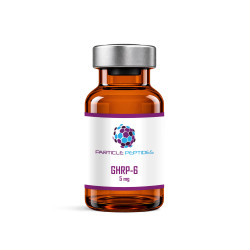
GHRP-6 5mg
- In stock