
- today
Tissue regeneration is an exceptionally complex biological process. It involves cellular repair, the formation of new blood vessels, extracellular matrix remodeling, and coordinated communication between multiple cell types. For this reason, peptide combinations that target different aspects of these processes are receiving increasing attention in scientific research.
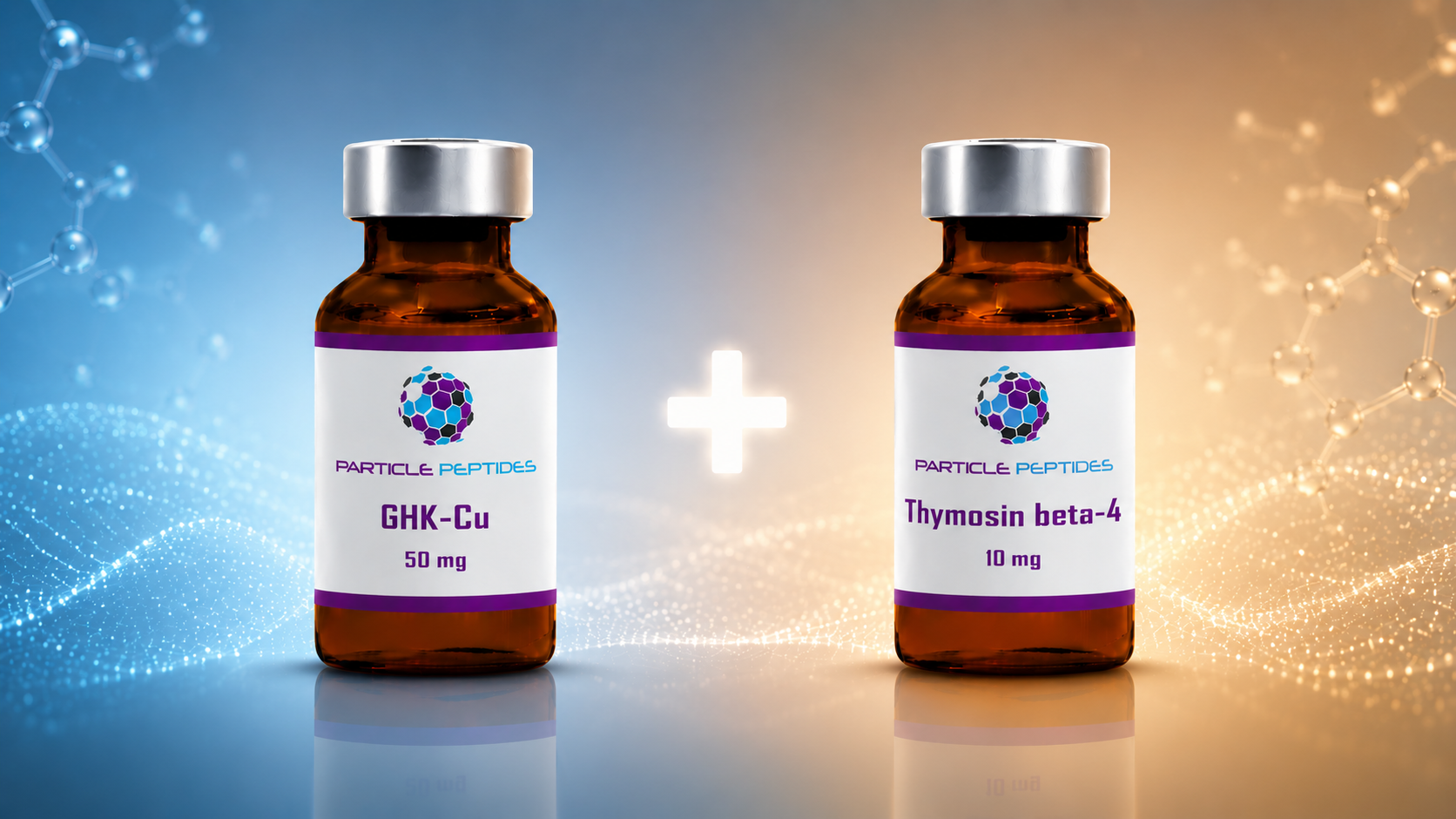
One of the most compelling combinations is GHK-Cu (Copper Peptide) and Thymosin Beta-4 (TB-500).
Each peptide exerts its biological effects through distinct mechanisms. GHK-Cu is best known for its influence on gene expression, fibroblast activity, and extracellular matrix synthesis, whereas Thymosin Beta-4 has been extensively investigated for its role in cell migration, angiogenesis, and cytoskeletal organization.
Together, they provide an interesting research model for studying skin repair and soft tissue regeneration.
It is important to emphasize that both peptides are intended exclusively for scientific research and laboratory use. They are not approved for human use.
What Is GHK-Cu?
GHK-Cu (glycyl-L-histidyl-L-lysine copper complex) is a naturally occurring tripeptide that was first identified in human plasma in 1973.
Following tissue injury, it is naturally released from damaged cells and participates in biological processes associated with tissue repair. Research has also shown that endogenous GHK-Cu concentrations gradually decline with age.
Over the past several decades, GHK-Cu has become one of the most extensively studied peptides in research related to:
-
Skin regeneration
-
Wound healing
-
Collagen synthesis
-
Extracellular matrix remodeling
-
Hair follicle regeneration
-
Gene regulation
How Does GHK-Cu Work in Research?
One of the most remarkable characteristics of GHK-Cu is its ability to influence gene expression.
Studies suggest that it may regulate thousands of genes involved in:
-
Tissue regeneration
-
Inflammatory responses
-
DNA repair
-
Cellular protection
-
Extracellular matrix metabolism
In addition, GHK-Cu has been investigated for its ability to support the activity of dermal fibroblasts, the cells responsible for producing collagen, elastin, and other essential structural components of the skin.
These biological properties explain why GHK-Cu has become one of the most extensively investigated peptides in skin regeneration research.
What Is Thymosin Beta-4 (TB-500)?
Thymosin Beta-4 is a naturally occurring peptide consisting of 43 amino acids. TB-500 is its synthetic analogue developed specifically for research applications.
Its biological role is closely linked to actin, the structural protein that forms the foundation of the cellular cytoskeleton.
Scientific studies have primarily investigated its potential role in:
-
Cell migration
-
Angiogenesis
-
Cell differentiation
-
Cytoskeletal organization
-
Extracellular matrix remodeling
-
Regeneration of damaged tissues
These biological mechanisms make Thymosin Beta-4 an important subject of investigation in soft tissue repair research.
Why Are GHK-Cu and TB-500 Studied Together?
Although both peptides are associated with regenerative processes, they target different aspects of tissue repair.
GHK-Cu is primarily investigated for its role in:
-
Regulation of gene expression
-
Promotion of collagen synthesis
-
Activation of fibroblasts
-
Extracellular matrix remodeling
-
Protection against oxidative cellular stress
Thymosin Beta-4 is primarily studied for its involvement in:
-
Cell migration
-
Angiogenesis
-
Organization of the actin cytoskeleton
-
Tissue remodeling
-
Regeneration following experimental injury
For this reason, researchers frequently use this combination to investigate the complex biological processes involved in skin and soft tissue regeneration.
What Is the Extracellular Matrix and Why Is It Important?
The extracellular matrix (ECM) is the structural framework that provides support for every tissue in the body.
It is composed primarily of:
-
Collagen
-
Elastin
-
Glycosaminoglycans
-
Proteoglycans
-
Other structural proteins
Following injury to the skin or soft tissues, regeneration involves more than simply producing new cells. Equally important is the restoration of the tissue’s structural architecture.
For this reason, extracellular matrix remodeling has become one of the primary areas of investigation for both GHK-Cu and Thymosin Beta-4.
Research Applications of This Combination
In the scientific literature, the combination of GHK-Cu and Thymosin Beta-4 is most commonly investigated in relation to:
-
Skin regeneration
-
Healing of experimental wounds
-
Angiogenesis
-
Fibroblast activity
-
Collagen synthesis
-
Extracellular matrix remodeling
-
Soft tissue regeneration
-
Cell migration
Several experimental studies suggest that these peptides may influence different phases of the tissue repair process, with each peptide targeting distinct biological mechanisms.
The Future of Skin Regeneration Research
Modern regenerative medicine is increasingly focused on understanding complex biological processes rather than investigating individual molecules in isolation.
The combination of GHK-Cu and Thymosin Beta-4 represents an excellent example of two peptides being studied for their complementary biological mechanisms.
GHK-Cu has been investigated for its potential role in regulating gene expression and promoting extracellular matrix remodeling, whereas Thymosin Beta-4 is primarily studied for its involvement in cell migration and the organization of regenerating tissues.
It is precisely this biological complementarity that makes this peptide combination one of the most compelling research models in the field of skin regeneration.
Conclusion
GHK-Cu and Thymosin Beta-4 are among the most extensively studied research peptides in the fields of skin and soft tissue regeneration.
Their biological mechanisms complement one another. GHK-Cu has primarily been investigated for its ability to regulate gene expression and support extracellular matrix remodeling, while Thymosin Beta-4 plays an important role in cell migration, angiogenesis, and cytoskeletal organization.
Despite the promising findings reported in experimental studies, it is important to emphasize that the majority of the available evidence originates from cell culture experiments and animal models. Additional well-designed clinical studies will be necessary to further evaluate their potential.
References
-
Pickart, L., & Margolina, A. Regenerative and Protective Actions of the GHK-Cu Peptide in the Light of the New Gene Data. International Journal of Molecular Sciences, 2018.
-
Pickart, L. The Human Tripeptide GHK and Tissue Remodeling. Journal of Biomaterials Science. A review of the biological effects of GHK-Cu on skin regeneration, collagen synthesis, and extracellular matrix remodeling.
-
Campbell, J. D., et al. GHK-Cu stimulates angiogenesis, collagen synthesis and wound repair. Research investigating the mechanisms by which GHK-Cu supports skin regeneration.
-
Philp, D., Goldstein, A. L., & Kleinman, H. K. Thymosin Beta-4 promotes angiogenesis, wound healing and tissue repair. FASEB Journal, 2004.
-
Goldstein, A. L., & Kleinman, H. K. Advances in the Understanding of Thymosin Beta-4 and Tissue Regeneration. Expert Opinion on Biological Therapy, 2015.
-
Smart, N., et al. Thymosin β4 Facilitates Epicardial Neovascularization and Cardiac Repair. Nature, 2007.
Research Quality Begins with Peptide Quality
At Particle Peptides, we believe that reliable research begins with reliable materials. That is why our research peptides are manufactured on cGMP-compliant production lines by a global pharmaceutical CDMO, and every batch undergoes independent third-party testing for:
- Purity
- Identity confirmation
- Peptide content
- Endotoxin levels
- Heavy metals (Class I & II)
- Microbial contamination (TAMC & TYMC)
Transparency and independently verified laboratory data form the foundation of high-quality scientific research.
Disclaimer: All Particle Peptides products are intended exclusively for scientific research and laboratory use. They are not intended for human or veterinary use, nor for the diagnosis, treatment, cure, or prevention of any disease.
Related products

GHK-Cu 50mg
- In stock
