
- today
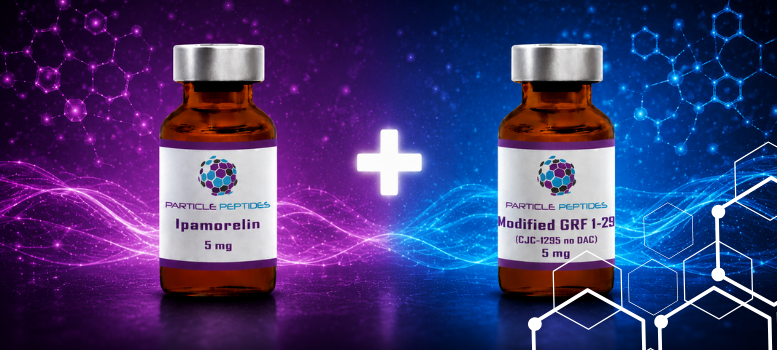
In the field of peptide research, few combinations are discussed as frequently as CJC-1295 and Ipamorelin. The reason is relatively straightforward: these are two molecules that influence the growth hormone (GH) axis through different yet complementary mechanisms. While CJC-1295 belongs to the class of GHRH (growth hormone-releasing hormone) analogs and supports signaling responsible for GH release, Ipamorelin acts as a selective agonist of the ghrelin receptor (GHS-R), stimulating the pituitary gland through a separate regulatory pathway. This dual mechanism is precisely why their potential synergistic effect is often discussed in the scientific literature.
However, one important clarification should be made from the outset: in the context of combination protocols with Ipamorelin, researchers and practitioners are generally referring to CJC-1295 without DAC, commonly known as Mod GRF 1-29. This shorter-acting form is mechanistically better suited to the pulsatile nature of GH stimulation that is frequently investigated alongside Ipamorelin. In contrast, CJC-1295 with DAC is a longer-acting GHRH analog and belongs to a somewhat different pharmacokinetic context.
As a result, research does not view this combination simply as “two peptides used together,” but rather as a model for simultaneously activating both the GHRH pathway and the ghrelin receptor system. This distinction is important because physiological GH secretion depends not on a single signal but on the coordinated interaction of multiple regulatory mechanisms, including GHRH, ghrelin, and somatostatin.
Why Are These Two Molecules Often Mentioned Together?
CJC-1295 without DAC and Ipamorelin belong to the broader field of GH secretion research, yet they do not function identically. CJC-1295 without DAC is a shorter-acting GHRH analog that is associated with supporting a more natural, pulsatile pattern of GH signaling. This characteristic makes it a logical partner for Ipamorelin, which also targets pulsatile GH stimulation, albeit through a different receptor pathway.
Ipamorelin, on the other hand, is classified as a selective GH secretagogue. Early pharmacological studies described it as a molecule with a strong capacity to stimulate GH release while demonstrating relatively high receptor selectivity and less influence on other hormones compared to some earlier GHRP peptides. For this reason, it has frequently been presented in scientific literature as a valuable tool for studying how selective activation of the ghrelin receptor affects GH secretion.
When these two pathways are considered together, a logical hypothesis emerges: a GHRH analog may support the regulatory framework of GH signaling, while a GHS agonist may influence the timing and magnitude of GH pulses. This is not merely a marketing concept but rather an idea rooted in endocrinological literature describing the synergy between GHRH and GHRP/GHS pathways.
CJC-1295 Without DAC: Shorter-Acting Support of the GHRH Axis
To accurately discuss this topic, it is essential to distinguish between the two forms of CJC-1295.
CJC-1295 with DAC is a long-acting GHRH analog whose extended half-life results from the Drug Affinity Complex (DAC), which enables binding to albumin. By contrast, CJC-1295 without DAC (Mod GRF 1-29) is a shorter-acting form that more closely resembles the natural GHRH signal.
Importantly, this is the form most frequently associated with Ipamorelin in both scientific discussions and research communities.
From a research perspective, CJC-1295 without DAC is particularly interesting because it allows investigators to observe a more precisely timed and pulsatile pattern of GH stimulation that aligns more closely with the natural dynamics of the hypothalamic-pituitary axis. Unlike the longer-acting DAC version, its primary purpose is not prolonged hormonal exposure but rather a shorter and more acute GHRH signal.
This distinction matters because GH-axis research is concerned not only with how much hormone is released but also with how secretion is organized over time.
Ipamorelin: Selective Activation of the Ghrelin Receptor
Scientific literature describes Ipamorelin as a selective growth hormone secretagogue that acts through the GHS-R (growth hormone secretagogue receptor). Unlike certain earlier GHRP peptides, Ipamorelin attracted attention because experimental studies demonstrated robust GH-releasing activity while producing less endocrine "noise" outside the GH axis. This made it an attractive molecule for studying selective GH stimulation through ghrelin receptor activation.
In the context of combination protocols with CJC-1295 without DAC, the key point is that Ipamorelin does not activate the GHRH receptor. Instead, it influences a separate regulatory pathway. In theoretical models, it therefore does not simply provide "more of the same" but rather affects GH regulation through a distinct mechanism. This is one of the primary reasons why this peptide pair continues to attract scientific interest.
Where Does the Synergy Come From?
The most important aspect of this topic is based on a longstanding but still highly relevant finding in endocrinology:
GHRH and GHRP/GHS compounds can exert synergistic effects on GH secretion.
Review articles and experimental studies have repeatedly shown that simultaneous activation of these two pathways produces a stronger GH response than activation of either pathway alone. This principle has been demonstrated in human research and has become so significant that combined GHRH-GHS testing is often cited in the literature as a powerful method for assessing GH reserve.
In other words, research suggests that GHRH signaling and ghrelin/GHS signaling do not completely overlap within the hypothalamic-pituitary axis. Instead, they complement one another. This explains why the combination of CJC-1295 without DAC and Ipamorelin is frequently interpreted as a model designed to mimic a more comprehensive regulation of GH secretion than can be achieved with either molecule independently.
“How Much” and “How Often”: A Useful but Simplified Metaphor
Popular descriptions of this peptide pair often claim that CJC-1295 determines how much GH is released, while Ipamorelin influences how frequently GH is released. While this simplification can be useful, it should be regarded as a metaphor rather than a scientifically precise explanation.
A more accurate description would be that CJC-1295 without DAC supports and amplifies GHRH-mediated GH signaling, whereas Ipamorelin, through activation of the ghrelin receptor, increases the likelihood and intensity of GH pulses. The resulting effect may be a more complex and physiologically organized GH-axis response than would be expected from isolated stimulation of a single pathway.
This interpretation aligns more closely with findings from studies investigating GHRH-GHS synergy.
Why Is This Combination Interesting for GH/IGF-1 Axis Research?
From a scientific standpoint, the most interesting aspect of this combination is not that it is considered a “powerful stack,” but rather that it provides a valuable model for studying GH dynamics.
Growth hormone is not secreted continuously under normal physiological conditions. Instead, it is released in pulses, and its regulation depends on numerous factors including GHRH, ghrelin, somatostatin, age, sex steroids, and IGF-1-mediated feedback. For this reason, combined GHRH + GHS models are particularly useful for understanding the complexity of the entire axis.
CJC-1295 without DAC is noteworthy because it provides a shorter and more physiological GHRH signal, while Ipamorelin demonstrates how a selective GHS agonist can trigger substantial GH responses through the ghrelin receptor. Their combination is therefore especially valuable as a research model of complementary GH-axis stimulation.
What About CJC-1295 with DAC?
This question is important because many people assume that the term “CJC-1295” always refers to the same molecule in the same context. This is not the case.
Research on CJC-1295 with DAC has demonstrated prolonged elevations in GH and IGF-1 over extended periods. Consequently, this form is more commonly associated with sustained stimulation of the GH/IGF-1 axis rather than with precisely timed pulsatile responses.
In practical terms:
CJC-1295 without DAC + Ipamorelin is more frequently associated with attempts to model a physiological pulsatile pattern of GH secretion.
CJC-1295 with DAC is more commonly described as a tool for investigating prolonged GH/IGF-1 stimulation.
Both forms have a place in GH-axis research, but they should not be considered interchangeable.
Limitations and Caution in Interpretation
It is equally important to acknowledge the limitations of the available evidence. Direct clinical studies specifically examining the combination of CJC-1295 without DAC and Ipamorelin are not as extensive as the broader literature on GHRH-GHS synergy. As a result, some of the interest in this peptide pair stems from a strong biological rationale and data on the individual compounds rather than from large-scale trials investigating the exact combination.
This distinction is important in order to avoid overstating the strength of the evidence.
From a scientific perspective, the most accurate conclusion is that the combination of CJC-1295 without DAC and Ipamorelin is mechanistically rational and supported by the well-established principle of synergistic interaction between GHRH and GHS pathways. It would be less accurate to claim that all of its proposed advantages have already been comprehensively validated in large clinical trials.
Conclusion
The combination of CJC-1295 without DAC and Ipamorelin is particularly interesting because it brings together two distinct regulatory pathways involved in growth hormone secretion. CJC-1295 without DAC acts as a shorter-acting GHRH analog that supports a more pulsatile pattern of GH signaling, while Ipamorelin activates the ghrelin receptor and promotes GH responses through the GHS pathway. Research on GHRH and GHS interactions indicates that these pathways can work synergistically, helping to explain why this peptide pair is so frequently discussed in both scientific and research communities.
The greatest value of this combination does not lie in a simple slogan about “more GH,” but rather in its ability to help researchers better understand how the amplitude, pulsatility, and temporal organization of growth hormone secretion can be coordinated. In this regard, CJC-1295 without DAC and Ipamorelin remain particularly compelling as a research model within modern endocrinology
References
- Raun K, et al. (1998).Ipamorelin, the first selective growth hormone secretagogue.Eur J Endocrinol. PubMed.
- Jetté L, et al. (2005).Human growth hormone-releasing factor (hGRF)1-29 analogs with enhanced CD26 resistance and biological activity: identification of CJC-1295.J Med Chem. PubMed.
- Teichman SL, et al. (2006).Prolonged stimulation of growth hormone (GH) and insulin-like growth factor I secretion by CJC-1295, a long-acting analog of GH-releasing hormone, in healthy adults.J Clin Endocrinol Metab. PubMed.
- Ionescu M, et al. (2006).Pulsatile secretion of growth hormone persists during continuous stimulation by CJC-1295.J Clin Endocrinol Metab. PubMed.
- Bowers CY, et al. práce o synergii medzi GHRH a GHRP/GHS v endokrinológii.
- Ghigo E, Arvat E, Broglio F, et al. review články o GH secretagogues, ghrelíne a regulácii GH osi.
Research Quality Begins with Peptide Quality
At Particle Peptides, we believe that reliable research begins with reliable materials. That is why our research peptides are manufactured on cGMP-compliant production lines by a global pharmaceutical CDMO, and every batch undergoes independent third-party testing for:
- Purity
- Identity confirmation
- Peptide content
- Endotoxin levels
- Heavy metals (Class I & II)
- Microbial contamination (TAMC & TYMC)
Transparency and independently verified laboratory data form the foundation of high-quality scientific research.
Disclaimer: All Particle Peptides products are intended exclusively for scientific research and laboratory use. They are not intended for human or veterinary use, nor for the diagnosis, treatment, cure, or prevention of any disease.
Related products

Ipamorelin 5mg
- In stock