
- today
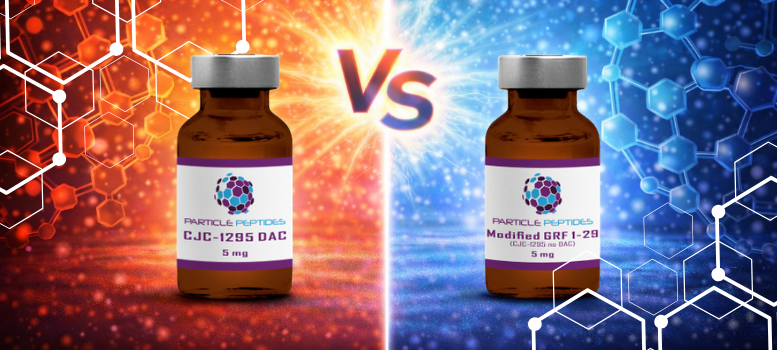
One major point of confusion frequently arises with the peptide CJC-1295: are we referring to CJC-1295 with DAC or without DAC? At first glance, this may appear to be only a minor technical distinction. However, from the perspectives of mechanism of action, pharmacokinetics, and research application, these are two distinct forms of the same core molecule.
In scientific literature, CJC-1295 with DAC and CJC-1295 without DAC are therefore not considered fully interchangeable peptides. Both target the same hormonal axis - GHRH / GH / IGF-1 - but they do so through different temporal dynamics and signaling profiles. Understanding this distinction is essential for correctly interpreting the findings of scientific studies.
What Is CJC-1295?
CJC-1295 belongs to the class of synthetic analogs of growth hormone-releasing hormone (GHRH). It was designed to mimic the effects of endogenous GHRH while offering greater stability and prolonged biological activity compared to the natural hormone, which is rapidly degraded in the body.
Research surrounding this molecule has primarily focused on how to prolong and optimize stimulation of growth hormone (GH) secretion and, consequently, insulin-like growth factor 1 (IGF-1), without directly administering GH itself.
The core concept remains the same for both forms: a peptide that stimulates the pituitary gland through the GHRH receptor. The key difference lies in how long the molecule remains active in circulation and what type of hormonal response it produces.
What Does DAC Mean?
DAC stands for Drug Affinity Complex. This is a pharmacokinetic modification that enables the peptide to bind to albumin, one of the primary transport proteins in the bloodstream. As a result, the molecule becomes more resistant to rapid degradation and can circulate in the body for a substantially longer period.
DAC is therefore the main reason why CJC-1295 with DAC behaves differently from the version without DAC. The distinction is not about targeting a different hormonal pathway, but rather about generating a different duration and pattern of hormonal signaling.
CJC-1295 With DAC: A Long-Acting GHRH Analog
CJC-1295 with DAC was developed to provide prolonged stimulation of the GH/IGF-1 axis. Clinical studies demonstrated that administration of the peptide leads to sustained elevation of both GH and IGF-1 levels, with effects lasting for several days.
An important observation was that, despite the prolonged activity, GH pulsatility was not completely abolished. In other words, the body did not release GH as a perfectly flat hormonal signal but retained a degree of physiological pulsatile secretion. This detail is highly relevant in endocrinology because GH is naturally secreted in pulses.
Characteristics Commonly Associated With CJC-1295 With DAC
Research most frequently associates it with:
- a longer half-life
- prolonged GH and IGF-1 stimulation
- a more stable hormonal profile
- greater emphasis on sustained endocrine effects rather than precise GH pulse timing
For this reason, CJC-1295 with DAC often appears in scientific literature as a model for studying prolonged activation of the GHRH axis.
CJC-1295 Without DAC: A Shorter-Acting Pulsatile Analog
When discussing CJC-1295 without DAC, researchers are often referring to the form known as Mod GRF 1-29. This version lacks the albumin-binding complex and therefore behaves much more like the body’s natural short-lived GHRH signal.
From a research perspective, CJC-1295 without DAC is more closely associated with short-duration, precisely timed stimulation of GH pulses. Rather than creating a prolonged background elevation in GH signaling, it is primarily used in contexts where pulsatile pituitary responses are being investigated.
Characteristics Commonly Associated With CJC-1295 Without DAC
Scientific and practical discussions most commonly associate it with:
- a shorter half-life
- a sharper, shorter-duration GHRH signal
- greater emphasis on GH pulse timing
- frequent mention alongside GH secretagogues such as Ipamorelin
This is also where one of the most common misunderstandings arises: many people simply say “CJC-1295” when they actually mean Mod GRF 1-29 - the version without DAC.
The Most Important Difference: Duration and Character of the Hormonal Signal
If the difference between these two forms had to be summarized in a single sentence, it would be this:
CJC-1295 with DAC prolongs the hormonal signal, whereas CJC-1295 without DAC more closely mimics short physiological GH pulses.
This represents the most important distinction from both mechanistic and research perspectives.
In simplified terms:
- With DAC = longer-lasting and more stable GH/IGF-1 stimulation
- Without DAC = shorter and more pulsatile GH signaling
This distinction largely determines the contexts in which each form is discussed and studied.
Why Is CJC-1295 Without DAC Frequently Combined With Ipamorelin?
In both scientific and community discussions, the combination of CJC-1295 and Ipamorelin is mentioned very frequently. However, in most cases, this refers not to the DAC version but specifically to CJC-1295 without DAC (Mod GRF 1-29).
The reason is mechanistic:
Ipamorelin acts as a selective agonist of the ghrelin receptor (GHS-R) and stimulates GH release through a different regulatory pathway than GHRH. When combined with a short-acting GHRH analog, the resulting model attempts to more closely replicate a physiological pulsatile GH response.
This is why, in combinations such as “CJC + Ipamorelin,” it is important to clarify whether the DAC or non-DAC version is being discussed, as these represent two fundamentally different mechanistic scenarios.
What Do Studies Show About CJC-1295 With DAC?
The best-known human studies involving CJC-1295 focused specifically on the DAC version.
In the study by Stephen L. Teichman and colleagues, researchers observed a pronounced and prolonged increase in GH and IGF-1 levels in healthy adults following administration of CJC-1295. The effect was dose-dependent, and elevated IGF-1 levels persisted for several days.
A subsequent study by Mihail Ionescu and colleagues demonstrated that even during prolonged stimulation, the pulsatile nature of GH secretion remained preserved. From an endocrinological standpoint, this represented a particularly interesting finding.
These results established CJC-1295 with DAC as an important research tool for studying the physiological consequences of prolonged activation of the GHRH pathway.
Which One Is “Better”?
From a scientific perspective, this is not the most appropriate question.
A more accurate question would be:
What type of hormonal response are we trying to study?
If the research focuses on:
- prolonged activation of the GH/IGF-1 axis → CJC-1295 with DAC is generally more relevant
If the research focuses on:
- shorter and more physiological GH pulses → CJC-1295 without DAC is more commonly discussed
In other words, neither form is universally “better.” Each is better suited to a different type of endocrine dynamics.
Conclusion
CJC-1295 with DAC and CJC-1295 without DAC represent two versions of the same foundational concept, yet from the standpoint of biological behavior they are two distinct molecular strategies.
The DAC version was designed for prolonged stimulation of the GH/IGF-1 axis, whereas the non-DAC version more closely resembles the body’s natural short pulsatile GHRH signal.
For this reason, it is always important to specify which form of CJC-1295 is being discussed. Otherwise, two fundamentally different pharmacokinetic realities can easily become conflated under a single name - leading to misunderstandings and incorrect interpretations in peptide research.

References
- Jetté L et al. (2005). Human growth hormone-releasing factor (hGRF)1-29 analogs with enhanced CD26 resistance and biological activity: identification of CJC-1295. Journal of Medicinal Chemistry.
- Teichman SL et al. (2006). Prolonged stimulation of growth hormone (GH) and insulin-like growth factor I secretion by CJC-1295, a long-acting analog of GH-releasing hormone, in healthy adults. Journal of Clinical Endocrinology & Metabolism.
- Ionescu M et al. (2006). Pulsatile secretion of growth hormone (GH) persists during continuous stimulation by CJC-1295, a long-acting GH-releasing hormone analog. Journal of Clinical Endocrinology & Metabolism.
- Raun K et al. (1998). Ipamorelin, the first selective growth hormone secretagogue. European Journal of Endocrinology.
Research Quality Begins with Peptide Quality
At Particle Peptides, we believe that reliable research begins with reliable materials. That is why our research peptides are manufactured on cGMP-compliant production lines by a global pharmaceutical CDMO, and every batch undergoes independent third-party testing for:
- Purity
- Identity confirmation
- Peptide content
- Endotoxin levels
- Heavy metals (Class I & II)
- Microbial contamination (TAMC & TYMC)
Transparency and independently verified laboratory data form the foundation of high-quality scientific research.
Disclaimer: All Particle Peptides products are intended exclusively for scientific research and laboratory use. They are not intended for human or veterinary use, nor for the diagnosis, treatment, cure, or prevention of any disease.
Related products
CJC-1295 + DAC 5mg
- In stock
CJC-1295 no DAC (Mod GRF 1-29) 5mg
- In stock