
- today
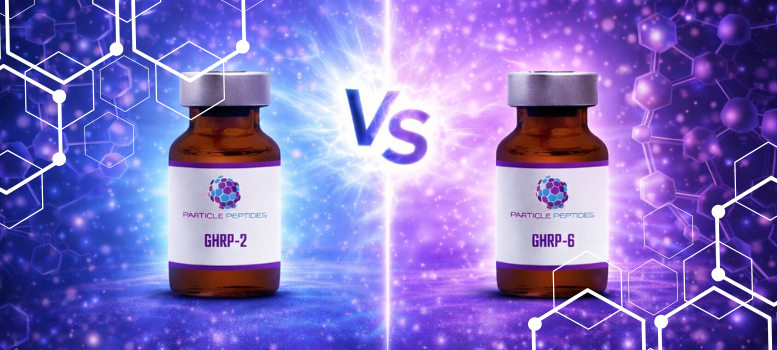
GHRP-2 and GHRP-6 belong to the classic group of synthetic peptides known as growth hormone secretagogues - compounds studied for their ability to stimulate the body’s natural release of growth hormone (GH). Both molecules act through the GHS-R receptor, also known as the ghrelin receptor, which is why they have long attracted attention in endocrinology and metabolic research. Although they share many similarities, scientific literature suggests that their biological profiles are not entirely identical.
Researchers are interested in these peptides for more than GH stimulation alone. Because the ghrelin receptor is also linked to appetite regulation, energy balance, neuroendocrine signaling, and several peripheral functions, both GHRP-2 and GHRP-6 are being investigated beyond their role as simple “growth hormone triggers.” For this reason, comparative studies often focus not only on the magnitude of GH release, but also on differences in appetite, hormonal response, and metabolic context.
What Are GHRP-2 and GHRP-6?
GHRP-2, also known as pralmorelin, is a synthetic hexapeptide developed as a growth hormone secretagogue. GHRP-6 belongs to the same category and is historically one of the oldest and most extensively studied GH secretagogues. Both molecules were designed to explore whether the pituitary gland could be stimulated to release GH in a pulsatile manner without directly administering exogenous growth hormone itself.
Mechanistically, both compounds are notable because they do not act through the classical GHRH receptor pathway, but through GHS-R1a, the receptor for ghrelin. This means their effects are tied to a physiological system naturally associated not only with growth hormone regulation, but also with hunger, energy adaptation, and neuroendocrine responses.
How Do They Work According to Scientific Studies?
Scientific studies show that both GHRP-2 and GHRP-6 stimulate growth hormone secretion from the anterior pituitary gland and may also influence the somatostatin inhibitory pathway, which normally suppresses GH release. As a result, both peptides produce a pulsatile GH response. From a research perspective, this pattern is particularly interesting because it more closely resembles natural GH physiology than continuous administration of exogenous hormone.
Despite their similar mechanism of action, comparative studies have shown that GHRP-2 is generally considered a more potent GH stimulator than GHRP-6. Early experimental studies using pituitary cell models demonstrated that although both peptides rely on related mechanisms, the intensity of the hormonal response differs between them.
The Most Important Difference: GH Potency
From a purely endocrine research perspective, GHRP-2 is frequently described in the literature as the more potent growth hormone secretagogue. This distinction has been observed not only in experimental models but also in human hormonal studies. Because of this, GHRP-2 was historically investigated as a tool for evaluating pituitary function and GH reserve.
This does not mean that GHRP-6 is “weak.” On the contrary, GHRP-6 has also demonstrated a strong ability to stimulate GH release. However, scientific literature more commonly emphasizes its broader connection to the ghrelin system and its metabolic implications.
GHRP-6 and the Ghrelin-Like Profile
In scientific studies, GHRP-6 is very often associated with more pronounced mimicry of certain orexigenic effects of ghrelin—signals related to hunger and food intake. Experimental research has shown that GHRP-6 can stimulate food intake in a manner similar to ghrelin, which represents one of the most well-known distinctions between it and GHRP-2.
Human studies have also observed increased appetite and food intake with GHRP-2. The difference is that with GHRP-6, this effect is more consistently described in the literature as a defining characteristic of its biological profile.
A Broader Hormonal Response
Comparisons between these peptides do not focus solely on GH release. Human studies have shown that some GH secretagogues, including GHRP-2, may also influence additional hormones such as prolactin, ACTH, and cortisol. This suggests that these compounds produce a broader neuroendocrine effect rather than an isolated action on a single hormonal axis.
This wider hormonal impact is one reason why GHRP-2 is often described in the literature as “stronger,” but also more complex in terms of endocrine response. GHRP-6 likewise has systemic effects, although greater emphasis is typically placed on ghrelin signaling, food intake, and peripheral metabolic actions.
GHRP-2 and GHRP-6 in Combination With GHRH
Research on GH secretagogues has repeatedly shown that these peptides cannot be fully separated from the GHRH pathway. Experimental models demonstrate that combining GHRPs with GHRH may lead to significantly greater GH release than activating either pathway alone. This synergistic principle has also been described for both GHRP-2 and GHRP-6 and is important for understanding the physiological regulation of growth hormone secretion.
What Does This Mean From a Scientific Comparison Perspective?
If the literature were summarized very briefly, GHRP-2 is more commonly described as a stronger stimulator of GH secretion, whereas GHRP-6 is often presented as a peptide with a more pronounced relationship to ghrelin signaling, appetite regulation, and metabolic control. The two molecules are closely related, but they are not fully interchangeable because they do not produce identical biological response profiles.
From a scientific standpoint, the key question is therefore not which peptide is “better,” but rather what type of hormonal and metabolic response researchers aim to study. For investigations involving the ghrelin receptor, energy intake, and orexigenic signaling, GHRP-6 is particularly interesting. In endocrine models focused on stronger GH stimulation, GHRP-2 is more frequently discussed.
Conclusion
GHRP-2 and GHRP-6 have played an important role in research involving growth hormone regulation, the ghrelin receptor, and neuroendocrine signaling. Although both molecules stimulate GH release through related receptor mechanisms, scientific literature describes clear functional differences between them. GHRP-2 is associated with a stronger GH response and broader hormonal activity, whereas GHRP-6 is more commonly linked to ghrelin signaling, appetite regulation, and metabolic processes.
For this reason, both peptides remain valuable primarily as research tools that help scientists better understand how the body regulates growth hormone secretion, hunger, and energy balance.

Sources
- Cheng J. et al. (1997). Growth Hormone Releasing Peptides: A Comparison of the Growth Hormone Releasing Activities of GHRP-2 and GHRP-6 in Rat Primary Pituitary Cells. Life Sciences. PubMed.
- Wu D. et al. (1996). The Effects of GH-Releasing Peptide-6 (GHRP-6) and GHRP-2 on GH Release. Peptides. PubMed.
- Arvat E. et al. (1997). Effects of GHRP-2 and Hexarelin, Two Synthetic GH-Releasing Peptides, on GH, Prolactin, ACTH and Cortisol Levels in Man. European Journal of Endocrinology. PubMed.
- Bennett K.A. et al. (2009). Growth Hormone Secretagogues and Growth Hormone-Releasing Hormone Interactions. PMC Review.
- Yin Y. et al. (2014). The Growth Hormone Secretagogue Receptor: Its Intracellular Signaling and Regulation. International Journal of Molecular Sciences. PMC.
- Laferrère B. et al. (2005). Growth Hormone-Releasing Peptide-2 (GHRP-2), Like Ghrelin, Increases Food Intake in Healthy Men. JCEM-linked literature.
- Yahashi S. et al. (2012). GHRP-6 Mimics Ghrelin-Induced Stimulation of Food Intake. PubMed.
- Gondo R.G. et al. (2001). Growth Hormone-Releasing Peptide-2 Stimulates GH and ACTH Secretion. JCEM / PubMed indexed.
Research Quality Begins with Peptide Quality
At Particle Peptides, we believe that reliable research begins with reliable materials. That is why our research peptides are manufactured on cGMP-compliant production lines by a global pharmaceutical CDMO, and every batch undergoes independent third-party testing for:
- Purity
- Identity confirmation
- Peptide content
- Endotoxin levels
- Heavy metals (Class I & II)
- Microbial contamination (TAMC & TYMC)
Transparency and independently verified laboratory data form the foundation of high-quality scientific research.
Disclaimer: All Particle Peptides products are intended exclusively for scientific research and laboratory use. They are not intended for human or veterinary use, nor for the diagnosis, treatment, cure, or prevention of any disease.
Related products
GHRP-2 5mg
- In stock
GHRP-6 5mg
- In stock
