- today
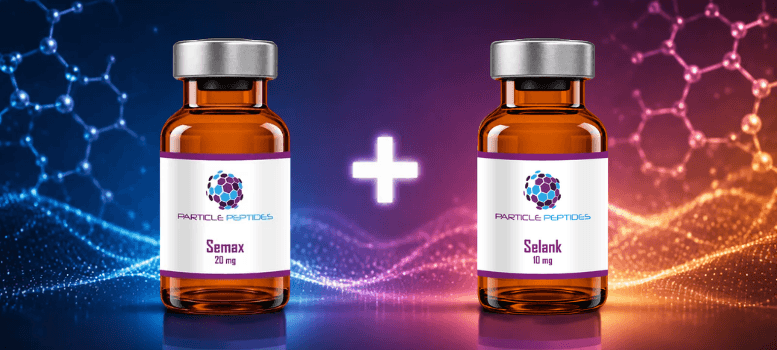
Semax and Selank are synthetic neuropeptides that have attracted the attention of researchers studying the central nervous system, neuroplasticity, memory, and the biological mechanisms of stress response. Although both peptides originated from Russian neurobiological research and share a similar seven-amino-acid structure, their investigated mechanisms of action differ. Semax is primarily studied in relation to the neurotrophic factors BDNF and NGF, gene expression, and neuronal protection. Selank is investigated for its relationship with the GABAergic system, neurotransmitter regulation, and the mechanisms underlying anxiety and stress responses. The Semax + Selank combination therefore represents an interesting research concept, allowing scientists to compare different molecular pathways involved in brain function. However, it is important to distinguish between findings from studies of the individual peptides and their combined activity, for which sufficient direct experimental evidence is not yet available.
What Is Semax and How Does It Affect the Nervous System?
Semax is a synthetic heptapeptide derived from a fragment of adrenocorticotropic hormone (ACTH). Its molecular structure contains the ACTH(4–7) sequence, supplemented with three amino acids: Pro-Gly-Pro. Unlike ACTH itself, Semax is primarily studied for its effects on the nervous system rather than for stimulating adrenal hormonal activity.
In experimental neurobiology, research focuses on its relationship with neurotrophic factors, which help regulate neuronal survival, differentiation, and functional adaptation.
Semax, BDNF, and Neuroplasticity
One of the most important areas of Semax research is BDNF (Brain-Derived Neurotrophic Factor), a protein involved in the regulation of neuronal function.
BDNF belongs to a group of regulatory proteins involved in synaptic plasticity, neuronal connectivity, and learning and memory processes. Experimental studies in rats have demonstrated that Semax can influence the expression of genes encoding BDNF and NGF (Nerve Growth Factor) in different regions of the brain.
Interesting findings were reported in a study published in Brain Research in 2006. Researchers observed increased BDNF protein levels and activation of its TrkB receptor in the hippocampus of rats following experimental administration of Semax.
These findings suggest a possible connection between Semax and the molecular mechanisms of neuroplasticity.
If you would like to learn more about Semax, its role in neuroplasticity research, cognitive functions, and neuroprotective mechanisms, read our article: Semax: A Scientific Perspective on a Neuropeptide in the Context of Contemporary Research, where we explore its biological properties and findings from scientific studies in greater detail.

What Is Selank and Why Is It Studied in Relation to Stress?
Selank is a synthetic heptapeptide derived from the naturally occurring immunomodulatory peptide tuftsin. Its amino acid sequence was modified to achieve greater stability compared with the original molecule.
Selank has become a subject of research primarily in the fields of stress neurobiology, neurotransmission, and the biological mechanisms of anxiety responses. A significant proportion of experimental research focuses on its interaction with the GABAergic system.
Selank and GABAergic Neurotransmission
GABA (gamma-aminobutyric acid) is the main inhibitory neurotransmitter in the central nervous system. Its role is to regulate neuronal excitability and maintain the balance between excitatory and inhibitory signals in the brain.
A study published in Frontiers in Pharmacology in 2016 investigated the effects of Selank on the expression of genes associated with neurotransmission in the frontal cortex of rats. Researchers analyzed 84 genes involved in the regulation of neurotransmitter systems, including GABA, dopamine, and serotonin. The results revealed significant changes in gene expression following experimental administration of Selank or GABA, with positive correlations observed between some of these changes.
The authors therefore proposed that one possible mechanism of Selank may involve modulation of the GABAergic system. These findings provide a molecular basis for further investigation of stress responses, although they do not demonstrate that Selank produces effects identical to those of commonly used anxiolytic medications.
If you are interested in a more detailed examination of Selank, its relationship with the GABAergic system, stress responses, and neurotransmitter regulation, read our article: Selank: A Scientific Perspective on Its Effects and Mechanism of Action, where we discuss its biological properties and findings from scientific research.

Why Is the Semax + Selank Combination Interesting for Neurobiological Research?
The primary reason for scientific interest in Semax and Selank is the difference between their investigated biological mechanisms.
While Semax is mainly associated with the regulation of neurotrophic factors and neuroplasticity, Selank is studied in connection with neurotransmitter signaling and stress responses. These differences create opportunities to investigate relationships between neuronal adaptation and the regulation of neuronal activity.
Comparison of Semax and Selank
| Research Area | Semax | Selank |
|---|---|---|
| Molecular origin | ACTH derivative | Tuftsin analogue |
| Main pathways investigated | BDNF, NGF, TrkB | GABAergic signaling |
| Neuroplasticity | Research into neurotrophic factors | Research into gene regulation and neurotransmission |
| Memory and learning | Experimental cognitive models | Memory consolidation models |
| Stress response | Neuroprotective and adaptive mechanisms | Mechanisms of anxiety and inhibitory neurotransmission |
| Other areas | Cerebral ischemia, neuroprotection | Enkephalins, immunomodulation |
Importantly, different mechanisms do not automatically imply a synergistic effect. Available studies primarily provide evidence concerning the individual biological activities of these molecules.
Semax and Selank in Enkephalin Research
One of the most interesting molecular mechanisms shared by both peptides is their relationship with enzymes responsible for breaking down enkephalins. These are naturally occurring regulatory neuropeptides belonging to the group of endogenous opioid peptides. They participate in pain processing, stress signaling, and other regulatory processes within the nervous system.
A study published in 2001 investigated the effects of Semax and Selank on enkephalin-degrading enzymes in human serum. The results demonstrated that both synthetic heptapeptides were able to inhibit the activity of these enzymes under laboratory conditions in a concentration-dependent manner. This experiment provided evidence that Semax and Selank may influence a similar regulatory mechanism.
Research Areas of the Semax and Selank Combination
1. Neuroplasticity and Neuronal Adaptation
Neuroplasticity refers to the nervous system's ability to modify its functional and structural connections in response to new stimuli. Research on Semax has provided insights into the expression of BDNF and NGF, while Selank studies investigate changes in genes involved in neurotransmission. Comparing these mechanisms may contribute to a better understanding of how molecular neuronal adaptation relates to the regulation of nervous system activity.
2. Memory, Learning, and Cognitive Processes
Neuroplasticity refers to the nervous system's ability to modify its functional and structural connections in response to new stimuli. Research on Semax has provided insights into the expression of the neurotrophic factors BDNF and NGF, while Selank studies investigate changes in genes involved in neurotransmission. Comparing these mechanisms may contribute to a better understanding of the relationship between molecular neuronal adaptation and the regulation of neuronal activity.
3. Stress Response and Neurotransmitter Balance
The stress response arises through interactions between the nervous, endocrine, and immune systems. Selank is primarily studied in relation to inhibitory neurotransmission, monoamine metabolism, and gene expression regulation, while Semax research focuses on neuroprotective processes and the molecular response of nervous tissue. Comparing these mechanisms may help researchers identify biological pathways involved in the body's adaptation to stressful conditions.
4. Neuroprotection and Gene Regulation
Neuroprotection refers to biological processes that may help protect nerve cells from damage. Semax has been studied in experimental models of cerebral ischemia and hypoxia, where researchers examined changes in the expression of genes associated with the nervous, immune, and vascular systems. Selank, on the other hand, has been investigated in relation to the regulation of neurotransmitter and immune pathways. Both peptides therefore represent different molecular approaches to studying nervous system adaptation, protection, and regulation.
For more detailed information about the mechanism of action of Semax, its influence on gene expression, and neuroplasticity processes, read our article: How Does Semax Work? A Scientific Perspective, which explores its molecular activity and key findings from neurobiological research.
The Future of Neuropeptide Research
Neuropeptide research offers new opportunities to investigate molecular communication within the nervous system. Semax and Selank are particularly interesting because they allow researchers to examine different but biologically related processes, ranging from the expression of neurotrophic factors to the regulation of neurotransmitter pathways. Comparing these peptides may expand our understanding of neuroplasticity, memory, stress responses, and molecular adaptation in the brain.
A key challenge for future research is determining whether the combined activity of Semax and Selank produces different biological outcomes compared with the activity of each peptide individually. Carefully designed experimental studies may help clarify the significance of this peptide combination in modern neurobiology.
Frequently Asked Questions About Semax and Selank (FAQ)
What Is the Semax + Selank Combination?
Semax + Selank refers to a pair of synthetic neuropeptides studied in neurobiology. Semax is primarily associated with neurotrophic factors and neuroplasticity, while Selank is investigated for its relationship with neurotransmission and stress responses. Their combined biological activity has not yet been sufficiently explored.
What Is the Main Difference Between Semax and Selank?
Semax is derived from an ACTH fragment, and much of its research focuses on BDNF, NGF, and neuroprotective mechanisms. Selank is a tuftsin analogue studied primarily in relation to GABAergic signaling, neurotransmitter regulation, and anxiety responses.
Can Semax and Selank Affect Memory?
Experimental studies of the individual peptides suggest that they are associated with molecular processes involved in learning and memory. However, it has not been established that their combination improves memory or cognitive performance in humans.
What Is the Relationship Between Semax and BDNF?
BDNF is a neurotrophic factor important for neuronal function and adaptation. In experimental studies involving rats, Semax influenced BDNF expression and activation of its TrkB receptor.
How Is Selank Related to GABA?
GABA is the brain's primary inhibitory neurotransmitter. Research suggests that Selank may influence the expression of genes involved in GABAergic signaling. The precise extent of these effects and their clinical significance remain subjects of further investigation.
Conclusion
Semax and Selank are two important synthetic neuropeptides investigated in relation to the functioning of the central nervous system. Semax is primarily studied for its influence on neurotrophic factors and the molecular mechanisms of neuroplasticity. Selank is investigated in connection with GABAergic signaling, stress responses, and neurotransmitter regulation.
The available findings provide a scientific foundation for further investigation of their biological mechanisms. At the same time, they highlight the importance of careful interpretation, as the direct effectiveness of their combination has not yet been reliably established.

Sources:
- Dolotov, O. V. et al. (2006). Semax, an analog of ACTH(4–10) with cognitive effects, regulates BDNF and trkB expression in the rat hippocampus. Brain Research.
- Agapova, T. Yu. et al. (2008). Effect of Semax on the temporary dynamics of brain-derived neurotrophic factor and nerve growth factor gene expression in the rat hippocampus and frontal cortex. Molecular Genetics, Microbiology and Virology.
- Shadrina, M. et al. (2010). Comparison of the temporary dynamics of NGF and BDNF gene expression in rat hippocampus, frontal cortex, and retina under Semax action. Journal of Molecular Neuroscience.
- Selank Administration Affects the Expression of Some Genes Involved in GABAergic Neurotransmission (2016). Frontiers in Pharmacology.
- Semax and Selank Inhibit the Enkephalin-Degrading Enzymes from Human Serum (2001). Experimental research on enzyme inhibition in human serum.
Research Quality Begins with Peptide Quality
At Particle Peptides, we believe that reliable research begins with reliable materials. That is why our research peptides are manufactured on cGMP-compliant production lines by a global pharmaceutical CDMO, and every batch undergoes independent third-party testing for:
- Purity
- Identity confirmation
- Peptide content
- Endotoxin levels
- Heavy metals (Class I & II)
- Microbial contamination (TAMC & TYMC)
Transparency and independently verified laboratory data form the foundation of high-quality scientific research.
Disclaimer: All Particle Peptides products are intended exclusively for scientific research and laboratory use. They are not intended for human or veterinary use, nor for the diagnosis, treatment, cure, or prevention of any disease.