
- today

Peptides for tanning are studied mainly in connection with melanogenesis - the natural biological process through which melanocytes produce melanin, the pigment responsible for the coloration of the skin and hair. One of the best-known molecules associated with this field is Melanotan 2 (MT2), a synthetic analogue of alpha-melanocyte-stimulating hormone (α-MSH). Research on MT2 focuses primarily on melanocortin receptors, melanocyte activity, and eumelanin production.
Melanotan 2 was developed as a more stable analogue of naturally occurring α-MSH and is among the best-known melanocortin peptides studied in relation to skin pigmentation. Research into the melanocortin system has also helped scientists better understand how the human body regulates skin colour and how melanocytes respond to different biological signals.
Melanotan 2 belongs to a broader group of peptide molecules studied across various areas of biology. To learn more about what peptides are, how they work, and why they are the subject of scientific research, read our dedicated article: Peptides - What They Are, How They Work, and Why They Are The Subject of Scientific Research.
How does skin tanning occur?
Skin colour is largely influenced by a pigment called melanin. It is produced by specialised cells called melanocytes, which are located mainly in the basal layer of the epidermis.
Melanocytes produce pigment inside structures known as melanosomes and subsequently transfer it to surrounding keratinocytes.
Human skin contains two primary types of melanin:
-
eumelanin - a dark brown to black pigment,
-
pheomelanin - a yellowish to reddish pigment.
The resulting skin tone depends on their amount, ratio, distribution, and melanocyte activity.
Natural tanning following exposure to UV radiation is also associated with increased melanocyte activity and melanin production. One of the major regulatory systems involved in this process is melanocortin signalling.

Peptides for tanning and α-MSH: where does melanogenesis begin?
When discussing peptides for tanning, it is important to understand the natural role of α-MSH - alpha-melanocyte-stimulating hormone. α-MSH belongs to the melanocortin family and acts in the skin as an important signalling molecule regulating melanocytes.
After binding to the MC1R melanocortin receptor, it promotes a signalling cascade that leads to increased activity of tyrosinase, one of the key enzymes involved in melanogenesis. This may result in increased eumelanin production.
The ability of α-MSH to regulate melanocytes became the basis for the development of synthetic analogues with longer-lasting biological activity. One of these analogues is Melanotan 2.

What is Melanotan 2 (MT2)?
Melanotan 2 (MT2) is a synthetic cyclic peptide and an analogue of naturally occurring α-MSH. It was developed as part of research into the melanocortin system, with the aim of creating a molecule with stronger and longer-lasting biological activity than natural α-MSH.
Structurally, it is a cyclic heptapeptide that acts as an agonist of several melanocortin receptors. From the perspective of pigmentation, the most important receptor is MC1R, which is found on melanocytes.
Activation of this receptor is associated with:
-
stimulation of melanogenesis,
-
increased melanocyte activity,
-
regulation of tyrosinase,
-
increased eumelanin production,
-
changes in skin pigmentation.
This mechanism explains why Melanotan 2 is among the most widely known peptides for tanning studied in scientific literature.
How does Melanotan 2 affect melanocortin receptors?
The melanocortin system includes several receptors known as MC1R to MC5R. These receptors are found in different tissues and perform different biological functions.
From the perspective of pigmentation, MC1R is the most important. When a melanocortin agonist activates MC1R on the surface of a melanocyte, intracellular signalling processes are triggered. These subsequently influence enzymes and genes involved in melanogenesis.
One of the key outcomes of this signalling is an increase in eumelanin synthesis. Research on human melanocytes has shown that activation of MC1R by melanocortins is associated with cAMP formation, tyrosinase activity, and melanogenesis.
Melanotan 2 and eumelanin
When studying peptides for tanning, not only the amount of pigment matters, but also its type. Eumelanin is the darker pigment that significantly influences the final colour of the skin. Melanocortin signalling through MC1R specifically supports processes leading to eumelanin production.
Research on synthetic α-MSH analogues has shown that stimulation of the melanocortin system can increase the amount of melanin and alter the balance between eumelanin and pheomelanin. This mechanism forms the basis of scientific interest in molecules such as MT2 in relation to pigmentation.
Why was Melanotan 2 developed?
The development of Melanotan 2 is connected with research into α-MSH and melanocortin receptors conducted at the University of Arizona. Natural α-MSH can stimulate melanogenesis, but its biological activity is relatively short-lived.
Researchers therefore looked for more stable analogues capable of activating melanocortin receptors more effectively. This line of research led to the development of several synthetic melanocortin peptides, including Melanotan 1 and Melanotan 2.
Early clinical studies involving MT-II subsequently observed increased skin pigmentation, confirming the melanotropic activity of this molecule in humans as well.
For a more detailed overview of the research and clinical studies, see our article: Melanotan 2: Research and Clinical Studies on Natural Tanning and Increased Libido.
Peptides for tanning and natural melanogenesis
One of the features that makes peptides for tanning scientifically interesting is the way they interact with the natural system that regulates pigmentation. They are not simply pigments that colour the skin superficially.
Research into melanocortin peptides focuses on biological signals that influence melanocytes themselves and the production of melanin.
In simplified terms, this mechanism can be described as:
melanocortin peptide → MC1R → intracellular signalling → tyrosinase → melanogenesis → melanin production
Understanding this signalling pathway made it possible to develop synthetic analogues of naturally occurring α-MSH.

Melanotan 2, MT2 or MT 2?
The terms Melanotan 2, Melanotan II, MT2, and MT 2 are used for the same molecule.
In scientific publications, the designations Melanotan-II or MT-II are most commonly used, while in the field of research peptides the simpler abbreviation MT2 is frequently used.
From a mechanistic perspective, however, they refer to the same synthetic melanocortin peptide.
Melanotan 2 and skin pigmentation: what has research shown?
The melanotropic activity of Melanotan 2 has also been studied in early clinical research.
In a pilot Phase I study published in 1996, researchers evaluated Melanotan-II as a synthetic melanotropic peptide. Increased pigmentation was observed in several areas of the participants’ skin, supporting its biological activity in relation to melanogenesis.
Broader research into α-MSH analogues has also shown that stimulation of the melanocortin system can increase the amount of melanin in human skin. This is why melanocortin analogues are an important part of research into the regulation of human pigmentation.
Is skin colour the same in everyone?
No. The biological response of melanocytes varies between individuals.
Important factors include:
-
genetics,
-
natural skin phototype,
-
the number and activity of melanocytes,
-
MC1R receptor function,
-
the ratio of eumelanin to pheomelanin,
-
individual genetic variants of MC1R.
Interestingly, differences between individuals are not primarily determined by the number of melanocytes themselves, but rather by their activity and by the way melanin is produced and distributed.
This is one reason why final pigmentation can vary significantly between individuals.
What role does the MC1R receptor play?
MC1R - melanocortin 1 receptor - is one of the most important regulatory elements in human pigmentation. It is located on melanocytes and responds to melanocortin signalling molecules, including α-MSH.
Activation of MC1R influences:
-
melanin production,
-
tyrosinase activity,
-
the ratio of pigments,
-
melanocyte response,
-
final skin pigmentation.
Genetic variants of the MC1R gene are also among the reasons why people have different skin phototypes and different capacities to produce eumelanin.
Melanotan 2 user experiences: why can individual results vary?
Experiences with Melanotan 2 can differ between individuals, particularly when it comes to the intensity of resulting pigmentation. From a biological perspective, this variability is understandable. Pigmentation is influenced by many factors - from natural skin colour and genetics to melanocortin receptor function.
Subjective experiences should therefore not be evaluated independently of biological differences between individuals. From a scientific perspective, controlled measurements of pigmentation, melanin levels, and melanocortin system activity provide more meaningful information about MT2 than individual observations alone.
Is melanin only a pigment?
Melanin is best known as the pigment that determines the colour of the skin, hair, and eyes, but its biological role is broader.
Eumelanin can absorb part of ultraviolet radiation and contributes to the skin’s natural cellular protection. This is why research into α-MSH and its analogues was originally linked not only to pigmentation, but also to the question of whether increasing eumelanin could influence the skin’s response to UV radiation.
Research into melanocortin analogues therefore became part of the broader field of photobiology and pigmentation regulation.

Peptides for tanning and UV radiation do not work through the same mechanism
In conventional tanning, UV radiation represents one of the main stimuli of melanogenesis.
Melanocortin peptides enter the process at a different point - they influence receptors and signalling pathways within melanocytes. This means that, from a biological perspective, peptides for tanning and UV radiation itself cannot be considered identical mechanisms for stimulating pigmentation.
However, both processes ultimately converge on melanocytes, melanogenesis, and melanin production.

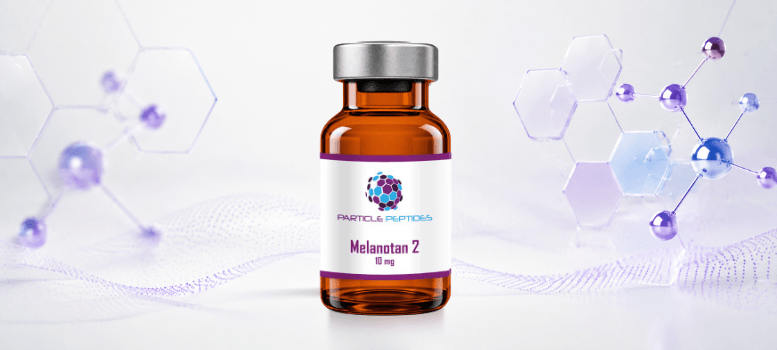
Melanotan 2 10 mg in melanocortin system research
The Melanotan 2 10 mg product from Particle Peptides is a research peptide intended for scientific and laboratory purposes.
Melanotan 2 is a synthetic analogue of α-MSH, and its research profile focuses mainly on:
-
melanocortin receptors,
-
melanogenesis,
-
eumelanin production,
-
pigmentation,
-
melanocyte activity,
-
MC1R signalling mechanisms.
Particle Peptides provides research peptides with an emphasis on analytical quality control of individual batches and independent laboratory testing.
Why is purity alone not enough when evaluating research peptides?
When studying a molecule such as Melanotan 2, the stated percentage of purity is not the only important factor. Experimental results can be influenced by multiple quality parameters of the research material.
For peptides, it is therefore appropriate to consider:
-
identity confirmation,
-
purity,
-
actual peptide content,
-
endotoxins,
-
heavy metals,
-
microbial contamination,
-
manufacturing process,
-
batch-to-batch consistency,
-
batch traceability,
-
authenticity of analytical documentation.
At Particle Peptides, products are manufactured by a global pharmaceutical CDMO on GMP production lines, and individual batches undergo independent laboratory testing for multiple quality parameters.
Frequently asked questions about peptides for tanning
What are peptides for tanning?
Peptides for tanning is a term used for peptide molecules studied in relation to the melanocortin system, melanocyte activity, and melanogenesis. One of the best-known examples is Melanotan 2.
What is Melanotan 2?
Melanotan 2 (MT2) is a synthetic cyclic analogue of the naturally occurring alpha-melanocyte-stimulating hormone α-MSH. It is studied primarily in relation to melanocortin receptors and processes involved in the regulation of pigmentation.
Is MT2 the same as Melanotan 2?
Yes. MT2, MT 2, MT-II, Melanotan II, and Melanotan 2 are different designations used for the same peptide.
How is Melanotan 2 related to melanin?
Melanotan 2 acts as an agonist of melanocortin receptors. From the perspective of pigmentation, the most important receptor is MC1R on melanocytes, whose activation is associated with increased melanogenesis and eumelanin production.
What is melanogenesis?
Melanogenesis is the biological process through which melanocytes produce melanin. Melanocortin receptors, α-MSH, and the enzyme tyrosinase play key roles in this process.
Why is Melanotan 2 associated with tanning?
Melanotan 2 is an analogue of α-MSH and activates melanocortin receptors, including MC1R. This receptor regulates melanocytes and melanin production, which is why MT2 is studied in relation to skin pigmentation.
What does the term “Melanotan 2 experiences” mean?
It mainly refers to individual user observations published online. From a scientific perspective, controlled studies and objective measurements of pigmentation provide more meaningful evidence because individual responses can depend on skin phototype, genetics, and melanocortin receptor function.
Conclusion
Peptides for tanning represent an interesting area of research into the melanocortin system and the biological processes that regulate human pigmentation.
One of the best-known examples is Melanotan 2 (MT2), a synthetic analogue of the naturally occurring hormone α-MSH.
Its research profile is closely associated with melanocortin receptors, particularly MC1R, melanocyte activity, and melanogenesis. Activation of these mechanisms is subsequently associated with the production of eumelanin, which significantly affects final skin pigmentation.
Research on Melanotan 2 and other melanocortin molecules has helped clarify how α-MSH, melanocortin receptors, melanocytes, and enzymes responsible for melanin production interact with one another.
When discussing peptides for tanning, the topic therefore extends beyond the final colour of the skin. It involves a complex biological system that includes receptors, signalling pathways, and the natural processes of melanogenesis.
Sources:
-
Dorr R.T. et al. Evaluation of Melanotan-II, a superpotent cyclic melanotropic peptide in a pilot phase-I clinical study.
-
Melanocyte function and its control by melanocortin peptides.
-
Melanocortin-1 receptor structure and functional regulation.
-
Rees J.L. The melanocortin 1 receptor (MC1R): more than just red hair.
-
Development of α-melanocortin analogs for melanoma prevention and targeting.
-
MC1R, eumelanin and pheomelanin: their role in determining skin pigmentation and photobiology.
-
The α-melanocyte-stimulating hormone/MC1R interaction and its role in melanogenesis.
-
Melanotan II User Experience: A Qualitative Study of Online Discussion Forums.
Research Quality Begins with Peptide Quality
At Particle Peptides, we believe that reliable research begins with reliable materials. That is why our research peptides are manufactured on cGMP-compliant production lines by a global pharmaceutical CDMO, and every batch undergoes independent third-party testing for:
- Purity
- Identity confirmation
- Peptide content
- Endotoxin levels
- Heavy metals (Class I & II)
- Microbial contamination (TAMC & TYMC)
Transparency and independently verified laboratory data form the foundation of high-quality scientific research.
Disclaimer: All Particle Peptides products are intended exclusively for scientific research and laboratory use. They are not intended for human or veterinary use, nor for the diagnosis, treatment, cure, or prevention of any disease.
Related products

Melanotan 2 10mg
- In stock