
- today

Peptides are short chains of amino acids that perform a variety of biological and regulatory functions in living organisms. They are involved, for example, in cell signaling, metabolism, hormonal processes, immune function, and tissue regeneration. Their properties depend on their specific amino acid sequence, which means that individual peptides can have very different mechanisms of action and areas of scientific research.
What Are Peptides?
From a chemical perspective, peptides are formed when amino acids are linked together by peptide bonds. Amino acids are also the basic building blocks of proteins, but in peptides, their precise sequence—the order in which the individual amino acids are arranged—is particularly important.
This arrangement largely determines the molecule’s final structure, stability, and ability to interact with specific receptors or other biological systems. Even a small change in the amino acid sequence can therefore result in significantly different properties.
A simple analogy is to think of words made from the same letters. Changing a single letter can completely change the meaning of a word. Similarly, changing a single amino acid can affect the three-dimensional structure of a peptide, its binding properties, or its biological activity.
Peptides therefore do not represent a single substance with one uniform effect, but rather a broad and highly diverse group of molecules. Individual peptides can differ considerably in length, structure, stability, and mechanism of action.
In living organisms, peptides naturally participate in many biological processes. They can act, for example, as signaling or regulatory molecules and contribute to cell communication, hormonal signaling, metabolic processes, immune mechanisms, and the regulation of other physiological functions.
Peptides occur naturally in the human body, animals, plants, and microorganisms. Some function as peptide hormones, others as neuropeptides or components of more complex regulatory systems. Their diversity and their ability to influence precisely defined biological mechanisms make peptides an important subject of modern scientific and laboratory research.
What Is the Difference Between a Peptide and a Protein?
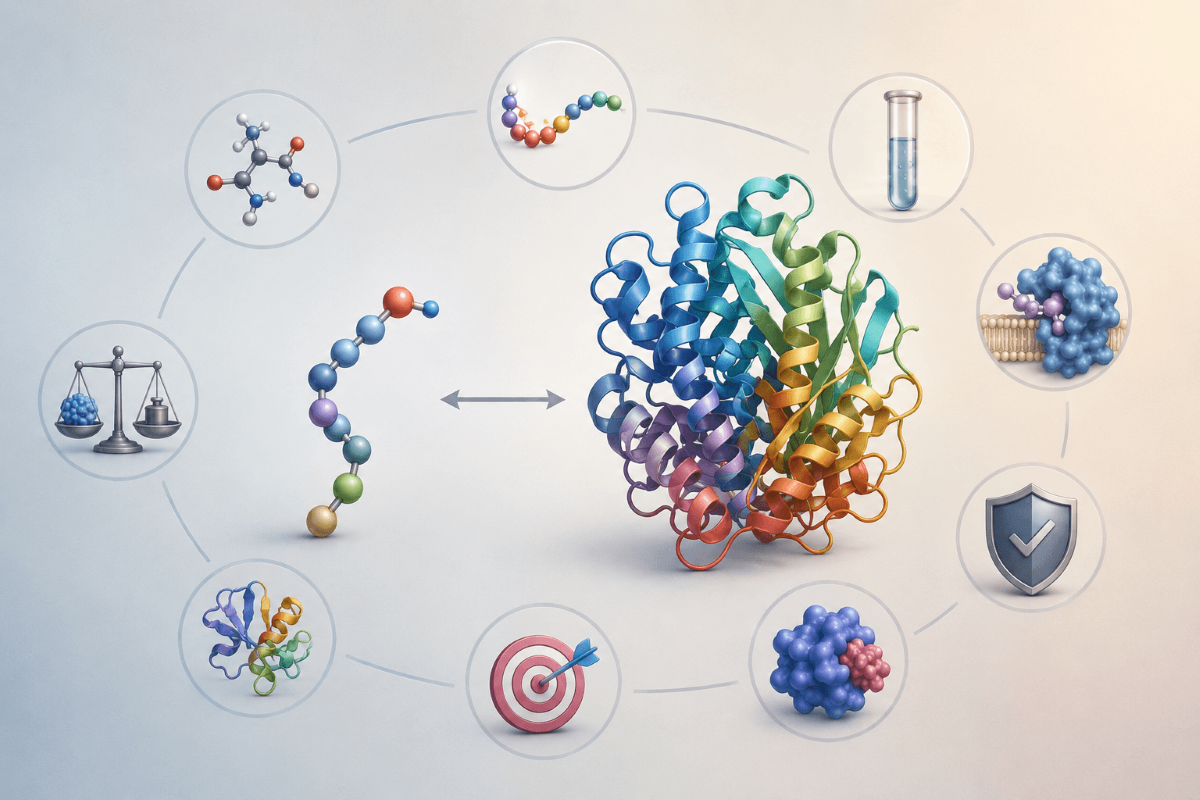
Peptides and proteins share the same basic building blocks—both are composed of amino acids.
The main difference generally lies in the length of the amino acid chain, its structure, and its complexity. Peptides are usually shorter, whereas proteins may contain hundreds or thousands of amino acids and form complex three-dimensional structures.
However, the exact boundary between the two is not absolute.
In scientific practice, it is therefore often more important to know:
-
the specific amino acid sequence,
-
molecular weight,
-
three-dimensional structure,
-
biological target,
-
receptor affinity,
-
stability,
-
and experimental conditions.
Rather than focusing solely on the number of amino acids.
How Do Peptides Work?
When discussing peptides, their “effects” are often mentioned, but these cannot be generalized. Every peptide has its own structure, mechanism of action, and biological role, which is why individual molecules must be evaluated separately.
Each molecule may function differently.
Many biologically active peptides act as signaling molecules. They bind to specific receptors and may subsequently activate or modulate signaling pathways within the cell.
A receptor can be thought of, in simplified terms, as a signal receiver.
When an appropriate molecule binds to the receptor, the cell may receive information that influences its subsequent behavior—for example, metabolic processes, the production of certain molecules, gene expression, or communication with other cells.
An important group includes G protein-coupled receptors, or GPCRs, which bind many naturally occurring peptide ligands. These receptors are among the most important mechanisms involved in cellular signaling and are also major targets of pharmacological research.
Peptide signaling is a complex process in which the resulting biological response depends on multiple factors. Some peptides may interact with several receptors, while a single receptor may respond to different signaling molecules. The final effect is also influenced by the cell type, peptide concentration, and specific experimental conditions.
Why Are Peptides So Interesting for Scientific Research?
One reason is that different peptides can selectively interact with specific receptors and influence precisely defined biological processes. Their amino acid sequence determines how the molecule behaves, which biological targets it may bind to, and which signaling pathways it can affect.
This allows scientists to use peptides to investigate the mechanisms of cellular communication, hormonal regulation, metabolism, regeneration, and many other processes occurring within living organisms in greater detail.
Peptides may be studied in areas such as:
-
cell signaling,
-
molecular biology,
-
endocrinology,
-
metabolism,
-
tissue regeneration,
-
immunology,
-
neurobiology,
-
skin biology,
-
pigmentation,
-
mitochondrial function,
-
cellular aging,
-
and hormonal regulation.
The importance of peptide science is also demonstrated by modern pharmaceutical research. Peptide molecules have been used for decades as models in the discovery and development of new therapeutic approaches, and dozens of peptide-based medicines have already been approved for various indications. However, this does not mean that every research peptide is a medicine or that findings relating to one molecule can automatically be applied to another.
This distinction is essential.
Research potential is not the same as approved medical use.
What Terms May You Encounter When Researching Peptides?
Peptides are often described using simplified terms based on the area in which they are being studied—for example, peptides for regeneration, peptides for joints, peptides for muscle growth, peptides for weight loss, peptides for skin, peptides for hair, or tanning peptides.
However, these terms do not represent precise scientific categories. Every peptide has its own structure, mechanism of action, and field of research, so each specific molecule must always be evaluated individually.
Let us take a closer look at these areas and examine the mechanisms and peptides most commonly associated with them in scientific research.
Peptides for Regeneration: What Is Actually Being Studied?
The term peptides for regeneration generally refers to peptide molecules studied in connection with tissue repair and remodeling processes. Regeneration, however, is not a single isolated biological process. It involves a complex network of interconnected mechanisms that may vary depending on the type of tissue and the particular experimental model.
Areas of research may include:
-
cell migration,
-
extracellular matrix formation,
-
angiogenesis,
-
fibroblast activity,
-
inflammatory signaling pathways,
-
tissue remodeling,
-
growth factor activity,
-
processes associated with tendons, connective tissue, and other types of supporting tissue.
At Particle Peptides, our portfolio includes several peptides that are the subject of research related to healing and regeneration. These include BPC-157, Thymosin Beta-4, GHK-Cu, Ipamorelin, Hexarelin, GHRP-2, GHRP-6, Mod GRF 1-29, CJC-1295 + DAC, and Tesamorelin.
Each of these peptides has a different structure and may influence different biological mechanisms. Their research significance must therefore be evaluated individually according to the specific molecule, signaling pathway, and available experimental evidence.
Peptides for Joints and Peptides for Knees
The terms peptides for joints and peptides for knees are most commonly used in connection with research into connective tissues and their repair mechanisms. From a scientific perspective, however, these do not constitute separate categories of peptides, as the joint system consists of several types of tissue with different structures and biological functions.
Research in this area may focus on:
-
cartilage,
-
tendons,
-
ligaments,
-
the extracellular matrix,
-
cell migration,
-
inflammatory signaling,
-
angiogenesis,
-
and mechanisms involved in the repair of damaged tissue.
One molecule frequently investigated in this context is BPC-157. It is a synthetic peptide consisting of 15 amino acids, with a significant proportion of the currently available evidence originating from preclinical studies and experimental models.
When interpreting such findings, it is therefore important to distinguish between data obtained from cellular or animal models and evidence of effects in humans.
Peptides for Muscle Growth, Exercise, and Sports Research
The terms peptides for muscle growth and peptides for exercise cover several different areas of biological and physiological research.
Muscle tissue is not regulated by a single mechanism. Its function and adaptation depend on energy metabolism, hormonal signaling, regeneration, protein synthesis, mitochondrial activity, and the physiological response to physical exertion.
Research may therefore focus on areas such as:
-
muscle regeneration,
-
protein synthesis and degradation,
-
energy metabolism,
-
mitochondrial function,
-
hormonal signaling,
-
angiogenesis,
-
cell migration,
-
or physiological responses to physical exertion.
A separate area involves research into peptides associated with the growth hormone axis.
At Particle Peptides, molecules studied in this context include Ipamorelin, GHRP-2, GHRP-6, Hexarelin, Mod GRF 1-29, and CJC-1295 + DAC.
However, these substances should not be regarded as a single group with an identical mechanism of action. Individual peptides interact with different receptors and regulatory pathways and therefore need to be evaluated separately.
What Are Growth Hormone Peptides?
The term growth hormone peptides is generally used to describe peptide molecules investigated in connection with regulation of the growth hormone axis. They are not growth hormone itself, nor do all peptides within this category act in the same way.
The regulation of growth hormone secretion involves several receptor-mediated and hormonal mechanisms.
Some peptides are studied in relation to the ghrelin receptor GHS-R1a, while others affect mechanisms associated with GHRH—growth hormone-releasing hormone.
Peptides studied in connection with the ghrelin receptor include Ipamorelin, GHRP-2, GHRP-6, and Hexarelin.
In contrast, Mod GRF 1-29 and CJC-1295 are studied in connection with GHRH signaling.
Although both groups are associated with regulation of the same hormonal axis, their molecular mechanisms differ. This is why peptide evaluation should focus on the specific molecule and its mechanism of action rather than merely on its general category.
Peptides for Weight Loss and Metabolic Research
The term peptides for weight loss covers molecules studied in various areas of metabolism and energy homeostasis. Body weight regulation results from complex interactions between multiple biological systems and cannot be attributed to a single mechanism.
Research in this area may examine:
-
appetite regulation,
-
energy intake,
-
energy expenditure,
-
glucose metabolism,
-
lipid metabolism,
-
hormonal signaling,
-
central nervous system activity,
-
mitochondrial function,
-
and the activity of specific receptor systems.
At Particle Peptides, our portfolio includes several molecules that are the subject of metabolic research, including AOD-9604, MOTS-c, Ipamorelin, GHRP-2, Hexarelin, Tesamorelin, Mod GRF 1-29, and CJC-1295 + DAC.
One example is MOTS-c, a mitochondria-derived peptide studied in connection with cellular metabolism, energy regulation, and cellular responses to metabolic stress.
However, individual peptides act through different mechanisms, so their research significance must always be evaluated on the basis of the specific molecule and the quality of the available scientific evidence.
Peptides for Skin and Peptides for the Face
The terms peptides for skin and peptides for the face are most commonly associated with skin biology and mechanisms that influence skin structure, renewal, and cellular communication.
The skin is a complex organ composed of multiple cell types, proteins, and extracellular structures.
Peptide research may therefore focus on processes such as:
-
fibroblast activity,
-
collagen formation and remodeling,
-
elastin,
-
the extracellular matrix,
-
oxidative stress,
-
angiogenesis,
-
cell migration,
-
tissue regeneration,
-
and mechanisms associated with biological skin aging.
One of the best-known peptides studied in this area is GHK-Cu.
GHK is a naturally occurring tripeptide, glycyl-L-histidyl-L-lysine. When it binds copper, it forms the GHK-Cu complex, which is studied primarily in relation to skin biology, the extracellular matrix, and regenerative processes.
At Particle Peptides, GHK-Cu is available exclusively as a material intended for scientific research and development, not as a cosmetic product.
Peptides for Hair
The term peptides for hair primarily refers to research into biological processes occurring within the hair follicle and the surrounding skin.
The hair follicle is a dynamic structure whose activity depends on communication between several cell types, vascularization, the extracellular matrix, and growth signals.
Research in this area may examine:
-
hair follicle cell activity,
-
cell proliferation,
-
vascularization,
-
the extracellular matrix,
-
growth and regulatory signals,
-
oxidative stress,
-
and communication between the hair follicle and surrounding tissue.
GHK-Cu is also studied in this area, particularly in relation to skin processes and the extracellular matrix.
However, available experimental findings must always be distinguished from approved uses of a specific product.
Tanning Peptides and the Melanocortin System
The term tanning peptides is most commonly used for peptides studied in connection with the melanocortin system and the regulation of pigmentation.
The melanocortin system consists of a group of receptors and naturally occurring signaling molecules involved in several physiological processes. One of its functions is the regulation of melanogenesis, the process by which melanin is produced.
One example of a research molecule in our portfolio is Melanotan 2.
It is a synthetic analogue of α-melanocyte-stimulating hormone and is studied in connection with melanocortin receptor activity and pigmentation mechanisms.
From a scientific perspective, it is therefore more accurate to refer to research into melanocortin signaling and melanogenesis rather than to universal “tanning peptides.”
Are Peptides Steroids?
Peptides and steroids are not the same. Although both terms frequently appear in discussions of hormonal regulation, sports physiology, or metabolism, they represent chemically and biologically distinct groups of molecules.
Peptides consist of amino acids linked by peptide bonds. Steroids, in contrast, have a characteristic chemical structure based on four interconnected carbon rings.
They therefore differ primarily in terms of:
-
chemical structure,
-
how they are formed in the body,
-
receptor interactions,
-
metabolism,
-
and mechanism of action.
A peptide cannot therefore be considered a steroid simply because certain peptides are studied in areas related to hormones, muscle physiology, or metabolism.
Peptides and Side Effects: Why There Is No Single Answer
Peptides do not share one common side-effect profile because they represent a highly diverse group of molecules with different structures and biological activities. Each peptide must therefore be evaluated separately.
The safety profile of a particular molecule may be influenced by factors such as:
-
its molecular structure,
-
receptor selectivity,
-
biological activity,
-
concentration,
-
duration of exposure,
-
metabolism,
-
and the experimental model used.
When interpreting data, it is also important to distinguish which type of research the findings come from. Results obtained in vitro, for example in cell cultures, may differ from results obtained in vivo in a living organism. Likewise, findings from animal models cannot automatically be extrapolated to humans.
Objective assessment therefore always requires consideration of the specific peptide, the type of study, and the quality of the available scientific evidence.
Why Can Two Peptides Have Completely Different Effects?
Imagine two peptides composed of a similar number of amino acids.
At first glance, they may appear similar. However, their sequences are different.
This can change:
-
their three-dimensional shape,
-
their binding site,
-
their receptor affinity,
-
their ability to activate a receptor,
-
their stability against enzymatic degradation,
-
their biological half-life,
-
the resulting cellular signaling.
Receptor specificity is one of the reasons peptides have become such an important area of molecular and pharmaceutical research.
For non-specialists, the simplest rule to remember is:
Do not ask “what do peptides do?” Ask instead, “what does this specific peptide do, and what evidence supports it?”
Natural and Synthetic Peptides
Peptides can occur naturally in living organisms, but they can also be produced synthetically.
Biological systems contain an enormous number of naturally occurring peptides.
These include, for example:
-
peptide hormones,
-
neuropeptides,
-
signaling peptides,
-
antimicrobial peptides,
-
regulatory peptides.
For laboratory research, it is often necessary to work with a molecule whose exact sequence is known and whose properties are reproducible. Chemical synthesis is used for this purpose.
How Are Synthetic Peptides Produced?
One of the most important methods is SPPS—Solid-Phase Peptide Synthesis.
The principle of this method was developed by Robert Bruce Merrifield, whose work in this field had a fundamental impact on modern peptide chemistry.
In simplified terms, the process begins by attaching the first amino acid to a solid support. Additional amino acids are then added sequentially according to the desired sequence.
Once the complete chain has been assembled, the process continues with:
-
cleavage of the peptide from the solid support,
-
removal of protecting groups,
-
purification,
-
analytical quality control,
-
and, depending on the specific product, further processing.
SPPS made it possible to produce precisely defined amino acid sequences and became one of the fundamental tools of modern peptide chemistry.
What Is a Lyophilized Peptide?
Research peptides are often supplied in lyophilized form.
Lyophilization, or freeze-drying, is a process in which water is removed under controlled conditions.
The result is a dry material that may be more suitable for storage and subsequent laboratory handling than a prepared solution.
Importantly, a lyophilized peptide does not always have the same visual appearance.
Inside a vial, it may appear as:
-
a compact material,
-
a fine powder,
-
small fragments,
-
or a layer deposited on the wall of the container.
Appearance alone is therefore not a reliable indicator of peptide identity, purity, or peptide content.

Peptides in Slovakia: What Should You Look for When Selecting Research Material?
When selecting peptides in Slovakia, price should not be the primary criterion. A significantly cheaper product may appear attractive, but in scientific and laboratory research, it is more important to know what is actually present in the sample being studied and how its quality has been verified.
For this reason, it is important to evaluate:
-
confirmation of identity,
-
purity,
-
peptide content,
-
endotoxin levels,
-
microbial load,
-
heavy metal content,
-
batch-to-batch consistency,
-
analytical documentation,
-
traceability of the specific batch.
Only within this context does it make sense to discuss quality.
Particle Peptides has operated in the field of research peptides for more than ten years and, according to company standards, its products are manufactured by a global pharmaceutical CDMO on GMP manufacturing lines. Batches are independently tested for identity, purity, peptide content, endotoxins, heavy metals, and microbial contamination.
An important point is that HPLC purity is only one parameter of quality, not a complete representation of the sample being studied.
For laboratory reproducibility, this is more important than a marketing claim such as “99%.”
Why Does Scientific Research Require Precisely Characterized Peptides?
Modern science is built on reproducibility.
If a laboratory conducts an experiment using a specific peptide, other researchers should be able to verify the result under comparable conditions.
For this to be possible, the following information should be known as precisely as possible:
-
which molecule was used,
-
how its identity was confirmed,
-
its purity,
-
its actual peptide content,
-
its endotoxin level,
-
its microbial load,
-
its heavy metal content,
-
the batch from which it originated,
-
and the experimental conditions.
Even a seemingly minor unknown variable can affect the result.
This is why the quality of research material matters—not as a marketing feature, but as part of a properly designed experiment.
Peptides Are a Broad Scientific Field, Not a Single “Miracle” Substance
The internet often reduces peptides to a handful of attractive phrases:
peptides for weight loss, peptides for muscle growth, peptides for skin, peptides for joints, or tanning peptides.
Such phrases may be useful for orientation, but they do not accurately reflect the scientific reality.
Every peptide molecule has:
-
a specific structure,
-
a specific sequence,
-
specific biological targets,
-
a different level of scientific evidence.
Some mechanisms are very well understood. Others remain the subject of preclinical research.
For still others, the available data remain limited or inconclusive.
This is precisely what makes peptides so interesting to scientists. Not because they represent one universal answer to everything, but because they constitute a vast range of precisely defined molecular tools that can help us better understand how cells and biological systems function.
Frequently Asked Questions About Peptides
What Are Peptides?
Peptides are molecules composed of amino acids linked by peptide bonds. Many naturally occurring peptides function as signaling molecules, hormones, or regulatory factors and participate in communication between cells.
How Do Peptides Work in the Body?
It depends on the specific peptide. Some bind to cellular receptors and influence downstream signaling pathways, while others have different biological functions. There is no single effect shared by all peptides.
What Effects Do Peptides Have?
The question “what effects do peptides have?” is too broad. Their effects depend on the amino acid sequence, receptor, biological mechanism, and experimental model being studied. Each peptide must therefore be assessed individually.
What Is the Difference Between a Peptide and a Protein?
Both groups are composed of amino acids. Peptides are generally shorter and structurally simpler, whereas proteins tend to be larger and form more complex three-dimensional structures. However, the precise boundary between the two is not absolute.
Are Peptides Steroids?
No. Peptides are composed of amino acids, whereas steroids have a characteristic ring-based chemical structure. They are different groups of molecules.
Are There Peptides for Regeneration?
There are peptides investigated in experimental models of regeneration, cell migration, angiogenesis, and other processes related to tissue repair. At Particle Peptides, molecules associated with this area of research include BPC-157, Thymosin Beta-4, and GHK-Cu.
What Is Meant by “Peptides for Joints” and “Peptides for Knees”?
These are primarily search terms. Scientific research focuses on specific molecules and mechanisms associated with connective tissue, tendons, ligaments, and inflammatory signaling. They do not represent a separate scientific class of peptides.
Which Peptides for Muscle Growth Are Being Studied?
This is a popular term covering several different areas of research—from hormonal signaling and the GH axis to metabolism, regeneration, and muscle physiology. There is no single universal category of “peptides for muscle growth.”
What Are Growth Hormone Peptides?
This term is often used for peptides investigated in connection with regulation of the GH axis. However, different molecules may act through different receptors and mechanisms, so they cannot be considered identical.
How Are Peptides for Weight Loss Studied?
More precisely, these are peptides investigated in relation to metabolism, energy homeostasis, lipid and glucose metabolism, and the regulation of other metabolic mechanisms.
How Are Peptides for Skin and Peptides for the Face Studied?
This is a very broad term. Peptide research in skin biology may investigate fibroblasts, collagen, elastin, the extracellular matrix, angiogenesis, or cellular signaling. One of the molecules studied in this area is GHK-Cu.
How Are Peptides for Hair Studied?
Research may focus on hair follicle biology, cellular signaling, or processes occurring in the skin surrounding the hair follicle. The term does not describe a single specific class of molecules.
What Are Tanning Peptides?
This phrase is most commonly associated with peptides studied within the melanocortin system. One example is Melanotan 2. However, Particle Peptides research products are not intended for cosmetic or human use.
Do Peptides Have Side Effects?
This cannot be answered without specifying the particular peptide. Individual molecules have different mechanisms of action and varying levels of safety data. It is also essential to distinguish between findings from cell-based, animal, and clinical studies.
Conclusion: What Should You Remember About Peptides?
Peptides are among the fascinating molecules of modern biology. They are composed of amino acids, but their significance extends far beyond simply serving as building blocks of proteins. Many peptides act as precisely targeted biological signals, enabling scientists to investigate processes occurring between receptors, cells, tissues, and entire regulatory systems.
This is why peptides are currently studied in the context of metabolism, regeneration, immunity, cellular aging, skin biology, muscle physiology, hormonal signaling, and many other areas.
Most importantly, however, peptides should not be regarded as a single group with one common effect.
Every molecule has its own sequence. Its own mechanism. Its own level of scientific evidence.
This is why any discussion about a peptide should always begin with the question:
Which specific peptide are we studying, through which mechanism does it act, and what do the scientific data actually show?
That is the perspective that separates scientific research from oversimplified claims found online.
Sources
-
Muttenthaler M., King G. F., Adams D. J., Alewood P. F. Trends in peptide drug discovery. Nature Reviews Drug Discovery. 2021;20:309–325. A scientific review of peptide development and their importance in modern science.
-
Davenport A. P. et al. Advances in therapeutic peptides targeting G protein-coupled receptors. Nature Reviews Drug Discovery. 2020;19:389–413. A review of peptide ligands and GPCR signaling.
-
Wu F., Song G., de Graaf C., Stevens R. C. Structure and Function of Peptide-Binding G Protein-Coupled Receptors. Journal of Molecular Biology. 2017. PMID: 28705763.
-
Posner B. I., Laporte S. A. Cellular signalling: Peptide hormones and growth factors. Progress in Brain Research. 2010;181:1–16.
-
Foster S. R. et al. Identifying Receptors for Neuropeptides and Peptide Hormones: Challenges and Recent Progress. Scientific review of peptide receptor signaling.
-
Merrifield R. B. Solid Phase Peptide Synthesis. Journal of the American Chemical Society. 1963. DOI: 10.1021/ja00897a041.
-
Particle Peptides Overview. Internal scientific documentation of Particle Peptides—research areas of individual molecules, manufacturing, storage, and Research Use Only designation.
-
Particle Peptides – Brand Positioning & Marketing Guidelines (2026). Information on GMP manufacturing lines, independent laboratory testing, identity, purity, peptide content, endotoxins, heavy metals, microbial contamination, and batch traceability.
Research Quality Begins with Peptide Quality
At Particle Peptides, we believe that reliable research begins with reliable materials. That is why our research peptides are manufactured on cGMP-compliant production lines by a global pharmaceutical CDMO, and every batch undergoes independent third-party testing for:
- Purity
- Identity confirmation
- Peptide content
- Endotoxin levels
- Heavy metals (Class I & II)
- Microbial contamination (TAMC & TYMC)
Transparency and independently verified laboratory data form the foundation of high-quality scientific research.
Disclaimer: All Particle Peptides products are intended exclusively for scientific research and laboratory use. They are not intended for human or veterinary use, nor for the diagnosis, treatment, cure, or prevention of any disease.
Related products

Ipamorelin 5mg
- Auf Lager